.svg)





The Order Exception Cost Most Manufacturers Never Measure
B2B manufacturers typically know how many order exceptions they handle each month. Almost none know what each exception actually costs. This post calculates the fully-loaded cost of an order exception in manufacturing and distribution, explains why the number stays hidden, and shows what it takes to eliminate exceptions at the source rather than resolve them downstream.
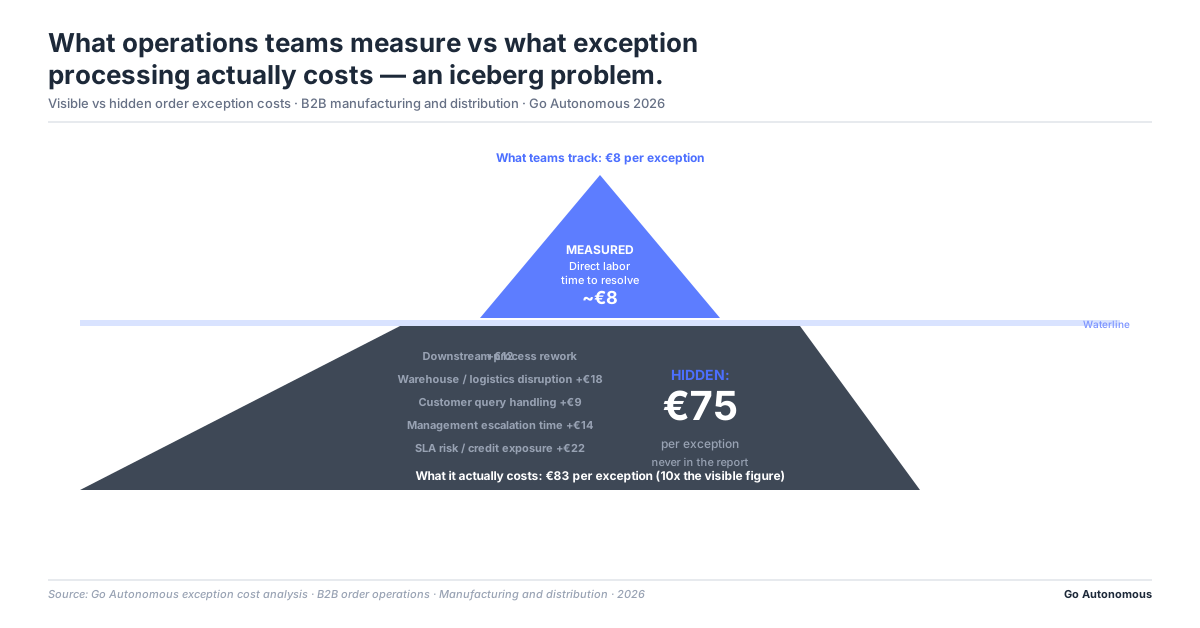
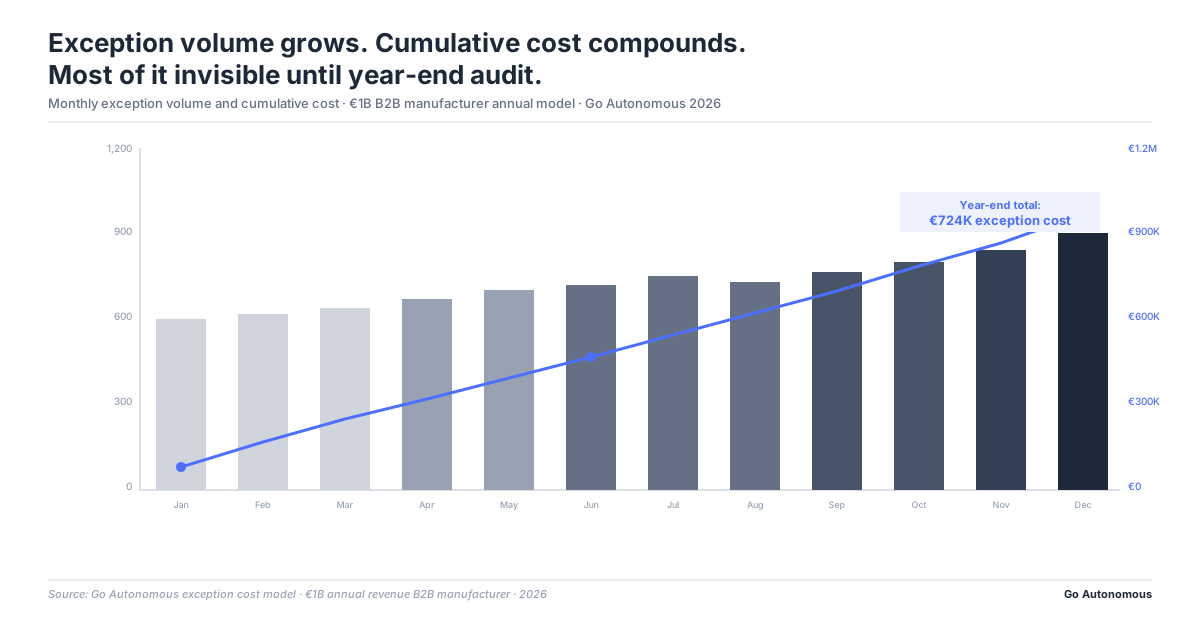
B2B manufacturers know their exception volume. Almost none know their exception cost. Operations managers estimate €5–10 per exception; the fully-loaded cost across all departments is typically €50–200 or more. The difference stays invisible because exception costs cross department lines that standard P&L reporting never aggregates. With 20–40% of B2B orders triggering at least one exception, and each exception running at 4–8x the base processing rate, the aggregate annual cost in a mid-market manufacturing operation is routinely seven figures — and routinely unmeasured.
Table of Content
- Most Operations Teams Count Exception Volume — Almost None Measure Exception Cost
- An Order Exception Costs 4–8x the Base Processing Rate Before Escalation
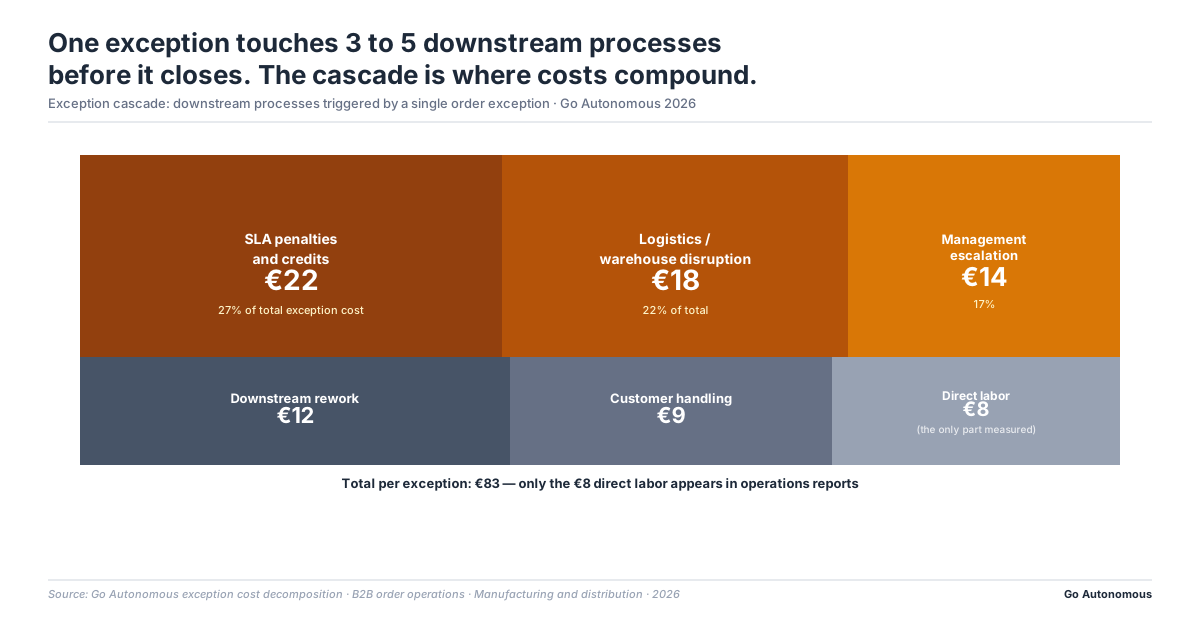
- The Downstream Cascade: One Exception Touches 3–5 Processes Before It Closes
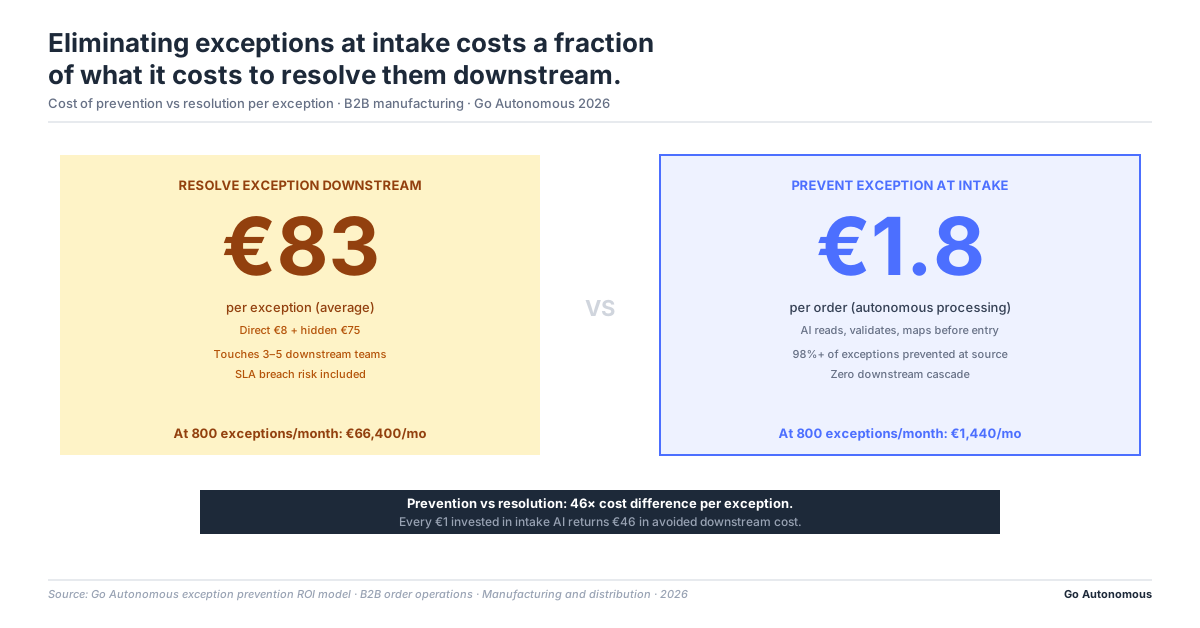
- Eliminating Exceptions at Intake Costs Significantly Less Than Resolving Them Downstream
- The Autonomous Execution Fabric: Eliminating Exceptions Across Every Commercial Transaction Type
- Frequently Asked Questions
- How do you calculate the true cost of an order exception in B2B manufacturing?
- What is a typical order exception rate for B2B manufacturers and distributors?
- What are the most common causes of order exceptions in B2B order processing?
- How do manufacturers reduce order exception rates without increasing operations headcount?
- What is the downstream cost of an order exception in B2B distribution operations?
Most Operations Teams Count Exception Volume — Almost None Measure Exception Cost
Why Exception Cost Is Invisible: It Sits Across Three Departments and No Single P&L Line
Exception volume is easy to measure. The ERP flags it. The team logs it. The weekly ops review covers it. Exception cost is structurally difficult to measure because it is distributed across departments that do not share a reporting line. Customer service handles the intake and the customer call. Sales handles the escalation when a pricing dispute requires approval. Finance reviews the credit hold or the invoice correction. The warehouse holds the shipment pending resolution. IT corrects the system entry if a workaround was used. No single manager owns all of these touchpoints. No single P&L line captures the aggregate. Each department sees its own slice and absorbs the cost as overhead. The result is that the true cost of an exception never appears in any report anyone actually reads. The efficiency case for addressing exceptions is therefore systematically underestimated in every budget cycle.
The Measurement Gap: What Gets Reported vs. What the Exception Actually Consumed
A typical exception resolution path: the customer service rep identifies the exception (5 minutes), attempts to resolve it using available data (10–15 minutes), escalates when resolution is not possible (5 minutes), waits for a response from sales or finance (30–90 minutes), receives the resolution, re-enters the corrected data, and sends the confirmation (10 minutes). Total time: 60–120 minutes per exception, spread across multiple people. At €40–60 per hour fully-loaded labor cost, a single exception costs €40–120 in direct labor alone — before accounting for the orders that were not processed while the team was resolving it, the customer call it may have generated, or the downstream shipment delay it may have caused. Managers reporting €5–10 per exception are measuring only the rep’s active time, not the full resolution path. The gap between reported cost and actual cost is typically 5–20x.
An Order Exception Costs 4–8x the Base Processing Rate Before Escalation
What Counts as an Exception: The Full Taxonomy of Disruptions
An order exception is any condition that prevents straight-through processing. The taxonomy is broader than most operations teams formally recognize:
- Unrecognized SKU reference: the customer’s part number does not map to a catalog entry
- Pricing outside contracted terms: the order price does not match the price book or customer agreement
- Missing mandatory fields: quantity, delivery address, purchase order number, or unit of measure absent
- Quantity outside standard pack sizes: the ordered quantity does not align with how the product ships
- Delivery address not in the system: a new site or an address entered differently than the master record
- Payment terms conflict: the order specifies terms that differ from the account’s credit agreement
- Discontinued product: the ordered item is no longer available and requires a substitute recommendation
Each type has a different resolution path and a different cost. An unrecognized SKU requires cross-referencing a translation table or calling the customer. A pricing dispute requires escalation to sales and waiting for approval. A missing field requires an outbound customer contact — which may not be answered immediately. Every path adds time, and every step in that path has a labor cost.
The Time Budget of a Single Exception: Step by Step
Standard order processing runs 5–10 minutes for an experienced rep handling a clean order. An exception-bearing order runs 30–90 minutes — and that 30–90 minutes often involves waiting periods where the rep cannot process other orders, or has moved on to other work and must context-switch back when the resolution arrives. At base processing time of 5–10 minutes and exception resolution time of 30–90 minutes, the multiplier is 4–8x. With 20–40% of orders triggering at least one exception, and average order volumes in mid-market manufacturing running 500–2,000 orders per week, the weekly exception processing burden runs to hundreds of hours. That is the labor cost of exceptions — before their downstream effects are counted. See the full Autonomous Commerce platform approach to eliminating exceptions at intake.
Each time we added one or two million euros in revenue, we had to add another operator. From a cost perspective, that's an unsustainable way of operating a business.

The Downstream Cascade: One Exception Touches 3–5 Processes Before It Closes
Shipment Holds, Invoice Disputes, and Customer Escalations That Follow a Single Exception
An unresolved exception rarely stays contained to the order entry step. A held order creates a shipment delay. A shipment delay triggers a customer inquiry. The customer inquiry consumes customer service capacity. A delayed shipment may trigger an invoice dispute: the customer received goods later than expected and disputes the invoice date or terms. An invoice dispute involves finance. Finance opens a correction process. The correction process may require a credit note, which requires approval. Each of these downstream events has its own labor cost, its own delay cost, and its own risk of further error. The average exception touches 3–5 distinct processes before it fully closes — not counting the customer relationship cost of the experience.
Why Resolving an Exception Does Not Undo Its Downstream Impact
Operations teams focus on exception resolution: fix the problem, close the ticket, move on. This is the right operational instinct, but it understates the total cost because resolving the exception does not undo the downstream effects it set in motion. The shipment that was held cannot be un-delayed. The customer who called to escalate has already experienced the friction. The warehouse team that held inventory pending the exception resolution has already absorbed the disruption to their workflow. The invoice dispute, once opened, has a resolution process that runs independent of whether the original exception is closed. Fully-loaded exception cost in manufacturing environments routinely reaches €200+ per exception when all downstream touches are accounted for — a number that makes the investment case for prevention extremely clear, particularly when 20–40% of order volume is affected.
Eliminating Exceptions at Intake Costs Significantly Less Than Resolving Them Downstream
What Intake Prevention Looks Like: AI Validation Before the Order Enters the System
The economic logic is straightforward. Prevent the exception before it enters the system rather than resolve it after the cascade has started. AI at intake validates each order field against ERP master data the moment the order arrives. SKU references are matched to catalog entries using order history and customer-specific translation tables. Pricing is validated against the customer’s contracted terms before the order is accepted. Missing fields are identified and, where possible, auto-populated from historical order patterns. Quantities are checked against pack size logic. Delivery addresses are matched to the customer’s registered locations. Orders that pass validation proceed to confirmation immediately. Orders with genuine ambiguities are flagged for human review before they enter the queue — not after they have already generated a downstream cascade.
The Operations Team After Exception Rate Falls Below 5%
Industry baseline exception rates run 20–40%. AI-driven intake validation brings exception rates below 5%. At 5% exception rate, the operations team’s work changes fundamentally. Instead of spending 40–60% of their capacity on exception resolution, they handle a small number of genuinely complex cases — orders that require commercial judgment, new customer onboarding edge cases, or technical specification questions that AI correctly escalates. VELUX processes 130,000+ orders across 9 markets with 88% decision autonomy. The same team processes significantly more volume without adding headcount. See the full picture of what this shift looks like across Go Autonomous success cases. The comparison between rule-based automation and AI is worth reviewing — rule-based automation plateaus at approximately 60% touchless rate, which means it leaves the exception problem largely unresolved. Only AI that generalizes across exception types can bring rates below 5%.
The Autonomous Execution Fabric: Eliminating Exceptions Across Every Commercial Transaction Type
The AI intake validation that prevents order exceptions before they cascade is the order processing component of the Autonomous Execution Fabric. The Autonomous Execution Fabric is a full commercial execution layer that connects directly to your SAP, Oracle, or Microsoft Dynamics environment and processes every inbound commercial transaction without human assembly. When it validates an order at intake, it applies the same business rule logic and AI inference that prevents exceptions across every transaction type the system handles: quotes, returns, pricing requests, credit notes, and tenders.
The Fabric handles more than order exceptions. The same exception taxonomy described in this post applies to every other commercial transaction type. A return authorization request that specifies an unrecognized SKU creates an exception. A quote request that specifies non-standard pricing triggers the same escalation path. A credit claim with a missing field requires the same customer outreach. The Autonomous Execution Fabric validates all of these at intake, resolving resolvable fields from ERP master data and flagging genuine exceptions before they cascade across 3–5 downstream processes.
Operations teams that measure exception cost only for orders are measuring a fraction of their total exception exposure. The same conditions that produce 20–40% order exception rates produce comparable exception rates across quote processing, returns handling, and credit management. The Autonomous Execution Fabric eliminates exceptions at intake across every commercial transaction type simultaneously. The exception rate falls below 5% for the full commercial execution layer, not just for the transaction type that was measured first. That is the only path to a sustained below-5% exception rate: one that closes the gap across every commercial transaction type, not just orders.
If your team is counting exceptions but not costing them, the number you are managing to is likely understated by a factor of 10 or more. Book a session with Go Autonomous to calculate the fully-loaded cost of exceptions in your operation and model what intake prevention would return.
Frequently Asked Questions
How do you calculate the true cost of an order exception in B2B manufacturing?
True exception cost includes direct labor across all departments involved in resolution (customer service, sales, finance, warehouse), the opportunity cost of orders not processed while the team resolves the exception, downstream costs from shipment delays and invoice disputes, and customer relationship costs. Fully-loaded exception cost in manufacturing is typically €50–200+ per exception, versus the €5–10 that most teams report from single-department measurement.
What is a typical order exception rate for B2B manufacturers and distributors?
Industry baseline exception rates run 20–40% of order volume. Rule-based automation reduces this to approximately 60% touchless rate, leaving 40% of orders still requiring intervention. AI-driven intake validation brings exception rates below 5% by validating orders against ERP master data before they enter the processing queue.
What are the most common causes of order exceptions in B2B order processing?
The most common exception causes are unrecognized SKU references, pricing outside contracted terms, missing mandatory fields (quantity, delivery address, PO number), quantities outside standard pack sizes, delivery addresses not in the ERP, payment terms conflicts, and discontinued products. Each has a distinct resolution path and cost.
How do manufacturers reduce order exception rates without increasing operations headcount?
AI at order intake validates each field against ERP master data before the order enters the processing queue. SKU references are matched to catalog entries, pricing is validated against contracted terms, missing fields are flagged or auto-populated from order history, and quantities are checked against pack size logic. Exception rates drop from 20–40% to below 5% without adding staff.
What is the downstream cost of an order exception in B2B distribution operations?
A single exception in distribution typically touches 3–5 downstream processes: shipment hold, customer inquiry, potential invoice dispute, finance correction, and possibly a credit note process. Each downstream event carries its own labor cost and delay cost. Resolving the original exception does not undo these downstream effects, which is why fully-loaded exception cost runs €50–200+ in distribution environments.