.svg)





What Is Your Autonomous Commerce Strategy? A Guide for Agencies and System Integrators
Manufacturers and distributors will ask their partners for an Autonomous Commerce strategy. Here is what it covers and what partners need to deliver it.
What is your Autonomous Commerce strategy? Manufacturers and distributors are starting to ask their agencies, system integrators and consultancies that question. This guide sets out what an Autonomous Commerce strategy covers, what partners need to deliver it, and where partners prepare the answer first.
Autonomous Commerce Partner Summit, Berlin, 1 December 2026. Request your seat
Table of Content
- What is an Autonomous Commerce strategy?
- Why manufacturers and distributors will ask partners for an Autonomous Commerce strategy
- What an Autonomous Commerce strategy covers for B2B manufacturers
- What partners need to deliver an Autonomous Commerce strategy
- Where partners answer the question first: the Autonomous Commerce Partner Summit
- Request your seat at the Autonomous Commerce Partner Summit
- Frequently Asked Questions
- Limited seats. Request yours.
What is an Autonomous Commerce strategy?
An Autonomous Commerce strategy is a plan to execute every customer request a manufacturer or distributor receives autonomously, across every channel, on the systems the business already runs. It covers which requests run autonomously first, the policies that govern them, and how Autonomous Commerce connects to ERP, CRM and the existing channels.
For partners, it is a new kind of engagement. It is not a new storefront or another integration project. It is the layer every channel runs on.
Why manufacturers and distributors will ask partners for an Autonomous Commerce strategy
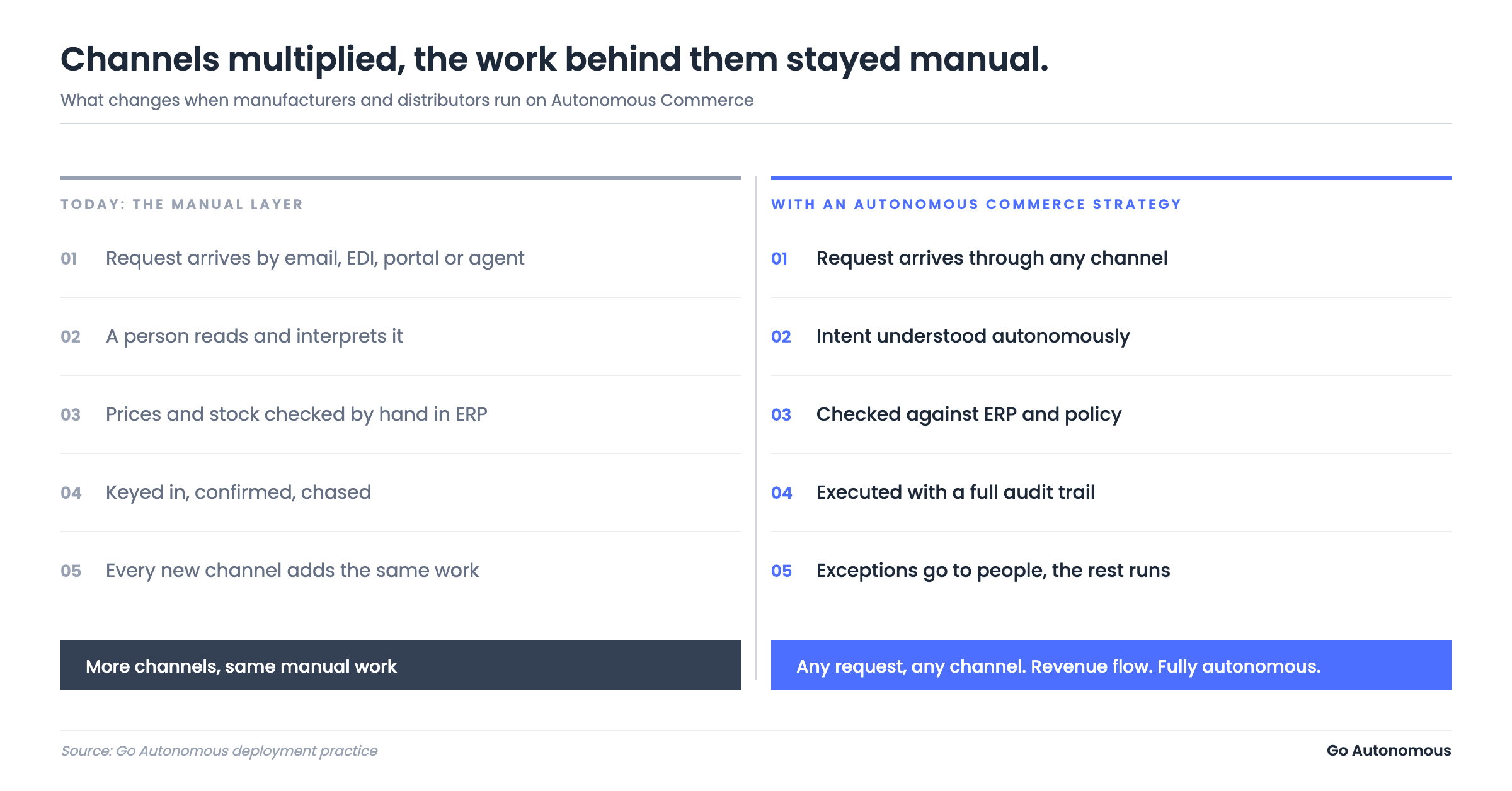
Manufacturers and distributors kept adding channels to handle B2B complexity. More channels than ever. The same manual work behind every one.
Which channels does the strategy have to cover?
All of them: EDI, email, phone, e-commerce, punch-out, procurement portals, chat and agentic commerce. Agentic commerce is one more channel in that list, not the strategy itself. A strategy that covers one channel leaves the manual work behind every other one untouched.
Where do requests stall between channels and ERP?
Requests stall between the channel and the systems. An email order, a quote request or a claim arrives, and a person reads it, checks it against ERP data and keys it in. That waiting time is Revenue at Rest.
Revenue at Rest is revenue that exists but is not moving, parked in inboxes, review queues and ERP holds while it waits for a person. It is measured as the value of requests waiting past their expected processing time. It matters because, in the words of the category: if revenue isn’t moving, it’s not revenue. It’s inventory.
Each time we added one or two million euros in revenue, we had to add another operator. From a cost perspective, that's an unsustainable way of operating a business.

What an Autonomous Commerce strategy covers for B2B manufacturers
Which requests run autonomously?
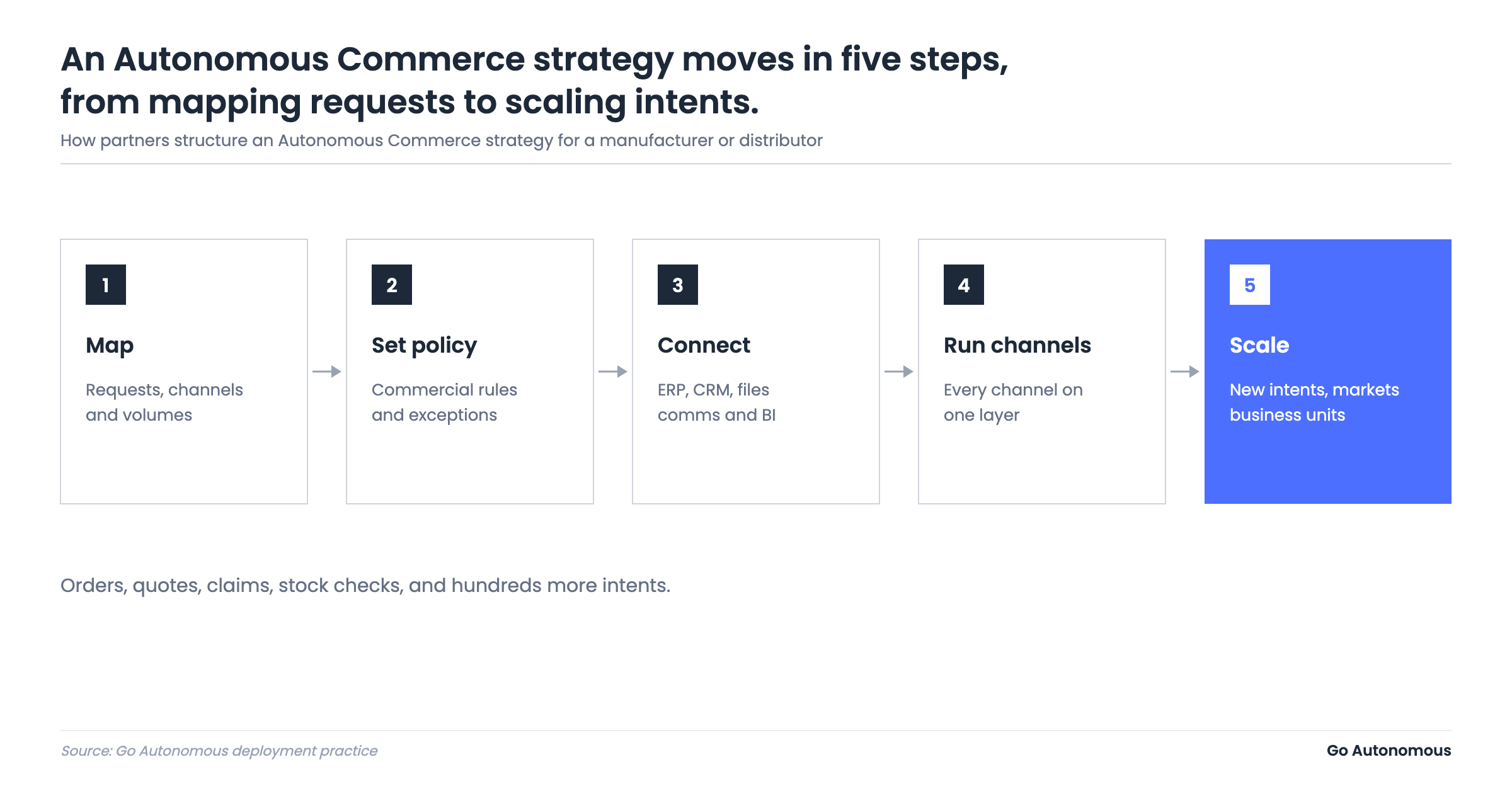
Every request type: orders, quotes, claims, stock checks, and hundreds more intents. A strategy sequences them by volume and value, starting where the manual load is heaviest.
How does autonomous execution stay within policy?
Autonomous execution follows the client’s own commercial policies, so every decision is visible, explained and within policy, with a full audit trail. Exceptions go to people. Everything else runs.
Does it replace the client’s existing systems?
No. Autonomous Commerce runs on existing systems such as SAP S/4HANA, Oracle and Microsoft Dynamics 365 through ERP integration, and on the channels already in place. Partners keep and extend what they built.
How is success measured?
Through dependency, not just speed. The Human Dependency Ratio measures how many manual decisions are still needed per unit of revenue. Automation scales labor. Autonomy eliminates dependency. Go Autonomous deployment results include 57 second orders and 99% first-time-right.
What partners need to deliver an Autonomous Commerce strategy
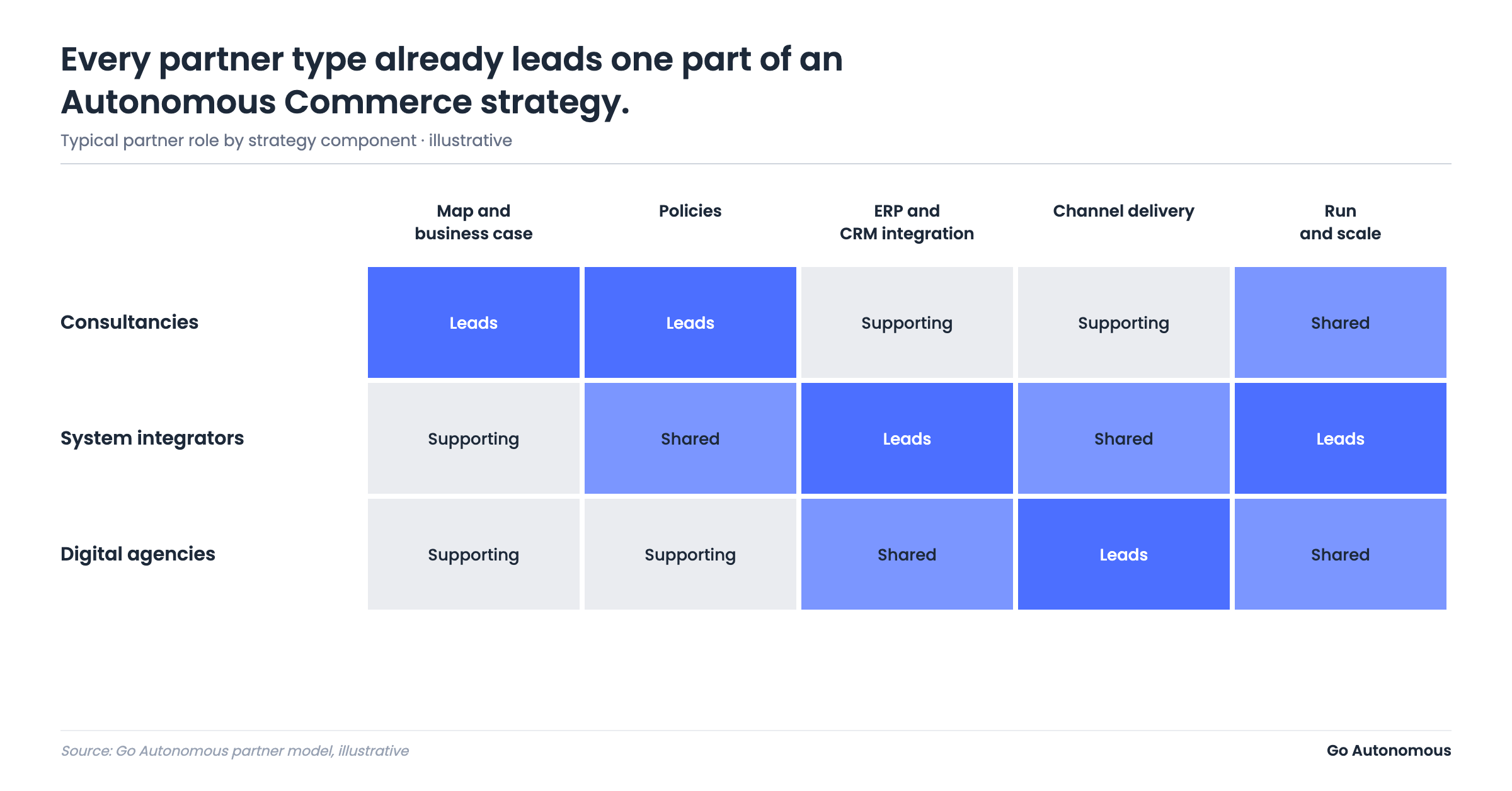
| Partner capability | Role in an Autonomous Commerce strategy | Where partners start |
|---|---|---|
| Commercial advisory | Map requests, channels and policies; build the business case | Consultancies |
| Systems integration | Connect the layer to ERP, CRM, files and BI | System integrators |
| Channel delivery | Run every existing channel on the layer, agentic commerce included | Digital agencies |
| Run and scale | Extend to new intents, markets and business units | All partner types |
Most partners already hold one or two of these. The Autonomous Execution Fabric white paper explains the architecture partners deliver on.
At CWS Hygiene, we're taking an important first step toward bringing autonomy to our commercial operations. We see Autonomous Commerce as a vital pillar of our enterprise architecture for the future.
Where partners answer the question first: the Autonomous Commerce Partner Summit
The Autonomous Commerce Partner Summit on 1 December in Berlin is where partners see Autonomous Commerce in action with the customers already running it, and work through how to deliver it to their own clients. The questions in this post are answered in the room.
Request your seat at the Autonomous Commerce Partner Summit
The leading digital agencies, system integrators and consultancies, their partners and C-suite, in one room, to ensure they lead in delivering Autonomous Commerce.
- When: 1 December 2026
- Where: Berlin, Kreuzberg
- Evening: An exclusive dinner, in the old pool of the Bechstein piano factory
- Build your business line: a new practice of your own, built on Autonomous Commerce
- Shape the category: help set how Autonomous Commerce is delivered
- Run every channel on it: the layer under every channel your clients sell through
- See it in action: with the manufacturers and distributors already running it
Seats are limited, so request yours today. More sessions and speakers will be announced on the Autonomous Commerce Partner Summit page.
Frequently Asked Questions
What is an Autonomous Commerce strategy?
An Autonomous Commerce strategy is a plan for a manufacturer or distributor to execute every customer request autonomously, across every sales channel, on its existing ERP and CRM systems. It defines which request types run first, the commercial policies that govern them, how exceptions reach people and how results are measured.
How can system integrators deliver Autonomous Commerce?
System integrators deliver Autonomous Commerce by connecting the execution layer to the ERP, CRM, files and BI systems their clients already run, such as SAP S/4HANA or Microsoft Dynamics 365. Their existing integration knowledge becomes the foundation of a new practice covering rollout, new request types and new markets.
How can digital agencies offer Autonomous Commerce to B2B clients?
Digital agencies offer Autonomous Commerce by running every channel they built for a client, from portals and e-commerce to chat and agentic commerce, on one autonomous layer underneath. The requests those channels generate are then executed autonomously instead of being handled manually behind the front end.
Is agentic commerce the same as an Autonomous Commerce strategy?
No. Agentic commerce is one more channel through which requests arrive, alongside EDI, email, phone, e-commerce and portals. An Autonomous Commerce strategy covers the layer underneath all channels, so every request is executed autonomously, whichever channel it comes from.
What is Revenue at Rest?
Revenue at Rest is revenue that exists but is not moving: quotes in inboxes, orders in manual review and requests waiting in ERP holds. It is measured as the value of requests waiting past their expected processing time and shows what manual execution costs a manufacturer or distributor.
Limited seats. Request yours.
The Autonomous Commerce Partner Summit brings the partners who will deliver Autonomous Commerce into one room in Berlin on 1 December 2026. Request your seat at the Autonomous Commerce Partner Summit.