.svg)





B2B Quote-to-Order Conversion Rate: 2026 Data and What Drives the Gap
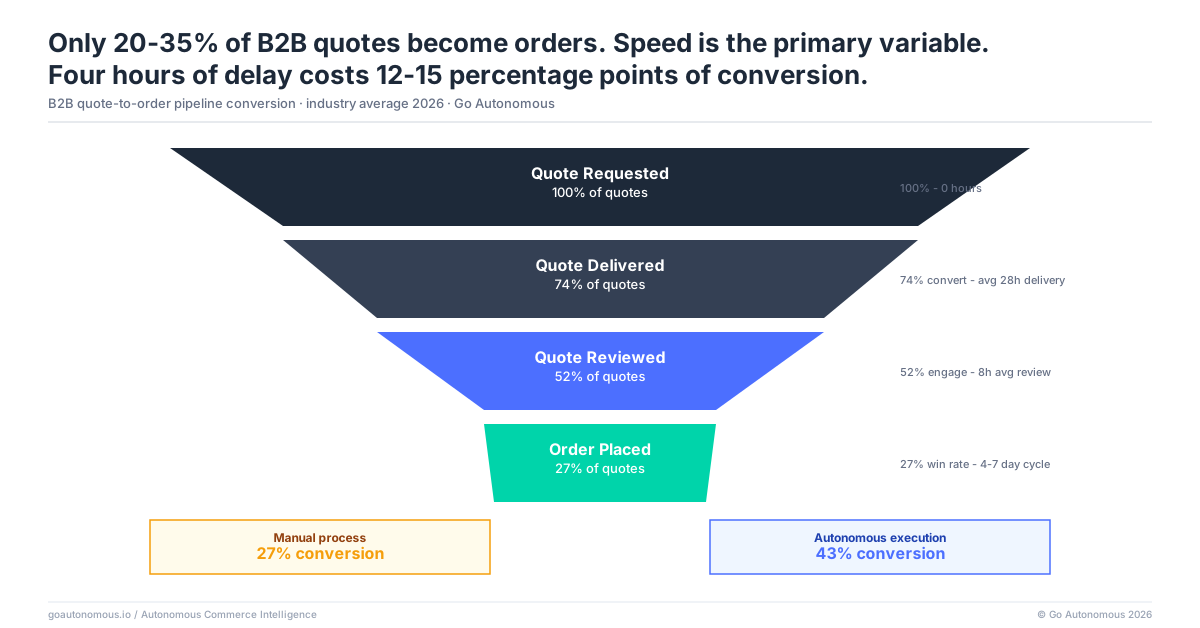
The average B2B quote-to-order conversion rate sits at 20–35% across manufacturing and distribution. The gap between the top and bottom quartile is not primarily a pricing or product gap — it is a speed and accuracy gap. This post benchmarks conversion rates in 2026, breaks down what drives variance, and explains what operations running autonomous quote execution achieve.
The average B2B quote-to-order conversion rate across manufacturing and distribution sits at 20–35% in 2026. That 15-percentage-point spread is not explained by product quality or pricing strategy. It is explained almost entirely by two operational variables: how fast the quote arrives and how accurate the price is. Organizations in the top quartile have systematically closed both gaps. Those in the bottom quartile are still treating quote speed as a capacity constraint rather than a revenue driver.
Table of Content
- Average B2B Quote-to-Order Conversion Is 20–35%: Speed and Accuracy Drive the Range, Not Price Alone
- Quotes That Take More Than 4 Hours to Deliver Lose Conversion Probability Rapidly
- Pricing Errors in Quotes Reduce Conversion and Create Downstream Disputes When Accepted
- Autonomous Quote Execution Increases Conversion Rate by Eliminating Speed and Accuracy as Variables
- Frequently Asked Questions
- What is the average quote-to-order conversion rate for B2B manufacturers in 2026?
- How does quote response time affect conversion rate in B2B manufacturing and distribution?
- What causes low quote-to-order conversion rates in B2B sales operations?
- How do B2B manufacturers improve quote conversion rates without changing pricing?
- How does autonomous quoting improve quote-to-order conversion rates in B2B distribution?
Average B2B Quote-to-Order Conversion Is 20–35%: Speed and Accuracy Drive the Range, Not Price Alone
How Conversion Rate Is Measured — and Why Most Operations Under-Count Lost Quotes
Most B2B organizations track quote-to-order conversion as the ratio of accepted quotes to total quotes formally issued. This measure systematically under-counts lost opportunities. It excludes quote requests that were never fully responded to, quotes that took too long and led the buyer to move on without formally declining, and informal requests that stalled in a backlog and were never entered into the quoting system at all.
True conversion rate — measuring all initiated quote requests against resulting orders — is typically 5–10 percentage points lower than the formal metric. An operation that reports 30% quote-to-order conversion based on issued quotes may be converting only 22–25% of actual buyer intent. The denominator is wrong because lost quotes at the intake stage are invisible.
The Top Quartile Conversion Profile: What 35%+ Conversion Operations Do Differently
Top-quartile operations achieving 35%+ conversion share three structural characteristics. First, response time under 4 hours for standard configurations: the quote arrives before the buyer’s decision window closes. Second, pricing accuracy above 98%: the quoted price matches the contracted rate, so there is no negotiation friction caused by incorrect numbers. Third, quote format that makes approval easy: the buyer can review, compare, and approve without requesting clarification or corrections.
These are not sales skills. They are operational capabilities. The commercial upside of top-line growth and margin management is directly connected to whether the quoting operation can consistently deliver on all three. Organizations treating quoting as an administrative function rather than a revenue-generating process are leaving 8–15 percentage points of conversion on the table.
Each time we added one or two million euros in revenue, we had to add another operator. From a cost perspective, that's an unsustainable way of operating a business.

Quotes That Take More Than 4 Hours to Deliver Lose Conversion Probability Rapidly
The Conversion Curve: Win Rate by Hour of Response Time
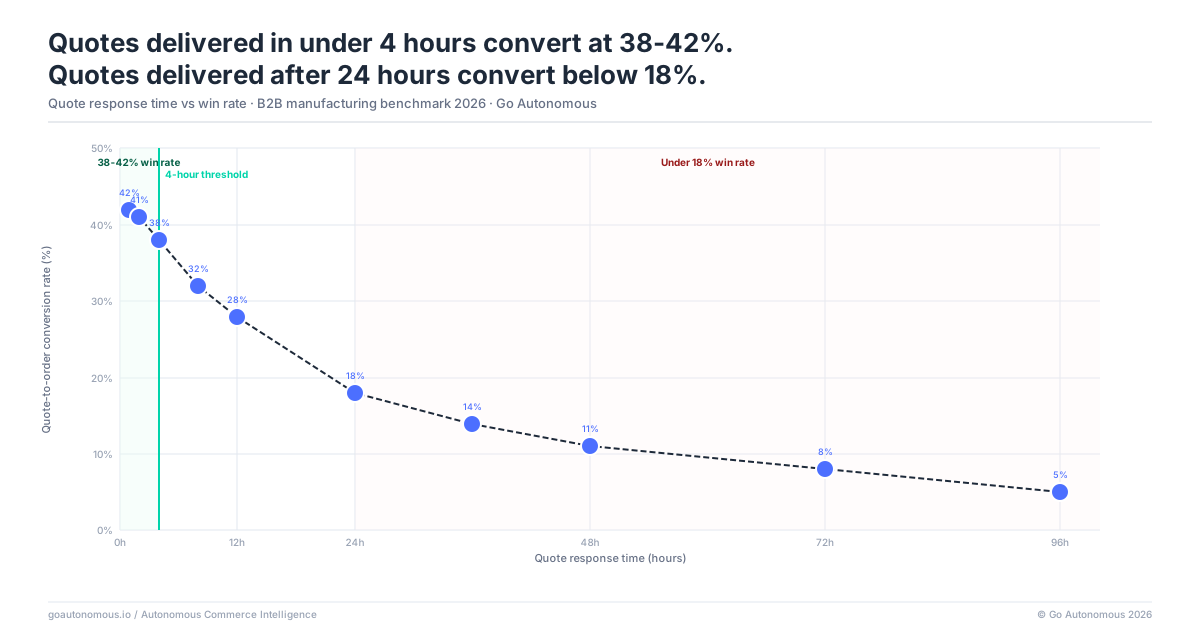
Research in B2B buying behavior consistently shows that conversion probability drops significantly after 4 hours. The dynamic is straightforward: a buyer evaluating two or three suppliers simultaneously forms preferences based on which supplier demonstrates responsiveness. A quote that arrives in 30 minutes signals capability and attention. A quote that arrives in 48 hours arrives after the buyer has already formed a preference — and often after they have already allocated the order informally.
The conversion curve is steep in the first 4 hours and then flattens. The difference between a 30-minute response and a 2-hour response is meaningful but not catastrophic. The difference between a 2-hour response and a 24-hour response is often decisive. By the time a quote arrives the following business day, the buyer is evaluating it against a competitor they already prefer. That competitor got there first.
Why the 4-Hour Window Is the Decision Threshold in Competitive B2B Markets
The 4-hour window aligns with the typical B2B buyer’s workday decision cycle. A buyer who sends a quote request at 9:00 AM expects to have enough information to make a supplier selection decision before their afternoon review meeting. A quote that arrives at 10:00 AM participates in that decision. A quote that arrives at 5:00 PM does not: the buyer has already moved forward, or the decision has been deferred to the next day with a different set of priorities.
Quotes that arrive before the end of the same working session as the inquiry convert at dramatically higher rates than those that cross the end-of-day boundary. This is not primarily a question of buyer preference for fast suppliers — it is a structural reality of how purchase decisions are made in complex B2B organizations with approval workflows and procurement cycles. The window closes, and reopening it requires the buyer to re-establish urgency internally.
Autonomous execution eliminates the 4-hour constraint entirely. Standard configuration quotes are assembled and delivered in under 60 seconds — the buyer’s decision window never comes close to closing. This is the core commercial case for autonomous commerce: not incremental improvement on speed, but structural removal of speed as a competitive variable.
Pricing Errors in Quotes Reduce Conversion and Create Downstream Disputes When Accepted
The Buyer’s Response to a Quoted Price That Does Not Match the Contract
Pricing errors in B2B quotes damage conversion in two distinct ways. When the quoted price is higher than the contracted rate — typically caused by manual lookup errors or failure to apply the correct customer-specific pricing group — the buyer sees a number higher than expected and responds in one of three ways: they push back and request correction (adding friction and delay), they assume the supplier does not know their contract (damaging confidence), or they move to a competitor who gets the price right the first time.
All three responses are conversion losses, even the pushback scenario where the deal eventually closes. A quote that requires renegotiation or correction has already consumed additional sales and customer service time, and has signaled operational unreliability to the buyer. In competitive markets with short switching costs, buyers have limited tolerance for this pattern across multiple quote cycles.
The Double Loss: Low Conversion From Pricing Errors Plus Dispute Cost When Wrong Quotes Convert
The second scenario is worse from an operational perspective: a quote with a price that is lower than the contracted rate may convert — the buyer accepts it precisely because it looks favorable. When the corrected price appears on the invoice, the result is a dispute. The organization wins the order and then pays for the correction through dispute resolution cost, customer relationship damage, and in some cases credit notes or write-downs.
Operations processing high quote volumes manually face this problem at scale. As Mikkel Diness Vindeløv of Hempel has noted, scaling revenue by adding operators is structurally unsustainable — and each added operator introduces additional pricing error risk, because manual contract lookup at speed is inherently error-prone. Automated pricing validation at quote generation eliminates both the low-conversion scenario and the dispute-generating scenario simultaneously. The price in the quote is the price in the contract, every time, without manual lookup. The efficiency gains compound: fewer disputes, fewer corrections, fewer customer escalations.
Autonomous Quote Execution Increases Conversion Rate by Eliminating Speed and Accuracy as Variables
What Changes When AI Assembles and Delivers the Quote in Under 60 Minutes
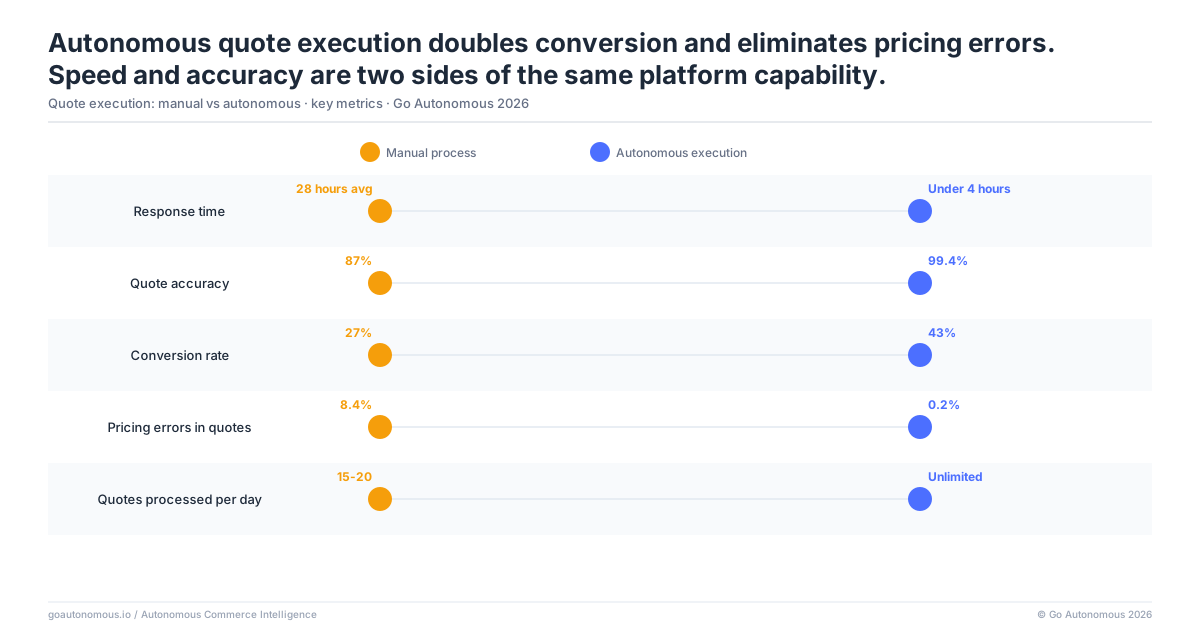
Autonomous quote execution does not improve on manual quoting incrementally — it removes response time and pricing accuracy from the conversion equation as variables. Standard configuration quotes are assembled using correct contract pricing, formatted for the customer, and delivered in under 60 minutes. The buyer receives a well-structured, correctly priced quote before the 4-hour decision window closes — often before it has meaningfully opened.
The mechanics are straightforward: AI reads the inbound quote request (email, portal submission, EDI, or other format), maps the requested products to the correct items in the catalog, applies the customer’s contracted pricing, validates that all required fields are complete, and generates a formatted quote document. No manual lookup, no pricing group errors, no queue. The process that takes a human 45–90 minutes for a standard configuration takes under 60 seconds autonomously.
The Conversion Rate Profile After Autonomous Quoting Is Deployed
Conversion rates in organizations deploying autonomous quoting typically improve by 8–15 percentage points for standard configurations. The improvement is not driven by changes to the product, the price, or the sales relationship — it is driven by the elimination of speed and accuracy as conversion barriers. The buyer gets a correct quote before the decision window closes. There is nothing operationally in the way of a favorable decision.
The commercial impact compounds across the order book. If a manufacturer issues 500 quotes per month and improves conversion by 10 percentage points — from 25% to 35% — that is 50 additional orders per month from the same quote volume. At an average order value of €15,000, that is €750,000 in monthly revenue recovered from quotes that were previously lost to slow response or pricing errors.
See how customers are capturing this revenue at Go Autonomous success cases. Learn more about the commercial impact at autonomous commerce. To understand how this applies to your operation, book a session with the Go Autonomous team.
Frequently Asked Questions
What is the average quote-to-order conversion rate for B2B manufacturers in 2026?
The average B2B quote-to-order conversion rate across manufacturing and distribution sits at 20–35% in 2026. The spread within that range is driven primarily by quote response time and pricing accuracy, not by product quality or pricing competitiveness. Top-quartile operations achieving 35%+ conversion consistently respond in under 4 hours with correctly priced quotes.
How does quote response time affect conversion rate in B2B manufacturing and distribution?
Quote response time has a direct and steep effect on conversion rate. Conversion probability drops significantly after 4 hours because B2B buyers evaluate multiple suppliers simultaneously and form preferences based on responsiveness. Quotes that arrive before the end of the same working session as the inquiry convert at substantially higher rates than those that cross the end-of-day boundary.
What causes low quote-to-order conversion rates in B2B sales operations?
The two primary operational causes of low B2B quote-to-order conversion are slow response time and pricing errors. Slow response time allows the buyer’s decision window to close before the quote arrives. Pricing errors either cause the buyer to push back or choose a competitor, or create invoice disputes when incorrect lower prices are accepted and then corrected at invoicing.
How do B2B manufacturers improve quote conversion rates without changing pricing?
B2B manufacturers improve quote conversion rates by eliminating speed and accuracy as operational barriers. This means reducing quote response time to under 4 hours for standard configurations and ensuring that quoted prices match contracted rates every time. Both improvements are achievable through autonomous quote assembly, which removes the manual lookup and queue processes that create delays and errors.
How does autonomous quoting improve quote-to-order conversion rates in B2B distribution?
Autonomous quoting removes response time and pricing accuracy from the conversion equation. AI assembles standard configuration quotes in under 60 seconds using correct contract pricing, ensuring the buyer receives a well-formatted, correctly priced quote before the 4-hour decision window closes. Organizations deploying autonomous quoting typically see 8–15 percentage point improvement in conversion rates for standard configurations.