.svg)





Why Email Order Volume Hits a Throughput Ceiling No SAP Headcount Can Fix
SAP Sales Order Management is designed to process sales orders once they are in the system. Getting email orders into SAP, which represents 50–70% of inbound volume for most manufacturers, requires manual entry for every order. At high volume, this creates a throughput ceiling that no additional headcount can permanently solve. This post explains where the ceiling is and the architecture that removes it.
SAP Sales Order Management is a powerful platform for processing, routing, and fulfilling orders. It is not a platform for reading email. For B2B manufacturers where 50–70% of order volume arrives by email, this gap is material: every inbound email purchase order requires a human to open it, extract the data, and enter it into SAP before the platform’s capabilities apply. At 200–300 orders per day, this is a staffing challenge. At 1,000 orders per day, it is a structural throughput ceiling that headcount additions shift but never eliminate.
This post examines the SAP email intake gap, what the throughput ceiling looks like in practice, the backlog economics of peak volume periods, and the AI layer architecture that removes the ceiling permanently.
Table of Content
- SAP Sales Order Management Has No Native Email Processing: Every Email Creates a Manual Entry Task
- Manual Email-to-SAP Entry Creates a Throughput Ceiling That Headcount Cannot Permanently Break
- The SAP Email Queue at Month-End and During Demand Spikes: What the Backlog Costs
- An AI Email Processing Layer Upstream of SAP Removes the Throughput Ceiling Permanently
- Frequently Asked Questions
- How do SAP users process email purchase orders from B2B customers?
- What is the throughput ceiling for manual email-to-SAP order entry?
- How do manufacturers break the SAP order entry throughput ceiling without unlimited headcount growth?
- Can AI automatically create SAP sales orders from customer email purchase orders?
- How does automated email processing improve SAP Sales Order Management efficiency in B2B manufacturing?
SAP Sales Order Management Has No Native Email Processing: Every Email Creates a Manual Entry Task
What SAP SOM Does: Processes, Manages, and Fulfills Orders That Are Already in the System
SAP Sales Order Management handles the downstream complexity of B2B order fulfillment with depth. Pricing determination draws from condition records and customer-specific agreements. Availability checking runs against current stock and confirmed supply. Credit management evaluates customer credit limits before order confirmation. Delivery scheduling coordinates with transportation and warehouse management. Downstream triggers flow to logistics, billing, and revenue recognition. For orders already in the system, SAP SOM is highly capable.
The critical qualification is “already in the system.” SAP does not bridge the gap between a customer email and a sales order. That gap is manual labor, every time, for every email order. No native SAP function opens an inbox, reads the purchase order, identifies the material codes, extracts quantities and delivery details, and creates the order. This is not a gap SAP was designed to fill; it predates the era when email became the dominant B2B order channel. The problem is that email now represents 50–70% of order volume for most manufacturers. The gap is structural and, at scale, expensive.
What SAP SOM Does Not Do: Read Email, Extract Data, or Interpret Unstructured Requests
The spectrum of what arrives by email in a B2B order inbox includes: PDF attachments of formally structured purchase orders, inline email text listing items and quantities, forwarded chains of approval emails with the order buried in the thread, and partial orders with references to previous orders that require context to interpret. None of these formats are machine-readable by SAP natively. All require a human reader who understands the customer’s ordering conventions, can locate the relevant data within the format, and can translate it accurately into SAP fields.
Attempts to address this gap through rule-based automation or RPA partially succeed for well-structured, consistently formatted inputs. They plateau at roughly 60% touchless rates because the 20–40% of orders containing format variations, missing fields, or ambiguous references fall outside the rules and return to manual processing. The ceiling is lower than the problem requires, and the maintenance overhead of maintaining rules for a shifting input set adds cost without eliminating the manual dependency.
Each time we added one or two million euros in revenue, we had to add another operator. From a cost perspective, that's an unsustainable way of operating a business.

Manual Email-to-SAP Entry Creates a Throughput Ceiling That Headcount Cannot Permanently Break
What the Ceiling Looks Like: Processing Rates at Normal Volume vs. Peak Volume
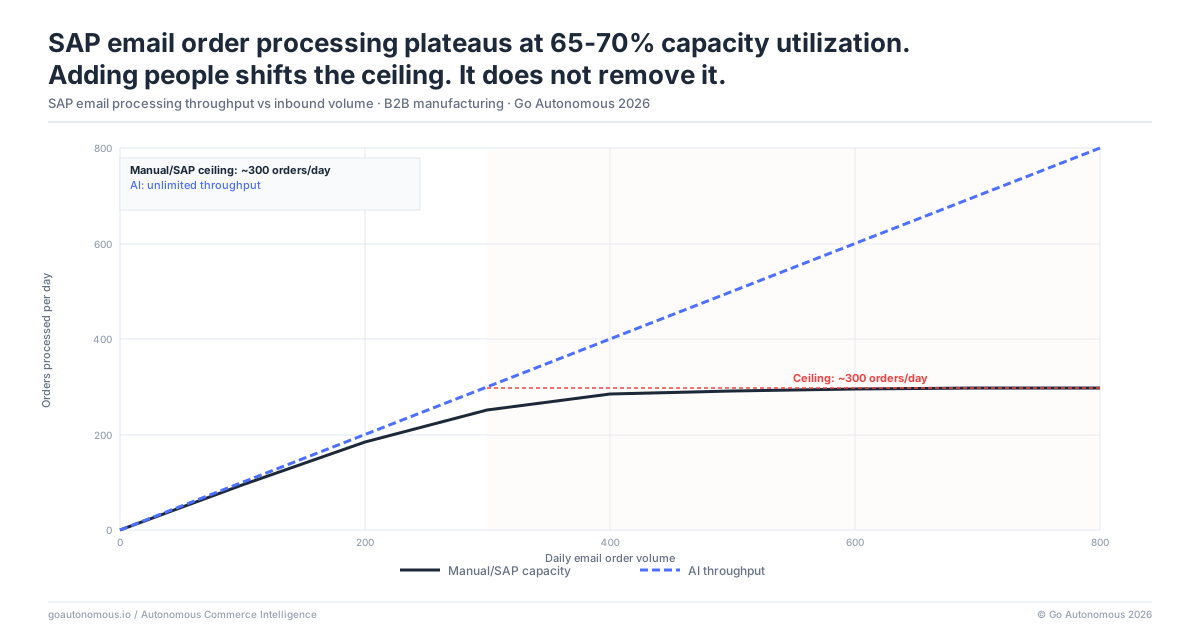
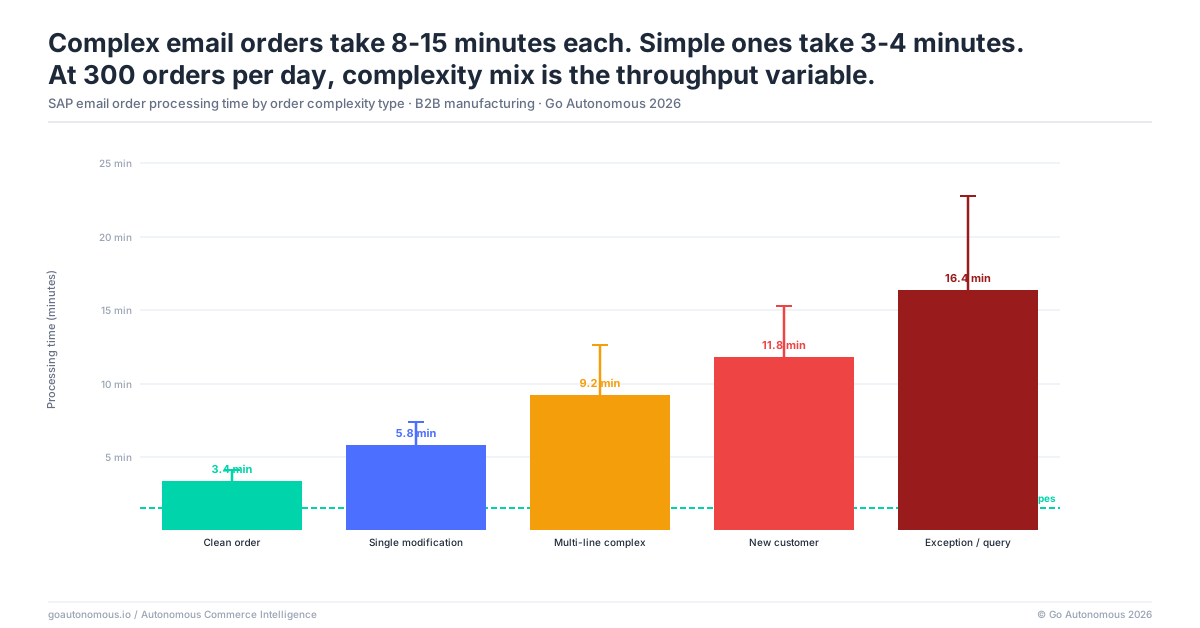
A trained customer service rep entering SAP orders from email can process approximately 20–30 standard orders per hour under normal conditions. Orders with exceptions, non-standard formats, or missing data reduce this rate significantly. A team of 10 reps operating at full capacity processes 200–300 orders per hour. That is the team’s throughput ceiling at normal operational conditions. As order volume approaches that ceiling, the queue grows, confirmation delays extend, and error rates rise as reps accelerate to keep up with demand.
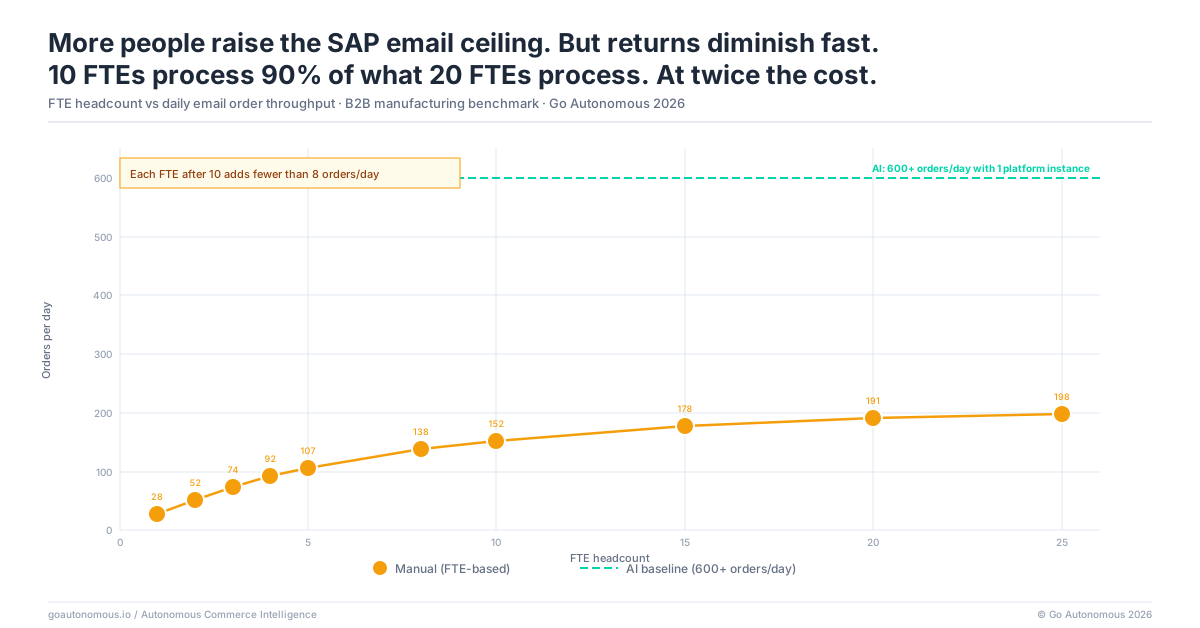
The ceiling moves with headcount: add 5 reps, gain 100–150 orders per hour of additional capacity. But headcount addition is not a ceiling removal strategy; it is a ceiling deferral strategy. The new team members require 4–8 weeks to reach full processing speed. During onboarding, error rates are higher. Coordination overhead grows with team size. And at any given team size, a volume level exists that exceeds the ceiling. The ceiling is always present; only its position changes. Operational efficiency requires a different approach than adding reps.
Why Adding Customer Service Reps Shifts the Ceiling Without Eliminating It
Beyond the ramp and coordination costs, headcount-based capacity scaling introduces a margin problem. Manual order processing costs €15–35 per order in fully-loaded labor cost. As order volume grows and the team grows proportionally, the total labor cost of order intake grows proportionally with revenue. The efficiency ratio, orders processed per unit of labor cost, does not improve with scale. It may worsen if coordination overhead grows faster than processing capacity.
This is the dynamic Mikkel Vindeløv describes at Hempel: each increment of revenue required a proportional increment of operator headcount. The cost structure of manual SAP email entry is a fixed per-order cost that scales linearly with volume. There is no learning curve, no economies of scale, no efficiency gain from processing more orders with the same team. The only lever is headcount, and headcount has a ceiling that reappears every time it is raised. The business case for breaking the ceiling is straightforward: autonomous processing costs below €2 per order versus €15–35 for manual entry, at any volume level.
The SAP Email Queue at Month-End and During Demand Spikes: What the Backlog Costs
How the Email Queue Behaves During End-of-Quarter Pushes
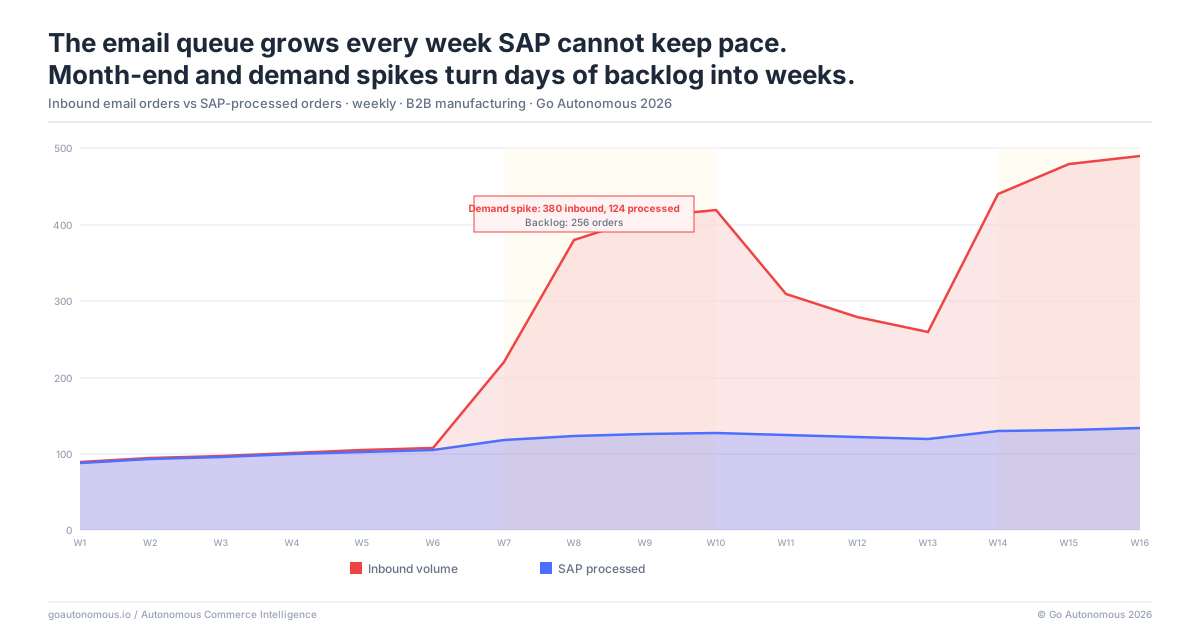
End-of-quarter commercial pushes generate order volume spikes that exceed team processing capacity by design: sales teams accelerating deal closures, customers placing orders before quarter-end to meet their own procurement targets, and promotional activity all compress into a short window. The email queue grows faster than the team can process it. Orders placed at the start of the peak period are confirmed hours or days later than customers expect. For customers with production schedules dependent on order confirmation timing, this delay has downstream consequences.
The processing backlog during peak periods is self-reinforcing. As confirmation delays extend, customers contact customer service to check order status. Status inquiries interrupt order processing, consuming the same team capacity that should be clearing the queue. The interruption further slows processing. The queue grows longer. Status calls increase. In severe spikes, a team may still be processing peak-period orders a week after the peak volume has subsided, while simultaneously handling normal incoming volume from the subsequent period.
What the Backlog Communicates to Customers Who Are Waiting for Order Confirmation
From the customer’s perspective, a delayed order confirmation communicates process unreliability. In B2B manufacturing, customers planning production runs or distribution schedules require accurate order confirmation timing. A supplier that processes orders in under a minute communicates operational capability. A supplier with a 48-hour confirmation backlog during peak periods communicates a process that cannot scale with demand, which is a commercial liability at contract renewal.
The operational cost of backlog clearance is also significant: overtime for the processing team, temporary staff costs if the backlog requires emergency capacity, elevated error rates from rush processing, and the customer communication overhead of managing delay expectations. These costs regularly exceed the direct processing cost of the peak volume itself, making peak periods disproportionately expensive relative to the revenue they generate.
An AI Email Processing Layer Upstream of SAP Removes the Throughput Ceiling Permanently
How AI Email Processing Works: From Inbox to SAP Sales Order Without Human Entry
An AI processing layer upstream of SAP reads each inbound order email, whether a formally structured PDF purchase order or an inline email with item and quantity lists, extracts all relevant data fields, maps them to SAP material masters, validates pricing against applicable trade agreements, confirms delivery addresses against ship-to master data, and creates the SAP sales order. The process runs in under 60 seconds per order. Where extracted data matches SAP master data with sufficient confidence, the order is created automatically. Where confidence is insufficient, for genuinely ambiguous items or missing required fields, the exception is routed to human review with the extracted data pre-populated for rapid resolution.
Processing capacity scales with order volume. At 100 orders per hour or 1,000 orders per hour, the same AI layer runs at the same speed with the same accuracy. Peak volume periods are volume events, not staffing crises. The queue does not grow. Confirmation times do not extend. Status calls do not spike. The SAP SOM platform that handles everything downstream of order creation runs at the efficiency it was designed to deliver, fed by clean, validated data rather than manual entry.
What SAP Operations Teams Gain When Email Volume No Longer Equals Manual Tasks
When AI processes email orders upstream of SAP, the operations team’s role shifts fundamentally. The majority of orders, those with clean data and clear matches, flow from email to SAP without any human intervention. The team handles exceptions: genuine ambiguities, orders requiring commercial judgment, escalations from key accounts. The volume of exceptions is a fraction of total order volume. Team capacity is allocated to high-value work rather than routine transcription.
Danfoss moved from 42-hour order processing to under 1 minute, operating across 26 countries with 80% handled autonomously. See the full deployment at Danfoss autonomous order intake. The broader picture of what manufacturers and distributors achieve when the throughput ceiling is removed is at Go Autonomous success cases. The platform enabling this is Autonomous Commerce: AI that executes orders end-to-end, not an assistant that helps reps enter them faster. Book a session to map your current email-to-SAP process and calculate the throughput ceiling your operation is running against.
Frequently Asked Questions
How do SAP users process email purchase orders from B2B customers?
SAP has no native email processing capability. B2B manufacturers using SAP process email purchase orders through manual entry: a customer service rep opens the email, reads the purchase order, extracts line items and order details, and manually creates the SAP sales order. For operations with high email volume, this manual step is the primary throughput constraint.
What is the throughput ceiling for manual email-to-SAP order entry?
A trained customer service rep processing SAP orders from email handles approximately 20–30 standard orders per hour. A team of 10 reps can process 200–300 orders per hour at capacity. This is the throughput ceiling for that team size. Adding headcount shifts the ceiling but does not eliminate it: at any team size, a volume level exists that exceeds capacity.
How do manufacturers break the SAP order entry throughput ceiling without unlimited headcount growth?
An AI email processing layer upstream of SAP reads inbound purchase order emails, extracts data, maps it to SAP material masters, validates pricing and delivery details, and creates SAP sales orders automatically. Processing capacity scales with volume, not headcount. Peak periods are volume events rather than staffing crises, and the throughput ceiling is permanently removed.
Can AI automatically create SAP sales orders from customer email purchase orders?
Yes. AI intake systems read inbound email purchase orders, extract line items and order fields, map them to SAP material masters and trade agreements, and create sales orders without human entry. Orders that cannot be matched with sufficient confidence are routed for human review with pre-populated data. The process runs in under 60 seconds per order at any volume.
How does automated email processing improve SAP Sales Order Management efficiency in B2B manufacturing?
Automated email processing removes the manual entry step that currently sits between an inbound email and SAP SOM. With that step automated, SAP receives clean, validated order data at the speed and volume the platform is designed to handle. Order processing cost drops from €15–35 per manual order to below €2. Peak volume periods no longer generate confirmation backlogs or require emergency staffing.