.svg)





What Happens When Your Largest Customers Use Non-Standard Order Formats
The customers that generate the most revenue are often the ones whose order formats are the most difficult to process. Strategic accounts using enterprise procurement systems send complex purchase orders with non-standard field structures, multiple line items, internal cost center references, and purchase order numbering conventions that do not match your catalog or ERP. This post explains why large customers create processing overhead and what the structural solution looks like.
The customers generating the most revenue are frequently the most expensive to serve on a per-order basis. Large enterprise buyers using SAP Ariba, Coupa, or Oracle Procurement Cloud generate purchase orders in formats optimized for their internal approval and tracking workflows, not for their suppliers’ ERP systems. Each line item requires lookup. Each cost center reference requires translation. Each delivery location code requires mapping. For B2B manufacturers and distributors with 10–20 strategic accounts, this creates a persistent per-account processing overhead that grows with customer base sophistication and does not scale.
This post examines why large customers create disproportionate processing overhead, what the custom workflow maintenance cost looks like as strategic accounts evolve, and how format-agnostic AI intake resolves the problem without requiring a custom mapping per account.
Table of Content
- Your Largest Customers Are Often Your Least Standardized: The Strategic Account Format Problem
- Non-Standard Formats From Strategic Accounts Create Custom Processing Workflows That Do Not Scale
- Dedicated Format Handling for Strategic Accounts Increases Per-Order Cost by 2–3x for Those Accounts
- Format-Agnostic Intake Handles Strategic Account Orders Without Custom Per-Account Workflows
- Frequently Asked Questions
- Why do large B2B customers often use non-standard order formats?
- How do B2B manufacturers manage order processing for customers using SAP Ariba or Coupa?
- What is the per-order processing cost for strategic accounts with non-standard formats?
- How do B2B distributors handle non-standard purchase order formats from enterprise customers without custom EDI?
- Can AI process strategic account orders with non-standard formats without building custom mapping per customer?
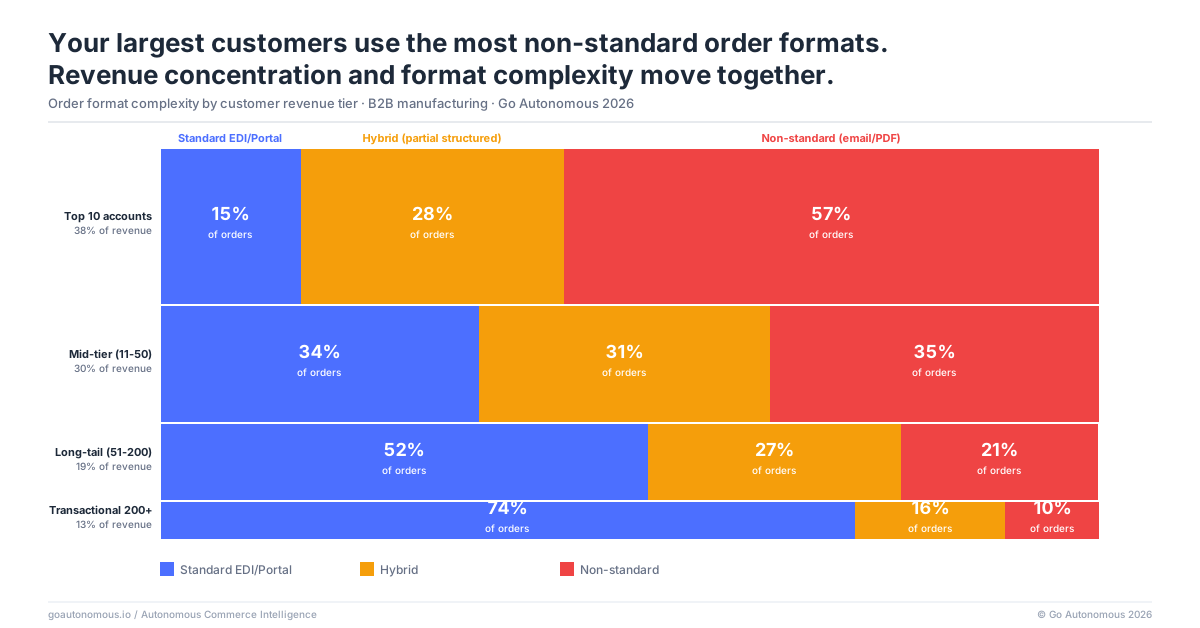
Your Largest Customers Are Often Your Least Standardized: The Strategic Account Format Problem
Why Enterprise Customers Use Complex Formats: Procurement System Outputs Are Not Designed for Suppliers
Enterprise procurement systems are designed to serve the buyer’s internal requirements: multi-level approval workflows, cost center allocation, budget control, and internal audit trails. The purchase order a system like SAP Ariba generates is a record optimized for the buyer’s finance and procurement team. It contains the buyer’s internal item codes, not the supplier’s catalog numbers. It references the buyer’s cost center structure, not the supplier’s customer account hierarchy. Delivery locations are described using the buyer’s internal site naming conventions, not the supplier’s ship-to master data.
This is not a deficiency in the buyer’s procurement system. It is operating correctly from the buyer’s perspective. The issue is entirely on the supplier’s side: converting a buyer-optimized format into ERP-ready data requires lookup, translation, and interpretation for each element that does not map directly. The more sophisticated the buyer’s procurement system, the more complex this translation task becomes. And the largest enterprise customers are those most likely to have invested in sophisticated procurement systems, precisely because their purchasing volume justifies the investment. Autonomous Commerce is built for this environment.
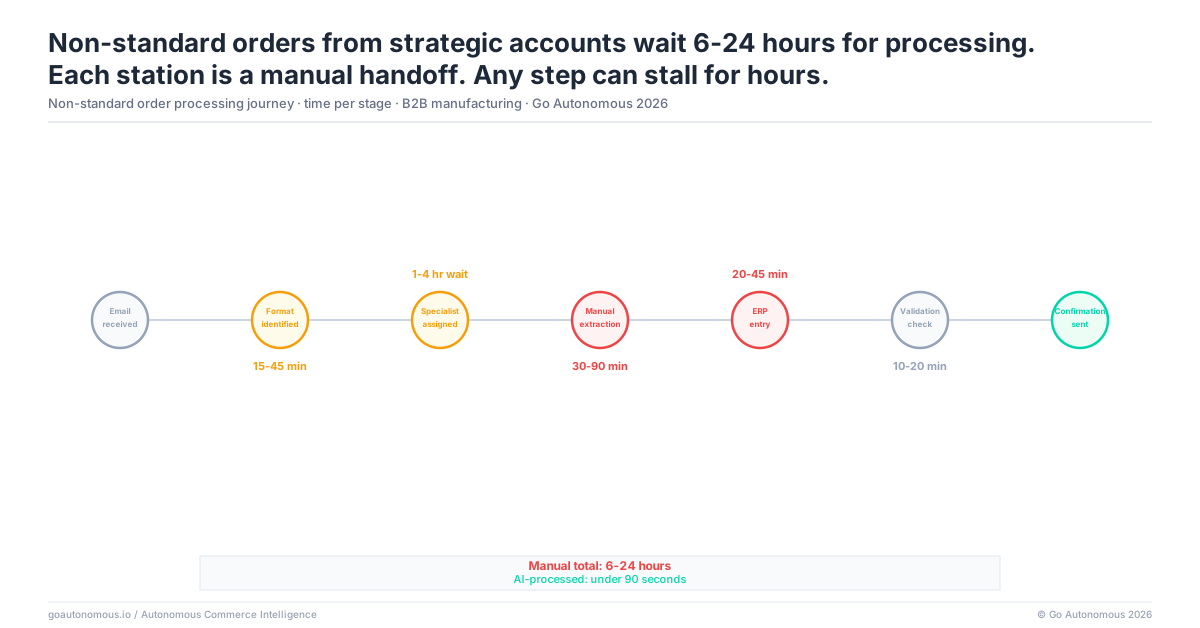
The Non-Standard Reference Problem: Cost Centers, Approval Numbers, and Internal Item Codes
The translation challenge in strategic account order processing has three distinct dimensions. First, item code translation: the buyer’s internal item code must be mapped to the supplier’s catalog number. For accounts with hundreds of unique items, this mapping table is large, requires maintenance as catalog items are updated or discontinued, and must be applied accurately at the line-item level for every order. Second, delivery location mapping: the buyer’s internal site code must map to the supplier’s ship-to master data. Buyers with multiple sites, particularly international accounts with dozens of facilities, create a location mapping challenge that grows with their own geographic expansion. Third, reference field interpretation: fields like cost center codes, approval numbers, and project references are required for the buyer’s internal processing but carry no direct meaning in the supplier’s ERP. They must be captured and passed through correctly to support the buyer’s reconciliation process, even though they have no ERP function on the supplier side.
Each time we added one or two million euros in revenue, we had to add another operator. From a cost perspective, that's an unsustainable way of operating a business.

Non-Standard Formats From Strategic Accounts Create Custom Processing Workflows That Do Not Scale
The Custom Translation Table: What Operations Builds to Handle Each Strategic Account
The standard operational response to a strategic account with a non-standard format is to build a custom translation workflow: an account-specific mapping document, a lookup table, or in more sophisticated environments, a custom EDI mapping that translates the account’s format into ERP-ready data. Customer service reps handling that account learn the mapping. A specialist may own the account relationship specifically because they know the format. The workflow functions, and orders from that account are processed correctly, by the reps who know the system.
The limitations of this approach are structural. The custom workflow is built against the version of the format that existed when the translation was designed. It is brittle. When the strategic account upgrades their procurement system, reorganizes their cost center structure, adds a new product line with different internal item codes, or opens new delivery sites with new location codes, the translation breaks. The operations team must identify the breakage, diagnose the mapping gap, rebuild the translation, and communicate the change to the reps handling the account. For operations with 10–20 strategic accounts, each with a custom mapping subject to change on the account’s own upgrade cycle, this creates a maintenance overhead that grows with time.
Why Custom Workflows Break When the Strategic Account Changes Its Format
Strategic accounts change their procurement system configurations regularly: annual budget cycles trigger cost center reorganizations, ERP upgrades change item code structures, and procurement policy changes alter what fields are required on purchase orders. Each change is driven entirely by the buyer’s internal needs. The supplier receives no advance notice. The first signal that the mapping has broken is a processing error, a failed order entry, or a customer complaint about incorrect order confirmation details.
The time between format change and detection, plus the time to rebuild the mapping, creates a window of degraded service for the account with the highest revenue contribution. Operations teams serving strategic accounts with custom workflows carry an implicit operational risk: the accounts they can least afford to fail on are the ones most likely to create processing disruptions when their own systems evolve. This dynamic illustrates why the Hempel model, where adding revenue required adding operators at a proportional rate, is not purely a volume problem but also a complexity problem.
Dedicated Format Handling for Strategic Accounts Increases Per-Order Cost by 2–3x for Those Accounts
What a Strategic Account Order Actually Costs When Custom Processing Is Required
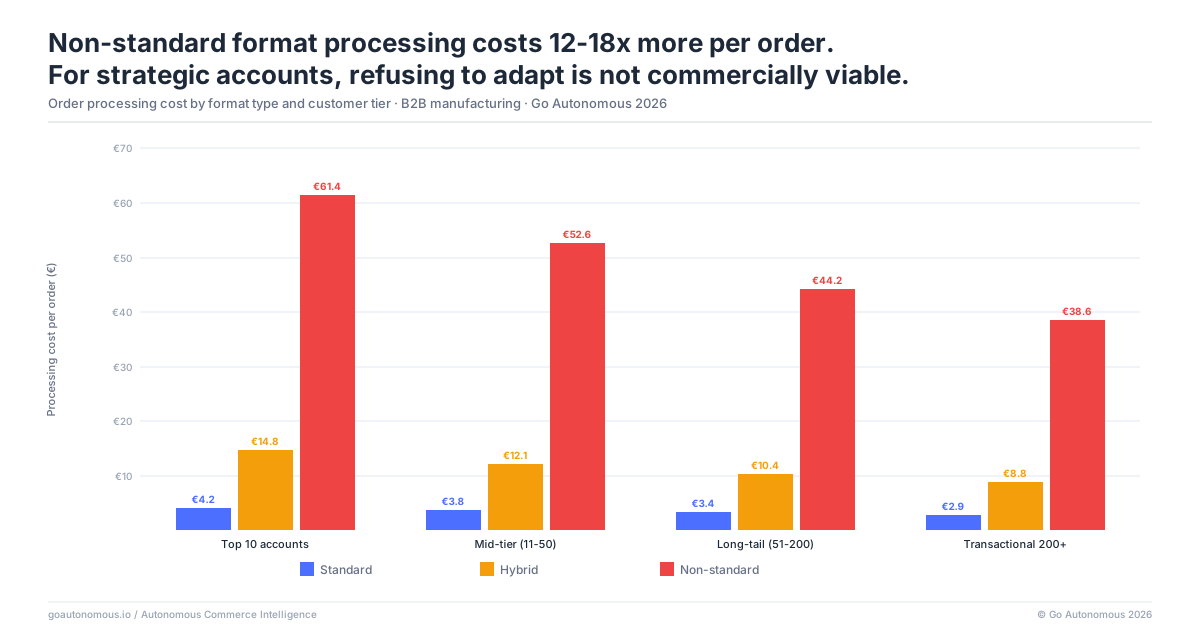
Standard order processing in a B2B operation costs €15–35 per order when all labor is counted. Strategic account orders requiring custom format handling cost significantly more: specialized rep time for accounts the handler knows, translation lookup steps for each non-standard field, quality checks to verify the translation was applied correctly, and the periodic maintenance cost of keeping the translation current. Per-order processing cost for strategic accounts with non-standard formats typically runs 2–3x the standard processing cost across a full year when maintenance is included.
The practical implication is that the accounts generating the most gross revenue are often not the most profitable to serve on a per-order basis when fully-loaded processing cost is calculated. Operations leaders who have not measured per-order cost by account are frequently surprised by the margin compression that strategic account processing overhead creates, particularly for accounts whose contract pricing already incorporates a volume discount negotiated over multiple renewal cycles.
The Perverse Economics: Your Most Valuable Customers Are Your Highest-Cost-to-Serve
The economics of strategic account order processing create a perverse structure. The accounts that justify the most commercial investment, strategic pricing, executive relationship management, and account team dedication, are also the accounts that impose the highest per-order processing cost. The net margin picture on a strategic account, when per-order processing overhead is fully loaded against the volume discount in the contract, is often materially worse than the gross revenue number suggests.
This is not an argument against strategic accounts. It is an argument for removing the per-order overhead that makes them disproportionately expensive to serve. If format-handling complexity is eliminated, the strategic account delivers its revenue advantage without the processing cost burden. The margin management implications of reducing per-order cost on high-volume accounts are direct: lower cost-to-serve on the same contracted revenue improves account margin without renegotiation.
Format-Agnostic Intake Handles Strategic Account Orders Without Custom Per-Account Workflows
How AI Reads Non-Standard Formats Without a Pre-Built Translation Table
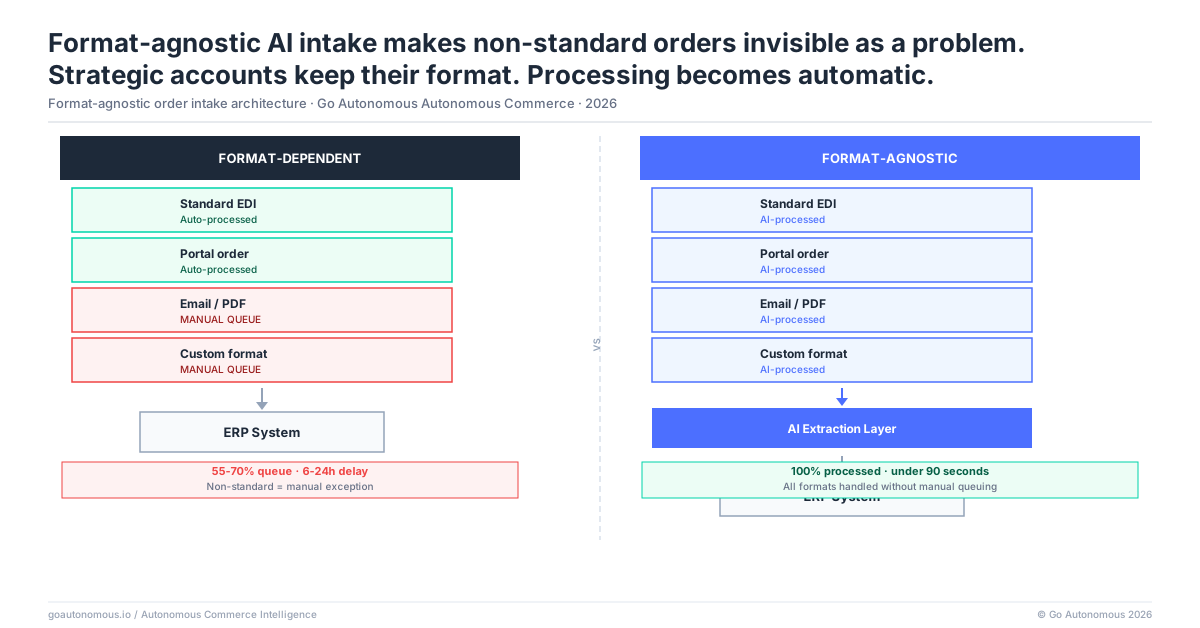
Format-agnostic AI intake processes strategic account purchase orders without requiring a pre-built, manually maintained translation table for each account. The AI reads each order as-is, including the buyer’s internal item codes, cost center references, procurement system numbering, and location codes, and maps them to ERP master data using a combination of order history patterns, product catalog similarity matching, and contextual pattern recognition learned from previous orders from that account.
When a strategic account changes their procurement system format, the AI does not require a manual rebuild. It processes the new format, identifies the mapping from context, and adapts. Exceptions where confidence is insufficient are routed to human review. The critical difference from a manual custom workflow is that the AI’s adaptation is automatic and does not create a window of degraded processing performance while a mapping is rebuilt. Strategic account format changes become routine variation rather than operational disruptions.
What Strategic Account Management Looks Like When Format Complexity Is Not a Cost Driver
When format-agnostic intake handles strategic account order processing, the per-order cost for those accounts aligns with per-order cost for standard accounts. The 2–3x processing cost premium disappears. The specialist reps who previously owned strategic account format handling can focus on relationship management and commercial activities rather than translation work. The maintenance overhead from periodic format updates no longer consumes operations capacity.
The strategic account becomes what it should be commercially: a high-revenue relationship with proportional margin, not a high-revenue relationship with disproportionate processing overhead. Danfoss, operating across 26 countries, now processes orders in under 1 minute with 80% handled autonomously. See that deployment at Danfoss autonomous order intake. Additional customer outcomes across manufacturing and distribution are available at Go Autonomous success cases. Book a session to assess the format complexity in your top 20 accounts and calculate what eliminating the custom workflow overhead would deliver.
Frequently Asked Questions
Why do large B2B customers often use non-standard order formats?
Large enterprise customers use procurement systems like SAP Ariba, Coupa, and Oracle Procurement Cloud that generate purchase orders optimized for the buyer’s internal approval workflows, cost center allocation, and audit requirements. These systems use the buyer’s internal item codes, cost center references, and site location naming, which do not map directly to the supplier’s ERP. The format is correct for the buyer’s needs; the translation burden falls on the supplier.
How do B2B manufacturers manage order processing for customers using SAP Ariba or Coupa?
Most B2B manufacturers manage SAP Ariba and Coupa order processing through custom translation workflows: account-specific mapping documents, lookup tables, or custom EDI mappings that translate the buyer’s format into ERP-ready data. These workflows require specialist reps, periodic maintenance when the buyer updates their system, and rebuild time when format changes break the existing mapping.
What is the per-order processing cost for strategic accounts with non-standard formats?
Strategic accounts with non-standard formats typically incur 2–3x the standard per-order processing cost when custom translation handling, specialist rep time, quality checking, and annual mapping maintenance are fully loaded. Standard B2B order processing costs €15–35 per order; strategic account orders requiring custom format handling regularly exceed this range.
How do B2B distributors handle non-standard purchase order formats from enterprise customers without custom EDI?
Format-agnostic AI intake processes non-standard purchase orders without requiring a pre-built custom mapping for each account. The AI reads the buyer’s internal item codes, cost center references, and location codes, maps them to ERP master data using order history and pattern recognition, and adapts automatically when the buyer’s format changes. This eliminates the maintenance overhead of per-account custom workflows.
Can AI process strategic account orders with non-standard formats without building custom mapping per customer?
Yes. AI intake systems use order history patterns, product catalog similarity matching, and contextual recognition to map non-standard buyer formats to ERP data without a pre-built per-account translation table. When buyer formats change, the AI adapts without requiring a manual rebuild, eliminating the operational disruption that custom workflow maintenance creates.