.svg)





Why Configuration Specialists Spend Half Their Time on Data Entry, Not Oracle CPQ
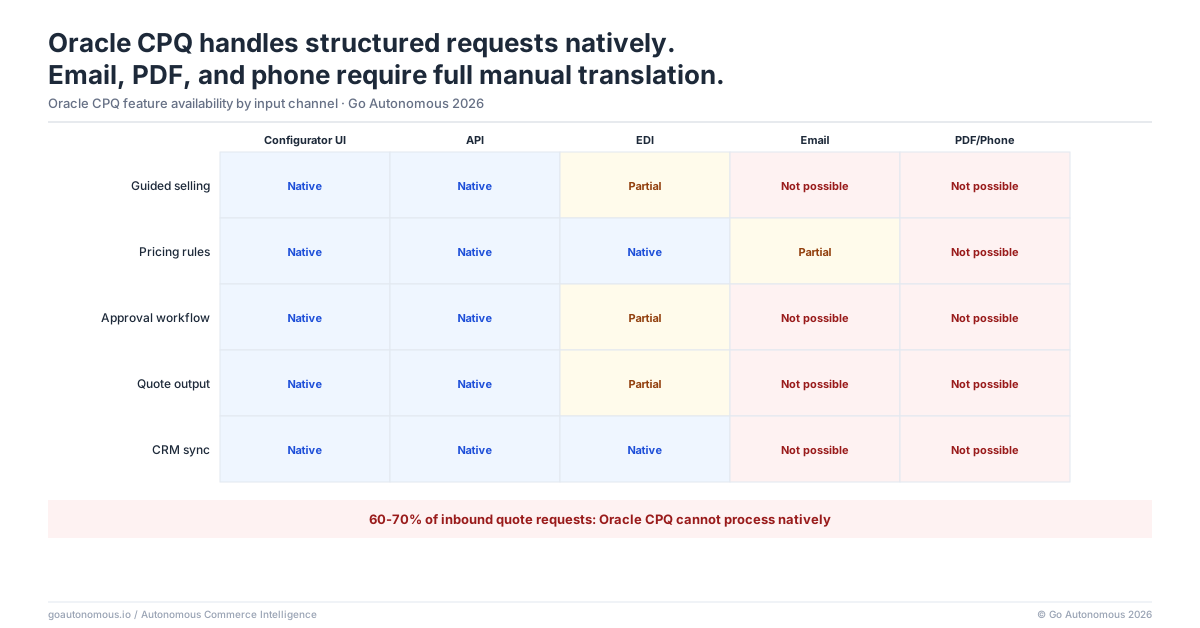
Oracle CPQ is built to automate the quote configuration and pricing process. It is not built to read email. For manufacturers where 60–70% of quote requests arrive as unstructured email, every quote involves a manual translation step before Oracle CPQ can begin its work. This post maps that gap and explains what closes it without replacing the CPQ investment.
Oracle CPQ automates quote configuration and pricing for complex B2B products. It does not read email. For manufacturers where 60–70% of quote requests arrive as unstructured email, every inbound quote requires a manual translation step before Oracle CPQ can begin its work. Skilled configuration specialists and inside sales reps spend 40–60% of their time on data entry rather than configuration. The gap between the customer’s inbox and Oracle CPQ is the primary constraint on quote throughput and win rate.
Table of Content
- Oracle CPQ Handles Structured Quote Requests: 60–70% of Inbound Quotes Are Unstructured Email
- Every Email Quote Request Requires Manual Translation Before Oracle CPQ Can Process It
- Unstructured Quote Volume Creates a Pricing Backlog That Slows Revenue Recognition
- AI Extraction Between Email and Oracle CPQ Closes the Unstructured Quote Gap
- The Autonomous Execution Fabric: Beyond Email-to-CPQ, Closing the Full Execution Gap
- Frequently Asked Questions
- How does Oracle CPQ handle quote requests sent by email from B2B customers?
- Can AI automatically process email quote requests for Oracle CPQ users?
- What is the cost of manual quote translation for Oracle CPQ in B2B manufacturing?
- How do B2B manufacturers reduce quote response time when using Oracle CPQ?
- Why do Oracle CPQ users still need manual steps for unstructured quote requests from B2B customers?
Oracle CPQ Handles Structured Quote Requests: 60–70% of Inbound Quotes Are Unstructured Email
What Oracle CPQ Requires as Input: Structured Product Configuration Data
Oracle CPQ (Configure, Price, Quote) automates the process of pricing and configuring complex products once the quote parameters are defined. The system requires structured inputs: product selection from the catalog, configuration choices across applicable attributes, quantity, required delivery date, applicable contract or price book, and customer account identification. Given these inputs, Oracle CPQ applies pricing rules, validates configuration, and generates a quote document automatically.
This capability is valuable. It eliminates manual pricing calculation errors, enforces approved discount structures, and produces consistent, professional quote documents. The investment in Oracle CPQ is justified by the volume of quotes it processes and the complexity it handles. The problem is upstream: most inbound quote requests do not arrive in the format Oracle CPQ requires.
What a Customer Email Quote Request Actually Contains: Natural Language and Ambiguity
A customer email quote request provides none of the structured inputs Oracle CPQ needs. It contains a description of what the customer wants, possibly a reference to a previous order or a part number from their own internal catalog, an approximate quantity expressed in natural language, a delivery requirement such as “by end of month” or “before our scheduled maintenance window,” and sometimes a target price. The customer is not withholding information: they are communicating in the way that is natural and efficient for them.
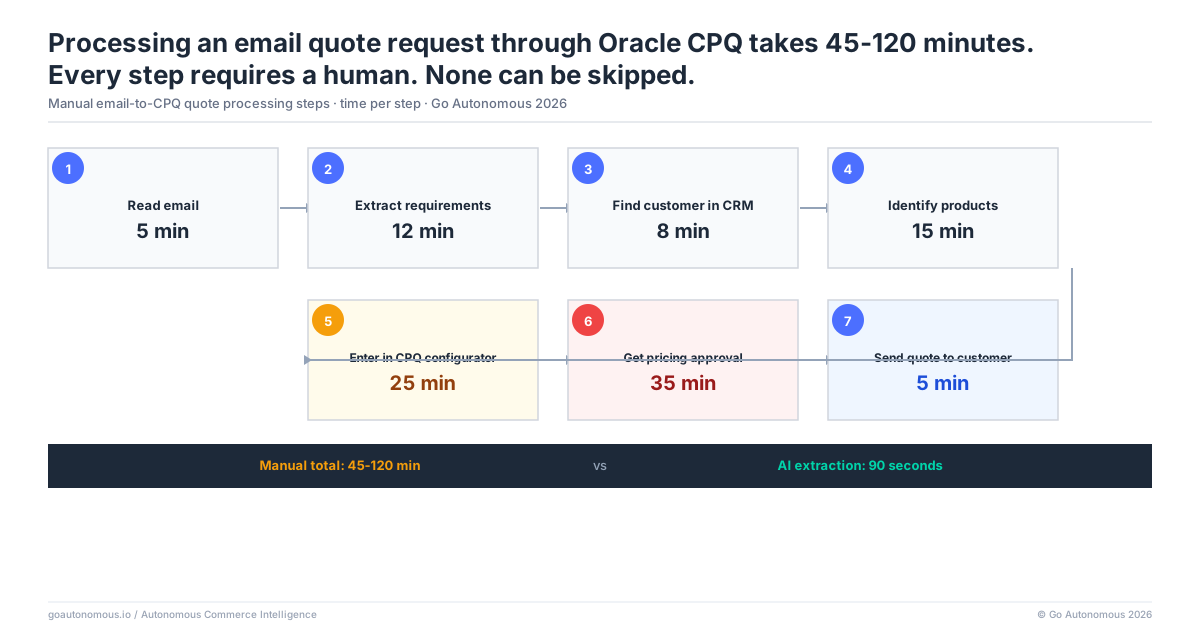
Translating that email into Oracle CPQ inputs is a manual task. A configuration specialist must read the email, identify the likely product or products, map the customer’s description to the correct items in the Oracle product catalog, resolve ambiguities, and enter the structured configuration into CPQ before the automated process can begin. The autonomous commerce approach addresses this translation layer directly, but understanding the cost first requires mapping what happens in the manual process.
Each time we added one or two million euros in revenue, we had to add another operator. From a cost perspective, that's an unsustainable way of operating a business.

Every Email Quote Request Requires Manual Translation Before Oracle CPQ Can Process It
The Email-to-CPQ Handoff: What Each Step Costs
The workflow between email receipt and Oracle CPQ engagement is entirely manual and involves multiple sequential steps. A configuration specialist or inside sales rep reads the email and identifies the product requirements. They map the customer’s language to the correct product codes in the Oracle catalog. If the request is ambiguous, they contact the customer for clarification, which adds another round-trip communication cycle. They enter the structured configuration into Oracle CPQ, validate it, generate the quote, review it for accuracy, and send it to the customer.
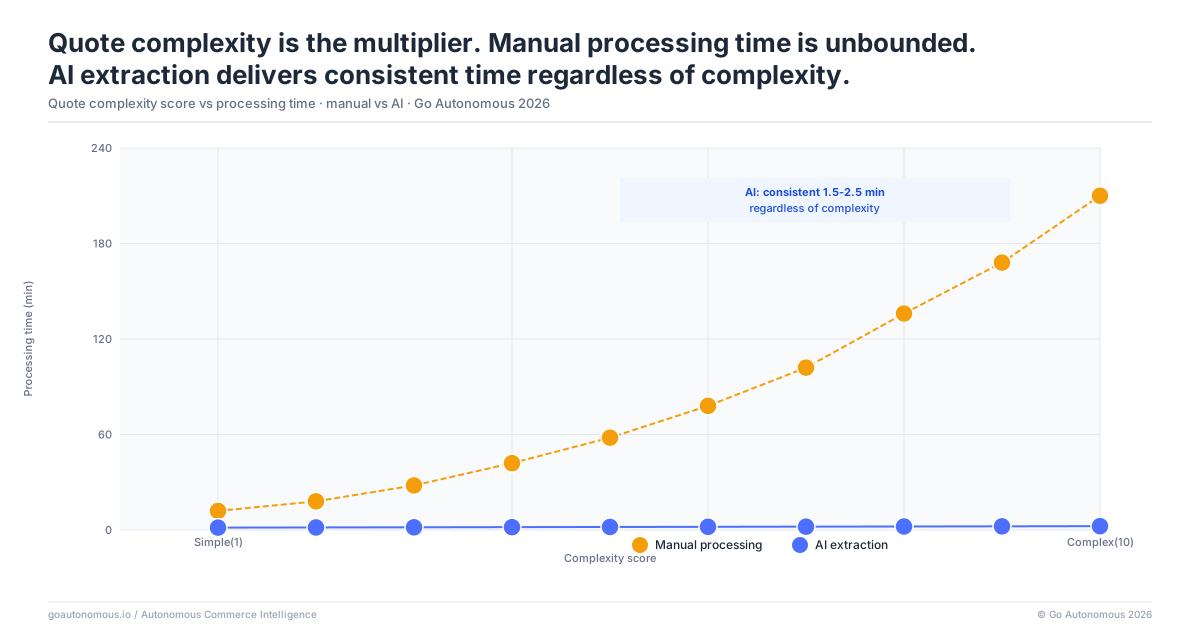
Each step consumes time. The email-to-quote workflow adds 2–8 hours before Oracle CPQ begins its actual configuration and pricing work. For standard product configurations that CPQ would process in minutes once the inputs are in place, the manual translation step represents 90–95% of the total quote cycle time. Oracle CPQ is fast. The manual step before it is not.
Configuration Specialists as Data Entry Workers: The Hidden Misallocation of Skilled Labor
The individuals performing this manual translation are typically configuration specialists or inside sales engineers with deep product knowledge. They were hired to handle technically complex configurations that require judgment: non-standard specifications, compatibility requirements, applications where the customer’s requirements are ambiguous and the correct product is not obvious from the catalog.
In practice, 40–60% of their time goes to translating routine requests from email format into Oracle CPQ inputs. These are standard products with known configurations: the specialist adds no value beyond the translation. The specialist’s product expertise is not used. Their time is used for data entry. This is a structural misallocation of expensive, specialized labor that grows worse as quote volume increases. Each additional revenue increment adds more email quotes, more translation work, and more pressure on the configuration team, consistent with the pattern Mikkel Vindeløv describes.
Unstructured Quote Volume Creates a Pricing Backlog That Slows Revenue Recognition
The Quote Queue: How Unstructured Intake Creates a Backlog That Grows With Sales Effort
When quote requests arrive faster than the configuration team can translate them, a queue develops. The queue is not a Oracle CPQ problem: CPQ is fast enough to handle any reasonable quote volume once it has structured inputs. The queue is a translation bottleneck. Adding sales capacity without adding translation capacity means the queue grows as sales activity increases. More pipeline generates more email quote requests, which generates a longer queue, which lengthens quote response times.
This dynamic creates a ceiling on how effectively the sales organization can generate quote volume. Sales teams learn that generating more opportunities than the configuration team can process in a reasonable time produces frustration rather than revenue. The constraint is not willingness to sell: it is the translation bottleneck between email and Oracle CPQ.
The Commercial Cost of a Quote Backlog in Competitive B2B Markets
In competitive B2B markets, multiple suppliers are typically being evaluated simultaneously. A buyer who has requested quotes from three suppliers will allocate the order based on price, delivery capability, and responsiveness. A quote that takes three days to emerge from the backlog often arrives after the buyer has already allocated the order to a faster respondent.
The commercial cost of a quote backlog is not only the orders lost to competitors who responded faster. It includes the cost of the sales effort that generated the opportunity, the cost of the configuration work invested in a quote that arrived too late, and the relationship cost of appearing unresponsive. For key accounts, repeated slow quote response signals that the supplier’s operations cannot support the buyer’s procurement tempo. This affects contract renewal conversations and share-of-wallet decisions.
50–70% of B2B order and quote volume arrives via unstructured channels including email. For manufacturers who have invested in Oracle CPQ to improve quote quality and speed, the email translation gap is directly limiting the return on that investment.
AI Extraction Between Email and Oracle CPQ Closes the Unstructured Quote Gap
How AI Translates Email Quote Requests Into Oracle CPQ Inputs
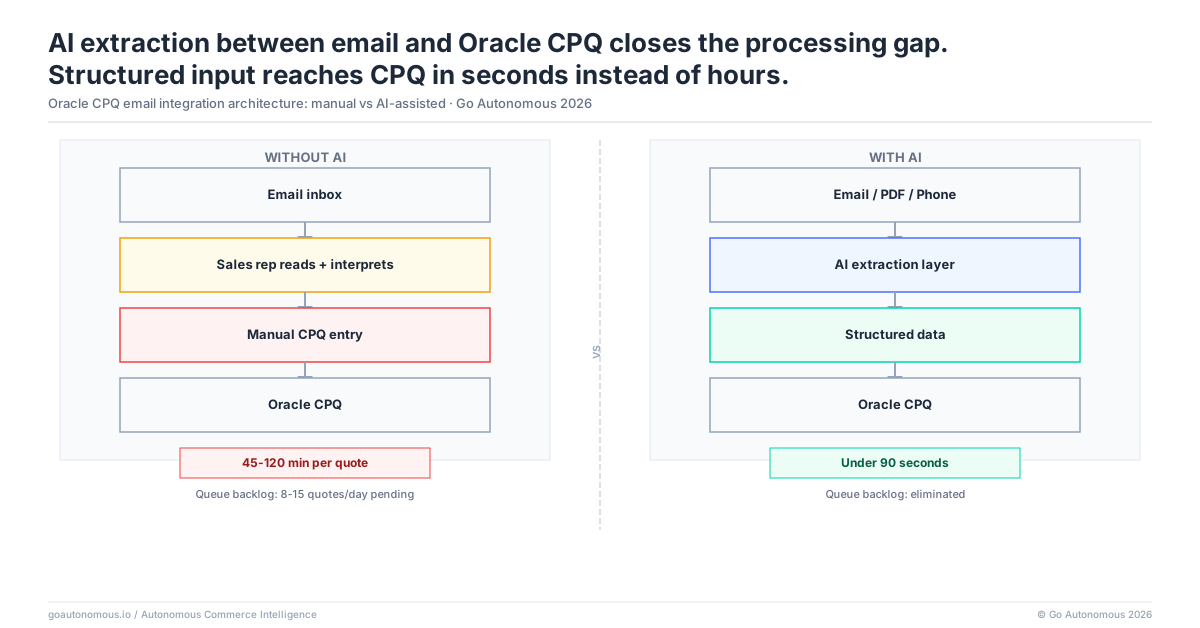
An AI extraction layer reads incoming email quote requests, applies natural language understanding to identify the product requirements, maps the customer’s language to the correct Oracle CPQ product codes and configuration options using order history, the product catalog, and the customer’s purchase patterns, and presents a pre-populated CPQ configuration for specialist review and confirmation.
For routine, standard-configuration quotes where the mapping is unambiguous, the AI handles the end-to-end translation with no specialist involvement beyond confirmation. The quote moves from email receipt to Oracle CPQ input in minutes rather than hours. For complex configurations requiring engineering judgment, the AI pre-populates all available data and flags the specific decision points where specialist input is needed. The specialist reviews a nearly complete quote, not a blank form. The time investment drops from 2–3 hours to 20–30 minutes for complex requests.
What Configuration Specialists Focus on When AI Handles Routine Translation
When AI handles the translation of routine email quote requests into Oracle CPQ inputs, configuration specialists recover the 40–60% of their time previously spent on data entry. That capacity becomes available for the work that requires their expertise: technically complex configurations, non-standard applications, customer consultations on specification requirements, and review of edge cases where the AI’s confidence is below threshold.
Quote response time compresses from days to hours for standard requests. Win rates improve because speed improves. The Oracle CPQ investment begins delivering its full potential because it is being fed structured inputs at the speed it is capable of processing them, not at the speed the manual translation step permits.
The Autonomous Execution Fabric: Beyond Email-to-CPQ, Closing the Full Execution Gap
The email-to-CPQ translation problem is the most visible constraint on Oracle CPQ ROI, but it is one component of a broader execution gap. The Autonomous Execution Fabric is a full commercial execution layer that connects directly to your Oracle environment and executes every inbound commercial transaction without human assembly. For quote requests, the Fabric reads inbound emails, extracts structured configuration parameters, applies correct contract pricing from Oracle, and delivers pre-populated CPQ configurations. Standard quotes are processed end-to-end. Complex configurations are pre-populated with all available data and flagged only at genuine decision points requiring engineering judgment.
The Fabric’s execution scope extends beyond quoting. It processes orders across every intake channel (email, EDI, customer portal, and direct API), handles pricing requests, manages return authorizations, processes credit notes, and responds to contract tenders. Each of these transaction types arrives through unstructured channels in the same way quote requests do. Each requires the same translation step from natural language or non-standard format to structured ERP inputs. The Fabric provides that translation layer across all commercial transaction types, not just the quoting workflow where the Oracle CPQ investment makes the constraint most visible.
The email gap problem identified in this post is part of a larger structural gap: B2B commercial transactions arrive in formats that require human translation before ERP systems can process them. This applies to orders, quotes, pricing requests, and returns alike. The Autonomous Execution Fabric closes this gap across the full commercial transaction stack. Configuration specialists recover from routine translation work. Account managers recover from status inquiry cycles. Finance recovers from correction workflows. The Oracle CPQ investment starts returning full value because it receives properly structured inputs at volume.
For the commercial and operational outcomes that follow from closing this gap, see Go Autonomous customer success cases. The pattern across manufacturers is consistent: when the email-to-CPQ translation is automated, quote volume increases, response time drops, and win rate improves without adding configuration headcount. See also how topline growth and margin management are connected to quote response speed.
If your configuration team is spending the majority of its time translating email into CPQ inputs rather than configuring complex products, the Oracle CPQ investment is not being fully utilized. Book a session to see how the email-to-CPQ gap is closed in practice.
Frequently Asked Questions
How does Oracle CPQ handle quote requests sent by email from B2B customers?
Oracle CPQ does not process email directly. It requires structured inputs: product selections, configuration attributes, quantities, and applicable pricing rules. Email quote requests from B2B customers arrive as natural language descriptions that must be manually translated into Oracle CPQ inputs before the automated pricing and configuration process can begin. This translation step is typically performed by configuration specialists or inside sales engineers.
Can AI automatically process email quote requests for Oracle CPQ users?
Yes. An AI extraction layer can read incoming email quote requests, map the customer’s natural language product requirements to Oracle CPQ product codes and configuration options using order history and the product catalog, and deliver pre-populated CPQ configurations for specialist confirmation. Routine standard-configuration quotes can be fully translated without specialist involvement. Complex configurations are pre-populated with available data and flagged at specific decision points requiring engineering judgment.
What is the cost of manual quote translation for Oracle CPQ in B2B manufacturing?
The primary cost is skilled labor misallocation. Configuration specialists and inside sales engineers with deep product knowledge spend 40–60% of their time translating routine email quote requests into Oracle CPQ inputs rather than handling technically complex configurations. Each email quote adds 2–8 hours of translation time before Oracle CPQ begins processing. The secondary cost is commercial: slower quote response time reduces win rates in competitive evaluations.
How do B2B manufacturers reduce quote response time when using Oracle CPQ?
The primary lever is automating the email-to-CPQ translation step. When AI handles the extraction of product requirements from email quote requests and delivers pre-populated Oracle CPQ configurations, quote cycle time compresses from days to hours for standard requests. Oracle CPQ processes the structured input quickly; the bottleneck is the manual translation step before it. Automating that step removes the constraint on quote throughput.
Why do Oracle CPQ users still need manual steps for unstructured quote requests from B2B customers?
Because Oracle CPQ requires structured inputs and B2B customers send natural language emails. CPQ is designed to automate pricing and configuration once the parameters are defined: it is not designed to read and interpret unstructured communication. Until an AI extraction layer is placed between the customer’s email and Oracle CPQ, every unstructured inbound quote requires a manual translation step by a configuration specialist before CPQ can begin its work.