.svg)





Agentic AI in B2B Order Management: What 2026 Deployments Reveal About the Execution Gap
Most enterprise agentic AI deployments in B2B manufacturing and distribution are still in assistance mode — helping humans work faster, not removing the human dependency that drives cost at scale. This post maps the execution gap between what agentic AI promises and what 2026 deployments actually deliver, using the Human Dependency Ratio as the honest measure of whether your AI investment is working.
This post is written for VP Operations, CDO, and CRO leaders at B2B manufacturers and distributors who are fielding internal pressure to show ROI on agentic AI investments. The core question is not whether agentic AI works. It is whether what has been deployed is agentic AI execution or agentic AI assistance, and what that distinction costs in revenue, headcount, and competitive position in 2026.
Table of Content
- Why 2026 Is the Year B2B Operations Leaders Are Asking Harder Questions About Agentic AI
- What Agentic AI Actually Means for B2B Order Management: Assistance vs. Execution
- What 2026 Deployments Reveal: Where Agentic AI Delivers ROI and Where It Stalls
- Agentic AI Assistants vs. Autonomous Commerce Execution: A Direct Comparison
- How Human Dependency Ratio Separates Agentic Assistants from Autonomous Execution
- What the Autonomous Commerce Architecture Looks Like in Production
- Find Out Where Your Agentic AI Deployment Is on the Execution Spectrum
- What the Board Is Actually Asking
- "How do we know whether our current AI investments are actually reducing manual dependency?"
- "What is the difference between what our AI vendor calls 'agentic' and what delivers measurable ROI on order processing?"
- "How long before we see return on autonomous order execution?"
- "What breaks if we wait another year while competitors deploy execution-layer AI?"
- Frequently Asked Questions
- What is agentic AI in B2B order management?
- What is the difference between an AI copilot and autonomous order execution for B2B manufacturers?
- How do B2B manufacturers measure whether their agentic AI is delivering ROI?
- How long does it take to see ROI from autonomous order execution in B2B manufacturing?
- Why do most enterprise agentic AI deployments stall before delivering structural cost reduction?
- What is the difference between agentic AI and RPA for B2B order processing?
- How does autonomous order execution integrate with SAP S/4HANA or Microsoft Dynamics 365?
Why 2026 Is the Year B2B Operations Leaders Are Asking Harder Questions About Agentic AI
The question the board keeps asking sounds deceptively simple: if we have deployed AI across our commercial operations, why does our headcount in customer service and order management keep growing?
That question is now forcing a reckoning across B2B manufacturing and distribution. According to Gartner’s 2025 Hype Cycle for Artificial Intelligence, agentic AI has moved from peak inflated expectation into early enterprise deployment, and the gap between what was promised in vendor pitches and what is running in production is becoming measurable. Operations leaders who signed off on agentic AI pilots in 2024 are now being asked to show what changed.
The honest answer, in most cases: not enough. Not because agentic AI is immature. Because most deployments stopped at the wrong layer.
The companies getting measurable results in 2026 share one characteristic. They moved from agentic AI that assists humans to agentic AI that executes transactions. That shift is the execution gap this post addresses.
What changed between 2024 pilots and 2026 production deployments?
The primary change is accountability. In 2024, enterprise agentic AI pilots were measured by user adoption scores, satisfaction ratings, and anecdotal productivity claims. In 2026, the same deployments are being measured against revenue metrics, headcount ratios, and processing capacity. Under that scrutiny, the distinction between “AI that helps people work faster” and “AI that removes people from the transaction flow” becomes the critical operational divide.
A manufacturer processing 600 email orders per day at 12 minutes each is committing 1,200 person-hours per week to execution that generates zero commercial value. At a fully loaded cost of 45 EUR per hour, that is 2.8 million EUR per year spent on the act of receiving revenue. If an agentic AI copilot reduces that to 10 minutes per order, the savings are real but marginal. If autonomous execution removes that manual step for 80 percent of standard transactions, the economics shift structurally.
That is the execution gap. It is not a technology gap. It is an architectural decision most manufacturers have not consciously made yet.
What Agentic AI Actually Means for B2B Order Management: Assistance vs. Execution
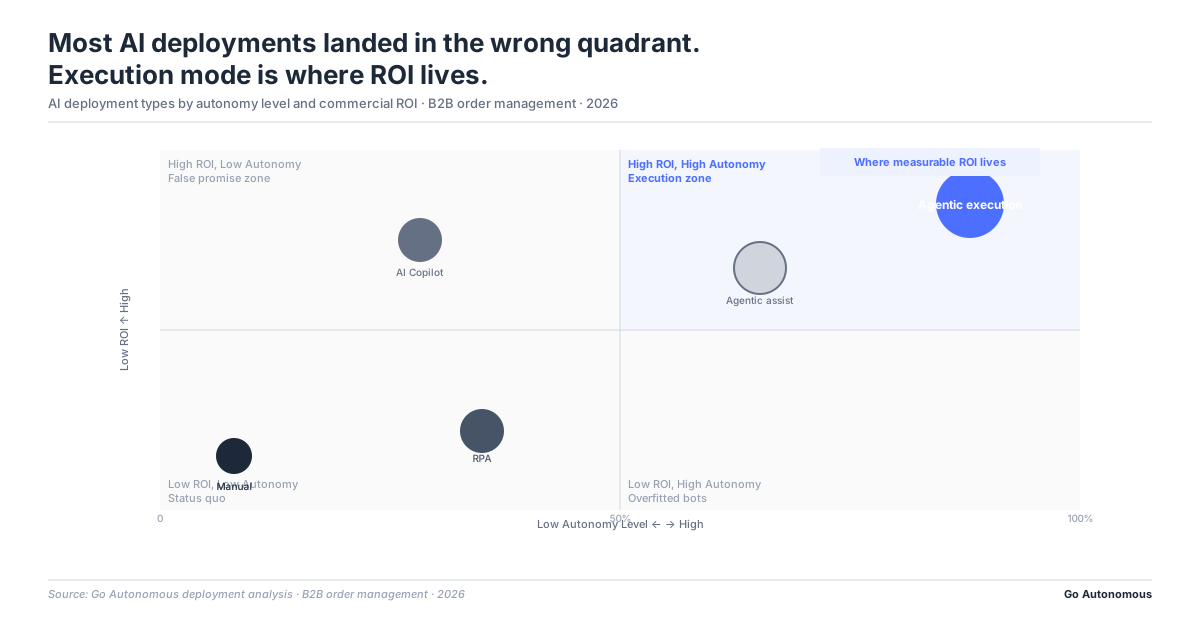
Agentic AI in B2B order management refers to AI systems that take sequences of actions to complete commercial tasks, reading orders, interpreting customer intent, resolving data mismatches, and moving transactions forward. However, “agentic” describes a capability spectrum, not a fixed outcome level. Where a system sits on that spectrum determines whether it reduces your Human Dependency Ratio or simply makes your existing headcount marginally faster.
What is agentic AI in B2B order management?
Agentic AI in B2B order management is AI that can autonomously sequence multiple steps to process a commercial transaction: reading a purchase order, matching it against the customer’s pricing contract in SAP S/4HANA, flagging discrepancies, resolving standard exceptions without human input, and confirming the order back to the buyer. The critical qualifier is “without human input”, that is what separates agentic execution from agentic assistance.
Most tools marketed as “agentic” today operate in assistance mode. Microsoft Copilot for Sales surfaces order data and drafts responses. Salesforce Agentforce proposes next actions and automates CRM updates. SAP Joule interprets queries and guides users through ERP workflows. ServiceNow AI agents route tickets and automate approvals within ITSM frameworks. These are genuine productivity improvements. None of them execute the transaction without a human at the decision point.
That final human decision is where the cost and the latency live.
What is the difference between an AI copilot and autonomous order execution for manufacturers?
An AI copilot accelerates human decisions. Autonomous order execution eliminates the human decision entirely for transactions that fall within defined parameters. For a manufacturer where 70 percent of orders are standard repeat transactions from contracted customers, that distinction determines whether AI delivers efficiency gains or structural cost reduction.
Consider what happens when a Danfoss distributor sends an EDI 850 purchase order for a catalog product at a contracted price. In a copilot model, a CSR sees the order surfaced with AI-suggested actions and approves the next step. In an autonomous execution model, the Autonomous Commerce platform reads the EDI, validates the pricing against the master data, confirms inventory availability, writes back to SAP, and sends the order acknowledgment, without a human in the loop. The CSR’s time goes to exceptions, escalations, and relationship-building. Not to routine confirmation clicks.
Adopting Autonomous Commerce at Danfoss is not just about speed and efficiency. It's about empowering our customer service teams and sales force to focus on building relationships and providing personalized support.

How does agentic AI differ from traditional order management software?
Traditional order management software, including ERP-native modules like SAP S/4HANA Order Management, Oracle Order Management Cloud, and Microsoft Dynamics 365, executes structured, rule-compliant transactions reliably. The gap is unstructured input: email orders, PDF attachments, free-text amendments, multi-line orders with partial SKU matches, pricing disputes on the face of the PO. Traditional OMS requires clean, structured data to function. Agentic AI can interpret unstructured input, resolve ambiguity, and make judgment calls on standard cases before routing exceptions to humans.
The distinction matters because 50 to 70 percent of B2B order volume still arrives via email and unstructured channels, according to Go Autonomous deployment analysis across 30 billion-plus processed B2B transactions. That is the volume traditional OMS cannot touch without human translation. Agentic AI execution closes that gap at scale.
What 2026 Deployments Reveal: Where Agentic AI Delivers ROI and Where It Stalls
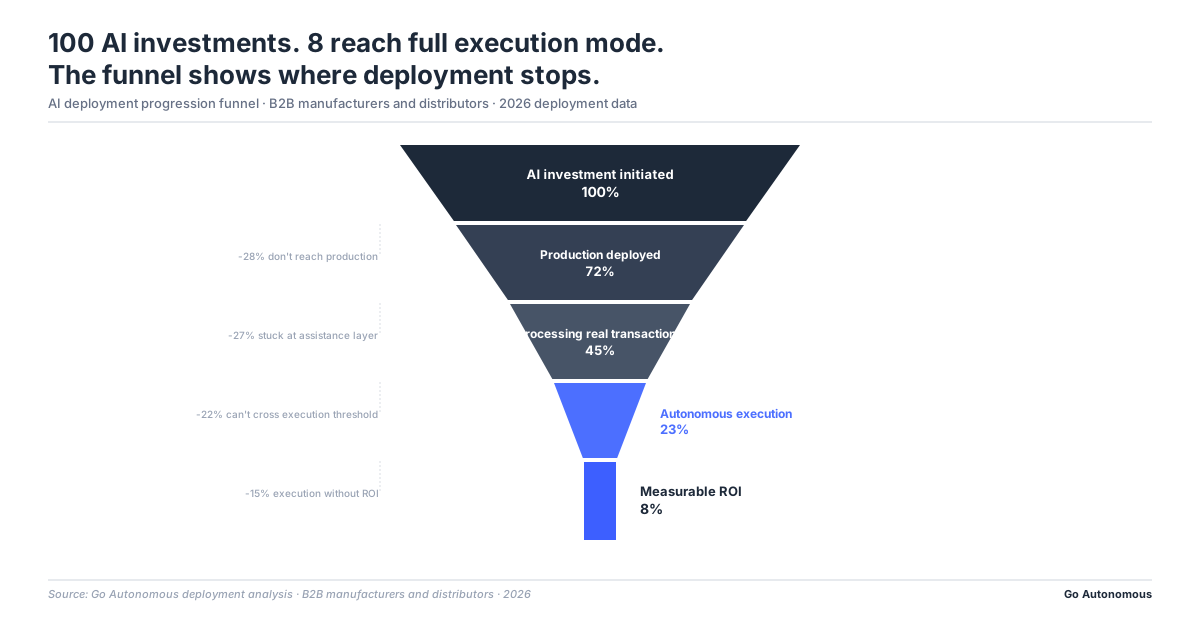
The pattern across 2026 enterprise deployments is consistent. Agentic AI delivers strong productivity ROI at the task layer and weak structural ROI at the transaction layer, unless it has been explicitly deployed for execution, not assistance.
Where agentic AI assistants deliver real value in B2B operations
The assistance-mode tools, Microsoft Copilot for Sales, Salesforce Einstein AI, ServiceNow AI agents, SAP Joule, are genuinely valuable in specific contexts. They reduce search time, improve CSR response quality, surface relevant order history, and accelerate onboarding for new team members. For organizations where the primary bottleneck is information retrieval rather than transaction execution, these tools move the needle.
However, their ROI has a ceiling. That ceiling is the human decision point they are designed to support. More capable assistance still requires the same number of human decisions per transaction. As a result, headcount requirements scale with volume. The treadmill gets faster, but it is still a treadmill.
Where agentic AI stalls in B2B order management deployments
The stall point is consistent across industries. Agentic AI pilots expand successfully from simple queries to complex data retrieval to draft generation. Then they reach the transaction boundary: the moment where the AI’s recommendation needs a human sign-off before action is taken. That boundary is where velocity dies.
For B2B manufacturers processing high volumes of repeat orders from contracted customers, that boundary is structurally misplaced. The human approval on a standard EDI call-off from a customer with a 3-year blanket PO adds latency without adding value. It is a risk management reflex, not a business necessity. Organizations that have redesigned that boundary, identifying which transaction categories can be fully executed by the system, are the ones reporting genuine ROI from agentic AI in 2026.
The companies still in pilot mode are the ones that handed their CSR team a better copilot and measured adoption rates. The companies reporting measurable operational efficiency gains are the ones that redesigned the transaction flow itself.
Agentic AI Assistants vs. Autonomous Commerce Execution: A Direct Comparison
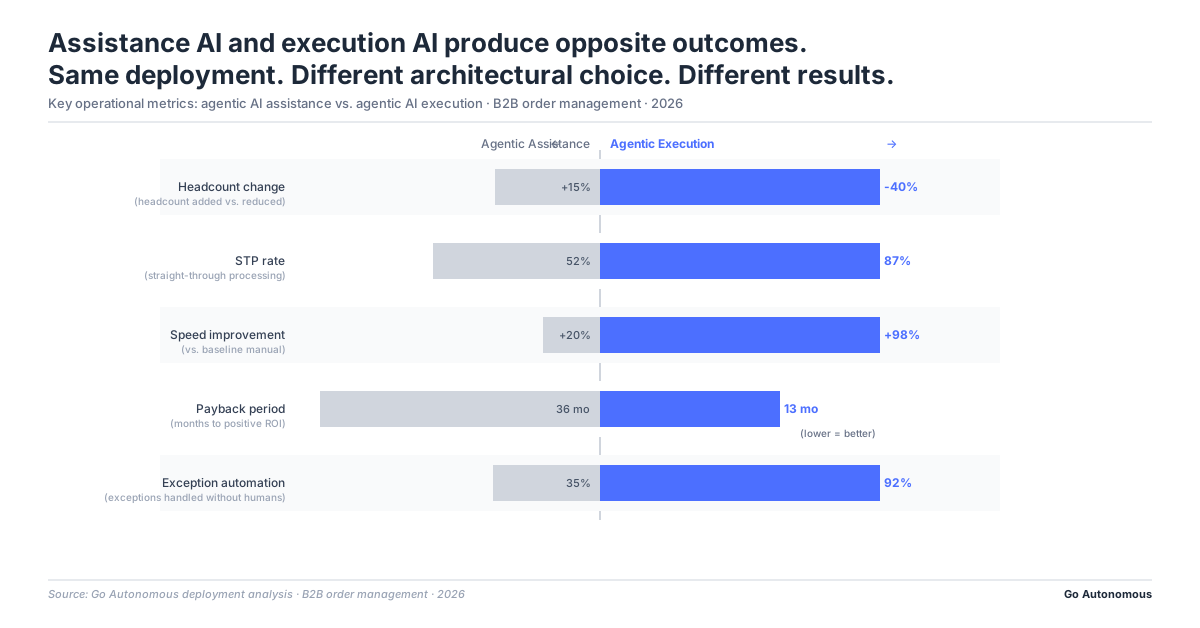
The table below maps the key dimensions of difference. Column headers name specific tool categories to ground the comparison in what operations leaders are actually evaluating.
| Dimension | Agentic AI Assistants (Microsoft Copilot for Sales, Salesforce Agentforce, SAP Joule, ServiceNow AI) | Autonomous Commerce Execution (Go Autonomous) |
|---|---|---|
| What it handles | Information retrieval, draft generation, CRM updates, workflow routing, guided approvals | Full commercial transaction execution: orders, quotes, pricing, exceptions, ERP writeback, order acknowledgment |
| Human role | Human remains the decision-maker on every transaction. AI accelerates preparation and recommendation. | Human handles genuine exceptions only. Standard transactions execute without human input. |
| Decision-making | Recommends. Human approves. | Executes within defined parameters. Escalates only true exceptions. |
| Integration depth | Typically sits above existing systems via API. Surfaces data. Does not write back transactional records autonomously. | Reads unstructured input (email, EDI, portal, PDF), resolves against ERP master data, writes confirmed transactions back to SAP S/4HANA, Oracle, or Dynamics 365. |
| ROI driver | Productivity per CSR. Faster response time. Reduced search overhead. | Structural headcount reduction. Revenue velocity increase. Human Dependency Ratio reduction. |
| Scalability ceiling | Headcount scales with volume. AI reduces time per transaction but does not remove the human from the flow. | Volume grows without proportional headcount increase. Standard transactions scale autonomously. |
| Primary metric improvement | Touchless rate marginal improvement. Average handle time reduction. | Human Dependency Ratio reduction. Revenue Velocity increase. Working capital released through faster order-to-cash cycles. |
How Human Dependency Ratio Separates Agentic Assistants from Autonomous Execution
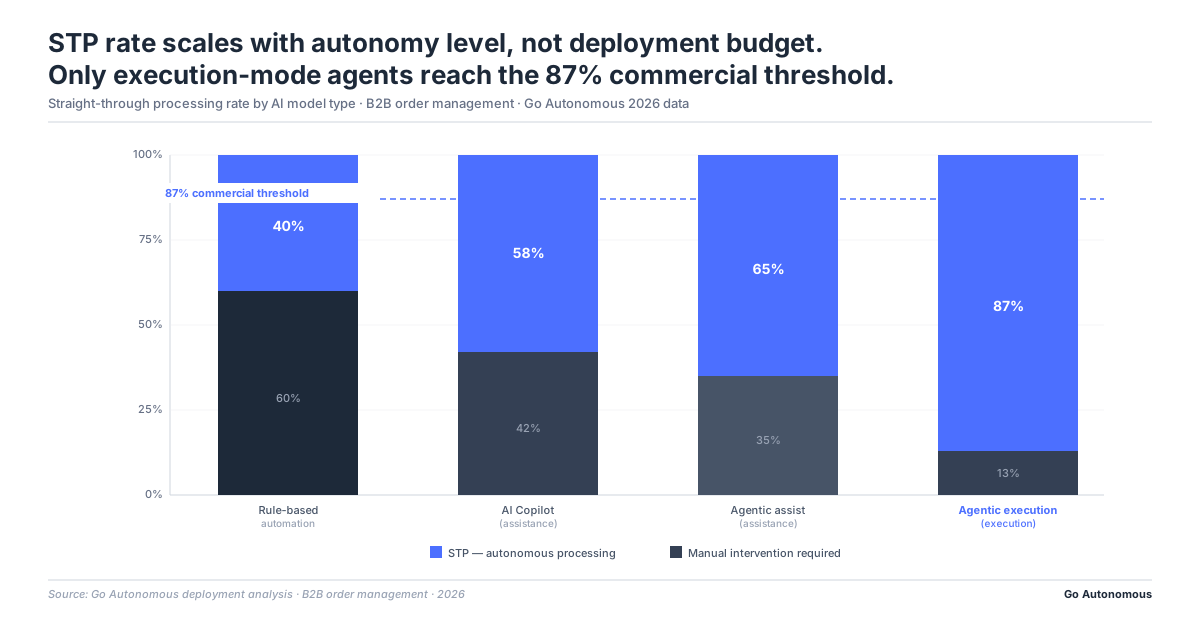
Most organizations measuring their agentic AI deployments are using the wrong metric. Average handle time, CSAT scores, and copilot adoption rates tell you how well the tool has been embedded. They do not tell you whether your manual decision count per unit of revenue is falling.
That is the measurement gap the Human Dependency Ratio is designed to close.
Human Dependency Ratio (HDR) is the number of manual decisions required per unit of revenue processed. It measures cognitive load on the commercial operation: specifically, how many human judgment calls must be made before a transaction can complete. The goal of autonomous execution is to drive this number as close to zero as possible for the standard transaction population.
The formula is direct: Total manual decisions divided by Total revenue. It can be segmented by stage, HDR for quotes, HDR for order intake, HDR for invoice exceptions, HDR for disputes. A rising HDR alongside rising revenue is the clearest possible evidence that automation, not autonomy, has been deployed.
“If revenue grows 20 percent but manual decisions also grow 20 percent, you haven’t built an autonomous system. You’ve built a bigger treadmill.”
How do B2B manufacturers measure whether their agentic AI is actually working?
The honest measurement framework for agentic AI in B2B order management tracks three numbers together: manual decisions per week, revenue processed per week, and headcount in order management. If the first two are diverging, revenue growing, manual decisions falling, autonomous execution is working. If all three are growing proportionally, you have a better copilot, not an autonomous system.
Beyond HDR, Revenue Velocity is the second metric that separates execution-layer AI from task-layer AI. Revenue Velocity measures the speed at which revenue moves from demand signal to confirmed cash. In an autonomous environment, the goal is not just more revenue. It is faster revenue with less lag. If velocity is capped despite high demand, you do not have a sales problem, you have a friction problem in your processing layer.
What is the Human Dependency Ratio and how does it apply to agentic AI deployments?
HDR applies to agentic AI deployments as the primary accountability metric. When an organization deploys a copilot tool, HDR typically holds flat or decreases marginally, the human still decides, just faster. When an organization deploys autonomous execution for standard transactions, HDR for those transaction categories drops sharply, often by 60 to 80 percent within the first production quarter. That is the measurable signal that the deployment has crossed from assistance into execution.
The distinction also matters for the RPA vs AI conversation. Robotic process automation scaled labor without eliminating dependency. The robot did the task, but a human had to structure the input, handle exceptions, and supervise the output. Autonomous execution differs because it handles unstructured input, resolves standard exceptions internally, and escalates only genuine edge cases. HDR for the RPA cohort stayed high. HDR for autonomous execution cohorts falls structurally.
At CWS Hygiene, we're taking an important first step toward bringing autonomy to our commercial operations. We see Autonomous Commerce as a vital pillar of our enterprise architecture for the future.
What the Autonomous Commerce Architecture Looks Like in Production
The Autonomous Commerce platform operates as the execution layer between the commercial demand signal and the ERP. It is not a workflow automation tool, an iPaaS connector, or an OMS overlay. It is the layer that reads commercial intent from any channel, email, EDI 850, EDIFACT, OCI punchout, cXML, customer portal, or PDF attachment, and executes the resulting transaction end-to-end.
How does Autonomous Commerce integrate with SAP, Oracle, and Dynamics 365?
Autonomous Commerce integrates at the ERP writeback layer. The platform reads incoming commercial documents, resolves them against pricing master data, customer contracts, and inventory status held in SAP S/4HANA, Oracle Cloud SCM, or Microsoft Dynamics 365, and then writes the confirmed, validated transaction back into the ERP without human intermediation. The ERP does not need to change. The existing data model, approval hierarchy, and fulfillment logic remain intact. What changes is that a human no longer has to translate the incoming document into ERP-ready data.
This is the architectural distinction that separates Autonomous Commerce from tools like MuleSoft, Boomi, or Workato. iPaaS platforms connect systems. Autonomous Commerce executes commercial decisions between them.
What does the transaction execution process look like step by step?
- Capture: The platform ingests the incoming order signal, email, EDI batch, portal submission, or unstructured PDF, from any channel, regardless of format.
- Interpret: AI agents parse the commercial intent: which customer, which products, which quantities, which delivery terms, which pricing tier.
- Validate: The platform cross-references the interpreted order against the customer’s contract, the current pricing master, open blanket PO call-offs, and inventory availability in the ERP.
- Resolve: Standard exceptions, partial catalog matches, minor unit-of-measure mismatches, pricing within contracted tolerance, are resolved autonomously using codified business rules.
- Execute: The platform writes the confirmed order into SAP S/4HANA or Oracle Order Management Cloud, triggers fulfillment, and sends the order acknowledgment to the buyer.
- Escalate: True exceptions, new customer relationships, pricing disputes outside tolerance, missing master data, are routed to a human operator with full context already assembled.
For manufacturers and distributors running this in production across the Nordics, DACH, and Benelux, the result is a measurable shift in how CSR time is allocated. Go Autonomous deployment data from the Danfoss deployment shows order intake moving from a labor-intensive, inbox-driven process to confirmed transactions in under one minute across 26 countries deployed simultaneously, with 80 percent of transactional decisions now executing without human input and a 50 percent reduction in overall processing time. At Mediq, processing approximately 4,000 orders per week across the Nordics in healthcare distribution, order handling time on the largest orders dropped by 75 percent with no additional headcount, decoupling order volume growth from staffing cost entirely. The CSR team’s capacity reallocates from execution to exception handling and relationship management.
That shift is what the topline growth and margin management case for Autonomous Commerce rests on: more revenue processed at lower cost-to-serve, with faster order-to-cash cycles that release working capital. For a closer look at the economics of this transition, the Autonomous Execution Fabric white paper outlines five lessons from enterprise deployments, including the architectural conditions that make autonomous execution possible at scale.
The outcomes across the Danfoss, Nilfisk, and broader Go Autonomous customer base follow a consistent pattern: significantly reduced manual processing steps, measurable capacity released from order intake teams, and faster revenue cycle times. These are not efficiency metrics. They are structural changes in how the commercial operation functions.
Sources
- Gartner, Artificial Intelligence Research and Hype Cycle
- Go Autonomous, Danfoss Case Study: Autonomous Order Intake
- Go Autonomous, Autonomous Commerce Blueprint: Human Dependency Ratio
- Go Autonomous, Autonomous Commerce Blueprint: Revenue Velocity
- Go Autonomous, The Autonomous Execution Fabric: Five AI Lessons on Enterprise AI
Find Out Where Your Agentic AI Deployment Is on the Execution Spectrum
If the patterns in this post match what you are seeing in your operations, agentic AI tools in place, but headcount in order management still growing with volume, HDR holding flat despite AI investment, the question is not whether autonomous execution applies to your environment. The question is which transaction categories are ready to move from assistance to execution today. Go Autonomous works with 500M to 20B EUR manufacturers and distributors in the Nordics, DACH, Benelux, UKI, and France. The starting point is always a transaction-level analysis: what is your current HDR by order type, what is your standard transaction population, and where is the human decision adding value versus adding latency. That analysis typically surfaces the deployment scope within the first conversation. Book a conversation with our team.
What the Board Is Actually Asking
Before any initiative of this scale reaches sign-off, the same questions come up. Here are the direct answers.
“How do we know whether our current AI investments are actually reducing manual dependency?”
Measure your Human Dependency Ratio before and after deployment, segmented by transaction type. If HDR for standard repeat orders is not falling, the deployment is assistance-mode, not execution-mode. Productivity gains are real but bounded. The question to ask your current AI vendor: what happens to manual decision volume when order volume doubles? If the answer is proportional growth, you have not built an autonomous system.
“What is the difference between what our AI vendor calls ‘agentic’ and what delivers measurable ROI on order processing?”
The operational test is straightforward: does the system complete the transaction, or does it complete the recommendation? Microsoft Copilot for Sales, Salesforce Agentforce, and SAP Joule complete the recommendation. The human completes the transaction. Autonomous Commerce executes the transaction for standard order types. The ROI difference is structural: one model reduces minutes per order, the other removes orders from the manual queue entirely. At scale, those are different cost structures.
“How long before we see return on autonomous order execution?”
For manufacturers processing 300 or more orders per day across multiple unstructured channels, payback on autonomous execution typically materializes within the first operating year. The mechanism is twofold: capacity released from order intake teams reallocates to revenue-generating activities, and faster order-to-cash cycles compress DSO. The working capital effect alone can be significant at 500M EUR-plus revenue scale. Go Autonomous deployments consistently show measurable results within the first production quarter.
“What breaks if we wait another year while competitors deploy execution-layer AI?”
Three things break simultaneously. First, the headcount gap compounds: every year of volume growth without autonomous execution adds another layer of structural cost that becomes harder to unwind as team size increases and process complexity deepens. Second, Revenue Velocity falls behind: competitors processing orders in under 60 seconds are winning re-order business from customers who value speed. Third, the data asymmetry grows: every transaction processed through an autonomous system trains the policy layer, making the next transaction faster and more accurate. Organizations that start 12 months later start 12 months behind on that learning curve. The execution gap does not stay constant. It widens.
Frequently Asked Questions
What is agentic AI in B2B order management?
Agentic AI in B2B order management refers to AI systems that autonomously sequence multiple steps to complete commercial transactions: reading purchase orders, interpreting customer intent, matching pricing contracts, resolving standard exceptions, and confirming orders in the ERP without human input at each step. The critical qualifier is autonomous execution, which is what separates agentic execution from agentic assistance, where a human still approves every decision the AI prepares.
What is the difference between an AI copilot and autonomous order execution for B2B manufacturers?
An AI copilot accelerates human decisions by surfacing data and suggesting next actions. Autonomous order execution eliminates the human decision entirely for transactions within defined parameters. For a manufacturer where 70 percent of orders are standard repeat transactions from contracted customers, a copilot reduces time per decision while autonomous execution removes the decision from the queue. The ROI difference is structural: one model reduces minutes per order, the other removes orders from the manual workflow entirely.
How do B2B manufacturers measure whether their agentic AI is delivering ROI?
The most direct measurement is Human Dependency Ratio: total manual decisions divided by total revenue in the same period. If HDR is not declining as order volume grows, the deployment is assistance-mode rather than execution-mode. Track whether order management headcount is growing proportionally to revenue despite AI investment. If both revenue and headcount scale together, the AI has not changed the execution architecture.
How long does it take to see ROI from autonomous order execution in B2B manufacturing?
For manufacturers processing 300 or more orders per day across unstructured channels, measurable ROI typically materializes within the first operating year. Danfoss reduced order confirmation time from 42 hours to under one minute across 26 countries, with 80 percent of transactional decisions now autonomous and a 50 percent reduction in overall processing time. Mediq reduced order handling time on its largest orders by 75 percent with no headcount addition. The payback mechanism is dual: capacity released from intake reallocation, and faster order-to-cash cycles compressing DSO.
Why do most enterprise agentic AI deployments stall before delivering structural cost reduction?
Most deployments stall at the transaction boundary: the point where the AI recommendation requires human approval before action. For manufacturers processing high volumes of repeat orders from contracted customers, this boundary is misplaced. The human sign-off on a standard EDI call-off from a contracted customer adds latency without adding value. Organizations that redesign this boundary, identifying which transaction categories can execute autonomously, are the ones reporting structural HDR reduction and genuine ROI in 2026.
What is the difference between agentic AI and RPA for B2B order processing?
RPA automates structured, rule-defined steps on known interfaces. Agentic AI executes commercial transactions including unstructured inputs like email and PDF, ambiguity resolution, and exception handling within defined policy. RPA reduces keystrokes on structured inputs and routes everything else to humans. Agentic AI resolves standard exceptions autonomously. The distinction matters because 50 to 70 percent of B2B order volume arrives via email and PDF, outside the structured input requirement that RPA needs to function.
How does autonomous order execution integrate with SAP S/4HANA or Microsoft Dynamics 365?
Autonomous order execution integrates with SAP S/4HANA and Microsoft Dynamics 365 through existing APIs and data interfaces, writing validated transactions back into the ERP without requiring ERP modification. The execution layer handles all upstream interpretation: reading the order, resolving exceptions against pricing master data and catalog, confirming completeness. The ERP receives a clean validated transaction and processes it through its standard workflow. The Danfoss deployment demonstrates this architecture across 26 countries on the same ERP infrastructure, without changes to the existing system of record.