
.svg)





Order Exception Handling Automation
Your exception volume has a cost. Most of it is the same problem, repeating.








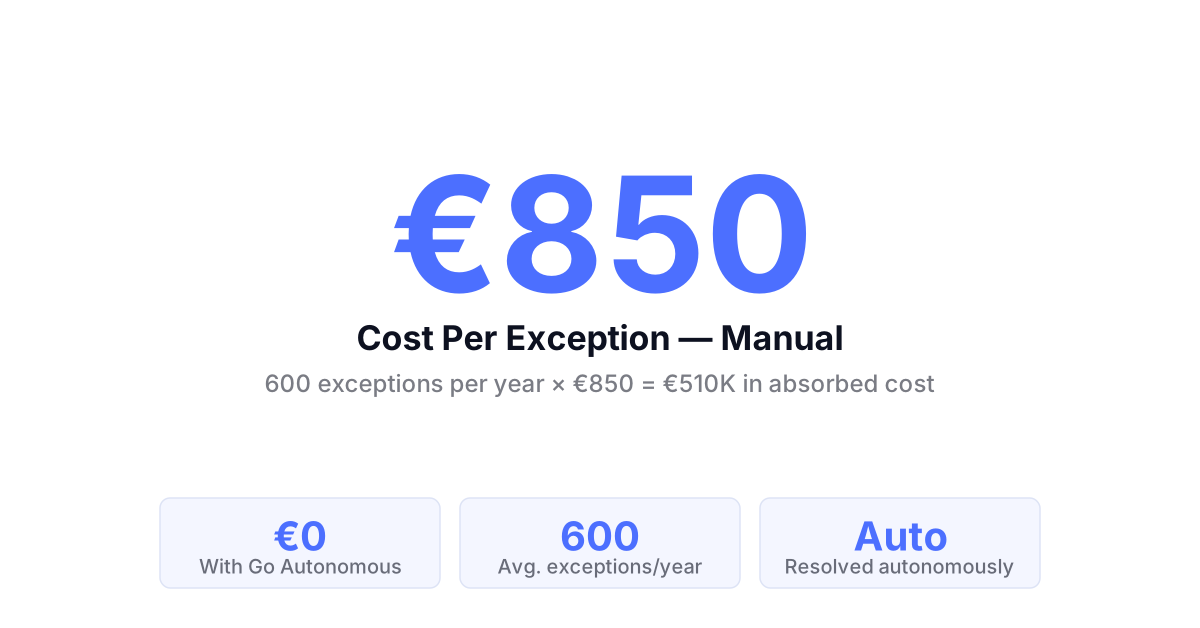
850 Euros per Exception. 510K per Year.
850 Euros per Exception. 510K per Year.
The True Cost of Manual Exception Handling
One exception. Multiple people. Hours of investigation. One credit note.
Walk through what a single exception actually costs: 30 to 60 minutes of investigation across two or three people, one to three customer communications, 45 to 90 minutes of credit note processing, and ERP correction. Multiply that by your monthly exception volume. That number is sitting in your operations, invisible in your P&L.
Routing Is Not Resolution. Flagging Is Not Fixing.
Routing Is Not Resolution. Flagging Is Not Fixing.
Why Ticketing Tools Left Exception Costs Unchanged
The ticket is assigned. The manual work still happens.
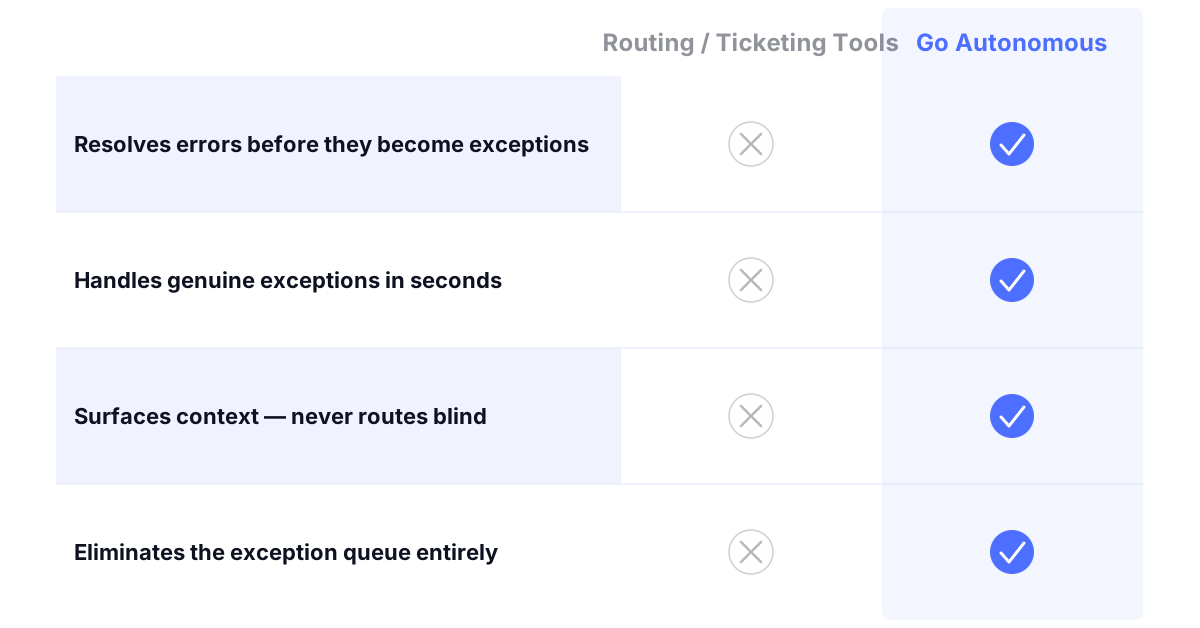
Exception management tools route problems to the right queue faster. They do not resolve them. The CSR still opens ERP, investigates, determines resolution, and raises the credit note. The manual work is unchanged. Just better organised.
Most exceptions are not exceptions. They are the same three problems, repeating.
Wrong price, quantity mismatch, product substitution — these three categories account for the majority of order exceptions at any manufacturer or distributor. When the resolution is the same every time, the question is not how to manage the queue — it is why there is a queue at all.

Most exceptions are not exceptions. They are the same three problems, repeating.
Wrong price, quantity mismatch, product substitution — these three categories account for the majority of order exceptions at any manufacturer or distributor. When the resolution is the same every time, the question is not how to manage the queue — it is why there is a queue at all.
Layer One: Errors Resolved Before They Exist.
Layer One: Errors Resolved Before They Exist.
Duplicates, mismatches, tolerance gaps — resolved.
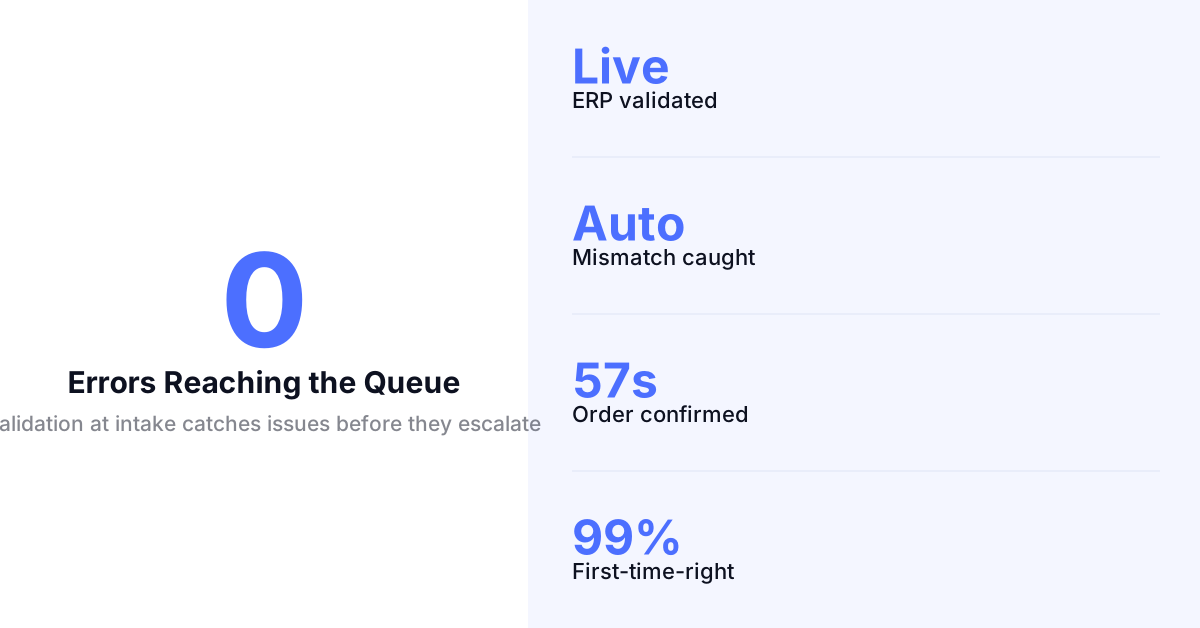
Most exceptions follow predictable patterns: duplicate orders, product mismatches with a known equivalent, pricing within tolerance. Go Autonomous resolves these at intake — before the order enters your ERP and before any queue item exists.
Layer Two: Genuine Exceptions in Seconds.
Layer Two: Genuine Exceptions in Seconds.
Request. Reason. Options. Recommendation — assembled.
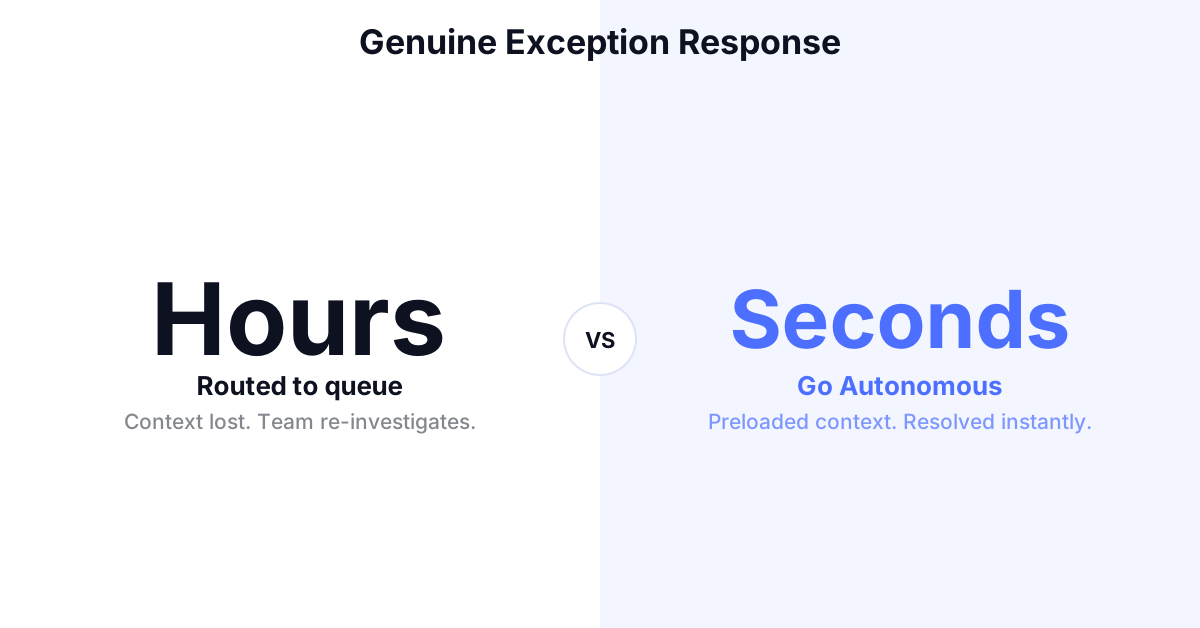
Exceptions requiring judgment surface in the supervised interface: original request, validation result, the specific decision point, and a recommended resolution. The operator confirms in seconds — not after 45 minutes of cold investigation.
What Changes After Deployment.
Error rate reduced 40-60% within the first quarter.
Autonomous validation at intake eliminates the class of errors caused by manual entry. Not improved — removed at source.
Cost per resolved exception falls 70-80%.
Context pre-loaded means judgment in seconds. The labour cost per exception collapses even for cases that need a human.
Resolution time: from hours to seconds.
No cold queue. Exceptions arrive preloaded. The time from identification to resolution drops from the first day.
OTIF performance improves without touching logistics.
Fewer errors mean fewer fulfilment failures. Orders that enter the ERP correctly reach the customer correctly.
Exception Handling. Resolved at Source.
Exception Handling. Resolved at Source.
Accuracy on all orders
Fewer errors at intake
Faster exception handling
Order-to-ERP confirmation
Duplicate Orders Caught Before They Ship.
Duplicate Orders Caught Before They Ship.
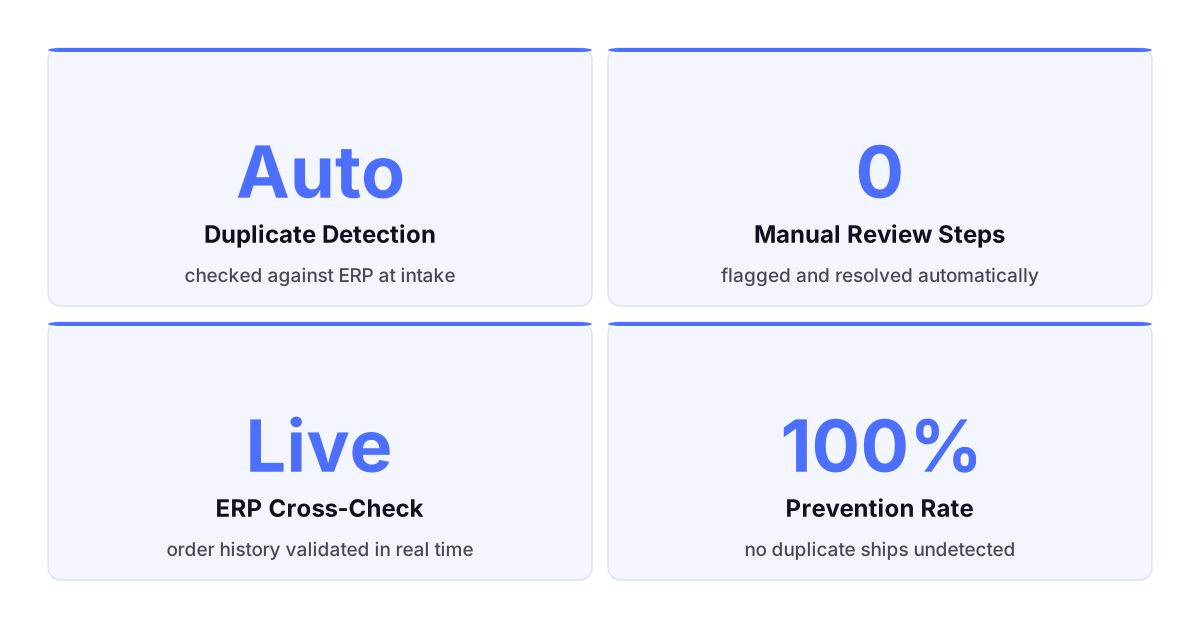
Same order via email and portal. Detected.
When the same customer sends an order by email and through a portal simultaneously — a common pattern in B2B — Go Autonomous identifies the duplication before either enters your ERP. One confirmation goes back. No double fulfilment.
Pricing Mismatches Caught at Intake.
Pricing Mismatches Caught at Intake.
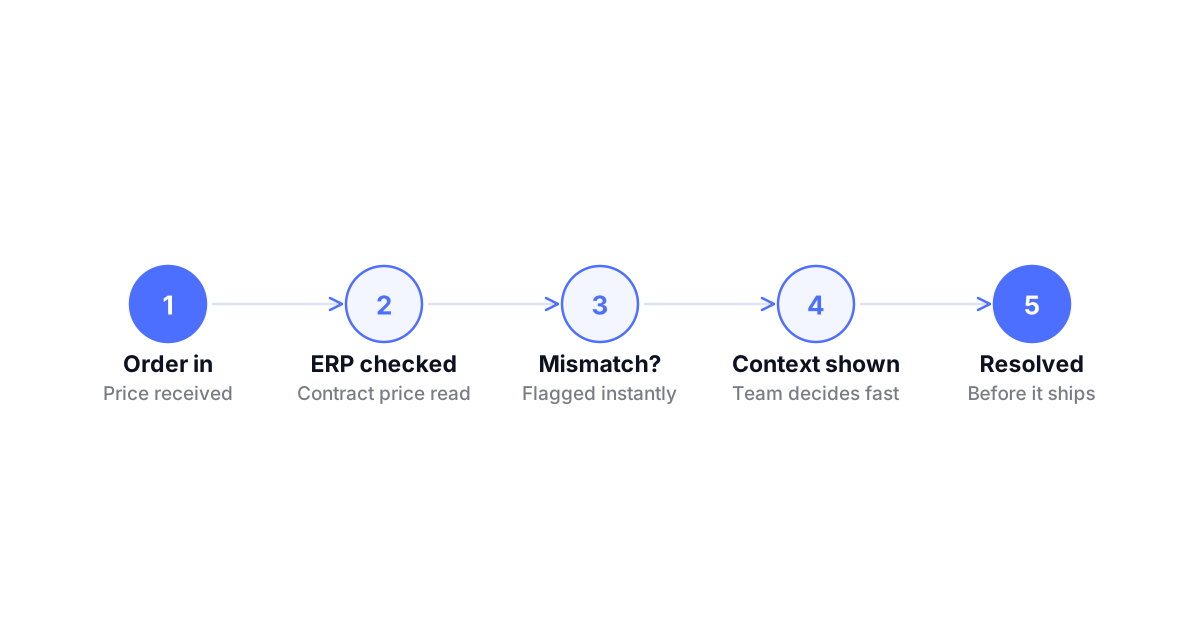
Wrong tier applied — caught before the order confirms.
A pricing mismatch that enters your ERP as a confirmed order becomes a credit note, a customer query, and an hour of your team’s time. Go Autonomous validates every order line against the customer’s pricing agreement before it confirms — the mismatch is flagged and resolved in seconds.
Exceptions Resolved at Source.
Danfoss — Orders executed in under one minute with 99% first-time-right across all formats and channels. Read the press release
Mediq — Autonomous execution across thousands of weekly orders, with exceptions handled at intake rather than downstream. See the success case
Nilfisk — Order error rate reduced significantly after deploying autonomous commerce, freeing customer service capacity. Read the press release
Common Questions
What types of order exceptions can Go Autonomous resolve autonomously?
Go Autonomous resolves autonomously the exceptions that have a rule-based answer: duplicate order detection, product code mismatches where a catalogue equivalent is configured, pricing discrepancies within a defined tolerance band, delivery address variants that can be matched to your customer master, and missing field completions where defaults are configured. These are resolved at the intake layer before the order enters your ERP. Exceptions requiring genuine judgment are surfaced to your team in the supervised interface with full context.
What does the supervised execution interface look like for exceptions?
When a genuine exception reaches the supervised execution interface, your operator sees: the original customer request exactly as it arrived, the specific element that failed validation and the reason it failed, the relevant customer account context including pricing agreement, order history, and credit status, the resolution options available under your configured business rules, and a recommended resolution based on how similar exceptions have been handled previously. The operator confirms, modifies, or overrides the recommendation and the resolution executes immediately.
How does the exception rate change over time after deployment?
The exception rate falls in two ways. First, the autonomous resolution layer at intake removes the 50 to 70 percent of exceptions that have rule-based resolutions — from day one. Second, as the platform processes more of your transaction volume, it learns the patterns of your specific customer base: which customers use non-standard product codes, which accounts have complex pricing configurations. The autonomous resolution rate increases over time.
How is this different from the exception management modules in our ERP or WMS?
ERP and WMS exception management validates records at the point of ERP entry — after manual re-keying, after interpretation errors have already occurred. Go Autonomous operates at the intake layer, before the ERP record is created. It validates the customer’s original request against your ERP data in real time and resolves resolvable issues before they become bad records. ERP modules manage the consequences of errors. Go Autonomous prevents the errors from occurring.
What is the ROI timeline for exception handling automation?
Take your monthly order volume, apply your current exception rate, and multiply by the hours spent per exception across investigation, correction, and credit note processing. That is the annual cost sitting in your operations. Most customers reach positive ROI within the first operating quarter after go-live.
Does this work across all the channels customers use to send orders?
Yes. Go Autonomous reads and processes orders regardless of how they arrive: email, EDI, customer portals, spreadsheet submissions, and structured messaging channels. Validation and exception resolution logic applies consistently across all channels, with duplicate detection operating cross-channel for customers who submit via multiple routes simultaneously.
How does exception handling connect to overall O2C performance?
Exceptions that are not caught early become claims downstream — disputes, short-shipment claims, pricing complaints. Resolving exceptions at the point of intake is the most cost-effective form of claims prevention available. It is cheaper by an order of magnitude than resolving the same problem after goods have moved. Fewer exceptions also means faster fulfilment, better OTIF performance, and fewer invoice mismatches that extend DSO.
What happens to exceptions that fall outside configured resolution rules?
Exceptions outside configured rules are surfaced in the supervised execution interface with all relevant context assembled: the original claim, the matched order record, the validation result, and a recommended action where one can be inferred. The operator handling the exception does not start from scratch — they confirm or modify the recommendation. Resolution time is materially faster than for manually processed exceptions, even though they require human involvement.
Voice of the Customers



Explore what autonomous execution means for your operations.
Talk to an expert or see Go Autonomous in action.

Explore what autonomous execution means for your operations.
Talk to an expert or see Go Autonomous in action.