.svg)





What Is Friction Debt? How B2B Operations Accumulate It and How to Pay It Off
Friction debt is the accumulated operational cost created by manual touchpoints and process workarounds in B2B commercial workflows. This post defines the concept, shows how manufacturers and distributors build it up, and explains what it takes to pay it off through autonomous execution.
Friction debt is the accumulated operational cost and growth constraint created by manual touchpoints, process workarounds, and system handoffs embedded in B2B commercial workflows. Unlike visible costs, headcount, software licences, overtime, friction debt compounds silently across every quote, order, and pricing cycle. This post defines the concept precisely, explains how B2B manufacturers and distributors accumulate it over years of incremental process decisions, and outlines what paying it off actually requires. Operations leaders, CFOs, and heads of commercial operations in manufacturing and distribution will find this framework directly applicable to how they diagnose and address scaling constraints.
What Is Friction Debt?
The term “technical debt” is well understood in software engineering: shortcuts taken during development that accumulate into structural constraints on future velocity. Friction debt is the operational analogue. It describes the compound cost created every time a business embeds a manual step, a human workaround, or a system-to-system handoff into a commercial process, and then builds subsequent processes on top of it.
In B2B commerce, friction debt accumulates across the full revenue workflow: from the moment a customer submits an enquiry to the moment an order is confirmed, invoiced, and fulfilled. Every touchpoint that requires a human to read, interpret, translate, or re-enter data is a unit of friction. Every process that depends on a person being available, rather than a system executing, adds to the debt load. And like financial debt, friction debt accrues interest. The longer it sits unaddressed, the more expensive it becomes to service.
This is distinct from operational inefficiency in the conventional sense. Operational inefficiency implies a fixable process problem, a workflow that can be redrawn, a team that can be retrained. Friction debt is structural. It is embedded in the architecture of how revenue is executed. Retraining does not remove it. Adding headcount services it without reducing it. Only rearchitecting the underlying execution model pays it down. That rearchitecting is what Autonomous Commerce is designed to accomplish.
How B2B Operations Accumulate Friction Debt
Friction debt rarely arrives as a strategic decision. It accumulates through a series of individually rational choices made under time and resource pressure. A new product line launches, the existing quoting tool cannot handle it, so a spreadsheet is built alongside it. A key customer wants a non-standard order format, a manual exception process is created. An ERP integration breaks, a human step is inserted as a bridge. Each of these decisions solves an immediate problem. Each of them adds to the debt.
The Quote-to-Order Gap in B2B Manufacturing
For manufacturers handling complex, configurable products, the quote-to-order workflow is the primary friction debt accumulation zone. A customer submits an RFQ, often via email, PDF, or a portal format that does not map cleanly to internal product structures. An inside sales representative reads it, interprets it, checks availability, applies pricing rules from multiple sources, and manually assembles a quote document. If the customer amends the request, quantities, delivery date, product spec, the cycle restarts. This process, which can take hours or days, is often described as “the way our business works.” It is, more precisely, friction debt at scale.
The commercial cost is measurable. Slower quote response times directly reduce win rates. Customers who receive a response in under an hour convert at dramatically higher rates than those who wait a day or more. Every hour of lag is friction debt expressing itself as lost revenue. The topline growth implications are significant, and they are invisible in most cost models because no one books “quotes we lost due to response time” as a line item.
Order Processing Friction in B2B Distribution
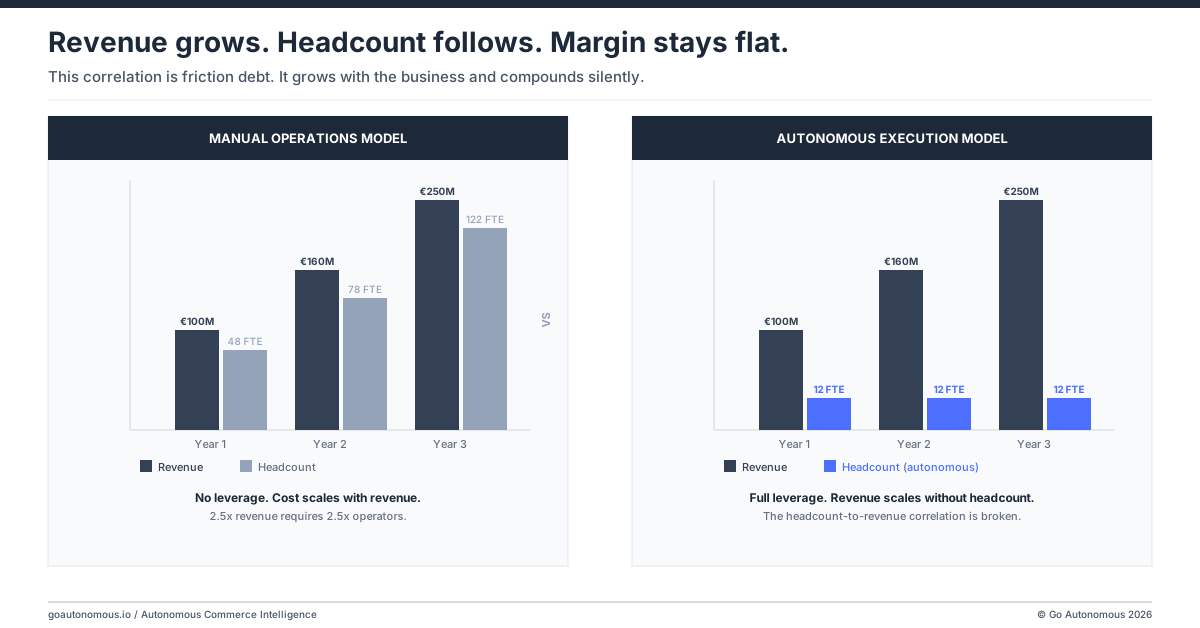
Distributors face a different friction debt profile. The volume of inbound orders, across EDI, email, portal, phone, and fax, creates a processing load that scales linearly with revenue. More customers means more orders means more operators. This is the most visible expression of friction debt: the business cannot grow revenue without growing headcount at nearly the same rate. The operational model has no leverage.
Within that volume, the complexity compounds. Orders arrive in formats that do not match internal systems. Customer part numbers need to be mapped to internal SKUs. Delivery instructions vary by account. Partial fulfilment logic differs by region. Each of these variations has been handled, at some point, by a human who created a workaround. Those workarounds are now load-bearing. Removing them requires understanding every downstream dependency, which no single person fully does. This is friction debt in its most entrenched form.
Each time we added one or two million euros in revenue, we had to add another operator. From a cost perspective, that's an unsustainable way of operating a business.

Pricing Execution Friction Across Industrial Channels
Pricing is a third major accumulation zone, particularly for manufacturers and distributors operating across multiple channels, geographies, and customer tiers. Pricing rules exist in ERP systems, in customer-specific agreements, in regional override tables, and in the heads of experienced account managers. Applying the correct price to a given order, accounting for volume tiers, contract terms, currency, and promotional conditions, frequently requires human judgment to reconcile conflicting data sources.
The result is pricing inconsistency, margin leakage, and delayed order confirmation while pricing queries are resolved. This is friction debt expressing itself as margin erosion. The problem is not that pricing rules are complex, complexity is a legitimate business requirement. The problem is that the execution of those rules depends on human intermediaries rather than a system that can apply them consistently, at speed, across every transaction. That gap is precisely where efficiency gains from autonomous execution become most material.
The Compound Cost of Friction Debt
Friction debt does not sit still. It compounds across three dimensions: direct operating cost, opportunity cost, and customer experience degradation.
- Direct operating cost: Headcount required to service friction, operators, inside sales, order desk staff, grows as revenue grows. The business has no leverage. Gross margin remains structurally constrained because people cost more as volume increases.
- Opportunity cost: Revenue that sits unconfirmed while quotes are assembled, orders are processed, or pricing queries are resolved is sometimes described as revenue at rest. It represents real commercial potential that friction is delaying or preventing. Deals lost to faster competitors, upsell opportunities not identified in time, contract renewals not flagged, these are the opportunity cost of friction debt.
- Customer experience degradation: B2B buyers have rising expectations shaped by their consumer purchasing experiences. A customer who can place a personal order in thirty seconds and track it in real time will notice when their business order takes two days to confirm. Customer experience in B2B commerce is increasingly a competitive differentiator, and friction debt erodes it systematically.
The compounding effect is what makes friction debt dangerous at scale. A business with modest friction debt at €100M in revenue may find that debt has become existential at €500M, not because the business grew poorly, but because the operating model was never rebuilt to match the new volume. Growth made the debt visible. It was always there.
External benchmarks support this. According to analyst research on B2B commerce operations, companies that rely predominantly on manual order processing spend between 40% and 60% of inside sales capacity on order management tasks rather than commercial activity. [SOURCE: Gartner B2B Buying Journey research]. That capacity displacement is friction debt consuming resources that should be generating revenue.
How to Pay Off Friction Debt: The Case for Autonomous Execution
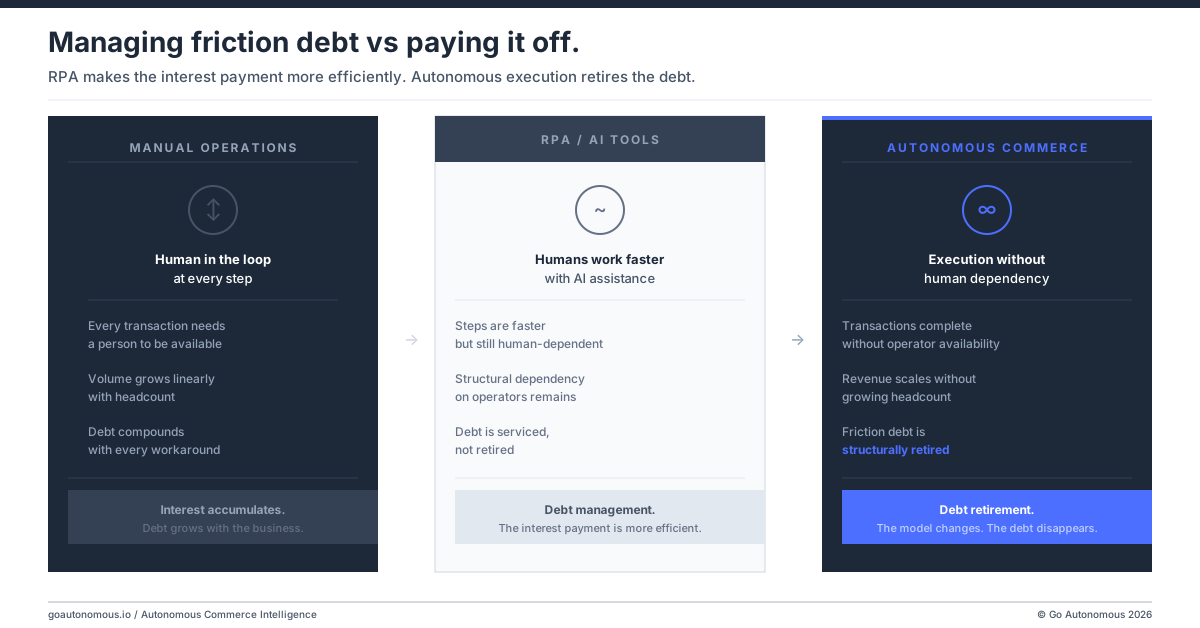
Paying off friction debt is not a process improvement exercise. Process improvement addresses individual friction points, it does not restructure the underlying execution model. Adding RPA to automate a specific manual step reduces one unit of friction. It does not address the structural dependency on human intermediaries that creates friction debt in the first place. This is why RPA falls short as a long-term strategy for B2B commercial operations: it services the debt without paying it down.
Paying off friction debt requires replacing the human-in-the-loop execution model with an AI-native one. That means building systems capable of reading any inbound format, applying business logic end-to-end, executing decisions within defined parameters, and only escalating genuine exceptions. It means execution that does not require a person to be available, informed, or consistent for a transaction to complete.
This is what Autonomous Commerce delivers in practice. Not a tool that assists operators. Not a copilot that suggests what to do next. An execution layer that completes commercial work, quote response, order intake, pricing application, exception routing, end-to-end, without human dependency at each step.
The payoff is measurable across the three dimensions of friction debt cost:
- Direct cost reduction: Operators previously absorbed in order processing are freed for exception handling, account development, and commercial conversations that genuinely require human judgment. A leading Nordic industrial manufacturer achieved this reallocation at scale within months of deployment, moving from reactive order processing to proactive commercial capacity. See customer success cases →
- Revenue velocity: Quotes that previously took hours are responded to in minutes. Orders that sat in queues are confirmed the same day. The business captures revenue that was previously lost to response lag, without adding headcount to achieve it.
- Customer experience repair: Consistent, fast, accurate order handling rebuilds confidence with customers who had learned to work around the friction, calling to chase order status, duplicating orders, switching suppliers for speed. Reliable execution becomes a retention mechanism, not just an efficiency gain.
A global B2B technology distributor operating across multiple European markets moved to near-full autonomous order execution within months of deployment. The friction debt that had required significant manual processing capacity was paid down not by hiring more operators, but by removing the structural dependency on manual processing entirely. See customer success cases →
The distinction between managing friction debt and paying it off is one of the clearest ways to explain why generic AI tools do not solve this problem. An AI assistant that helps an operator process orders faster is debt management, it makes the interest payment more efficiently. An autonomous execution platform that eliminates the operator dependency from routine commercial transactions is debt retirement. B2B manufacturers and distributors seeking to break the headcount-to-revenue correlation need the latter.
See Autonomous Commerce in Action at the 2026 Summit
The Autonomous Commerce Summit 2026 brings together operations and commercial leaders from B2B manufacturing and distribution who are actively transforming how revenue is executed. Hear directly from companies that have paid down their friction debt and moved to autonomous execution, and what that shift delivered for revenue, cost, and working capital. Attendance is by invitation only.
Request your invitation →
Frequently Asked Questions
Friction debt is the accumulated operational cost and growth constraint created by manual touchpoints, process workarounds, and system handoffs embedded in B2B commercial workflows. It compounds over time as processes are built on top of each other, making it increasingly expensive to service without structurally rearchitecting the execution model.
Operational inefficiency implies a process problem that can be fixed through retraining or workflow redesign. Friction debt is structural, embedded in the architecture of how revenue is executed. It cannot be resolved by improving individual steps; it requires replacing the human-in-the-loop execution model with autonomous execution end-to-end.
Manufacturers typically accumulate friction debt through the quote-to-order workflow: inbound RFQs arrive in non-standard formats, require manual interpretation and pricing, and depend on human availability to progress. Each exception process and workaround added over time increases the debt load. Complex product configurations, multi-tier pricing, and multi-channel order intake compound the accumulation.
Friction debt creates a direct correlation between revenue growth and headcount growth. Because revenue processing depends on human operators, more volume requires more people. This eliminates operational leverage, the business cannot grow margin without growing cost at nearly the same rate. Friction debt is the structural reason many B2B operations cannot scale efficiently.
No. RPA automates individual manual steps but does not remove the structural dependency on human intermediaries. It services friction debt by making existing processes faster, rather than paying it down by eliminating the need for those processes. AI-native autonomous execution platforms that handle end-to-end commercial workflows are required to structurally reduce friction debt.
In practice, paying off friction debt means replacing manual order intake, pricing application, and exception handling with an autonomous execution layer. Orders submitted via email, EDI, or portal are read, matched to internal systems, priced, and confirmed without operator intervention on routine transactions. Exceptions are escalated automatically. The result is consistent throughput regardless of volume, without linear headcount growth.
Autonomous Commerce is the execution model designed to pay off friction debt. Rather than assisting operators in completing commercial tasks, an Autonomous Commerce platform executes those tasks end-to-end, quote response, order intake, pricing, fulfilment handoff, removing the human dependency that creates and compounds friction debt. It is the structural solution, not a process improvement layer.