.svg)





Touchless Order Processing: Why B2B Manufacturers Plateau at 60% and How to Break Through
Touchless order processing rate is the single metric that reveals your actual automation ceiling in B2B manufacturing. This post explains why most manufacturers plateau between 30 and 60 percent, what 85 percent touchless actually requires operationally, and how to calculate exactly where you stand today.
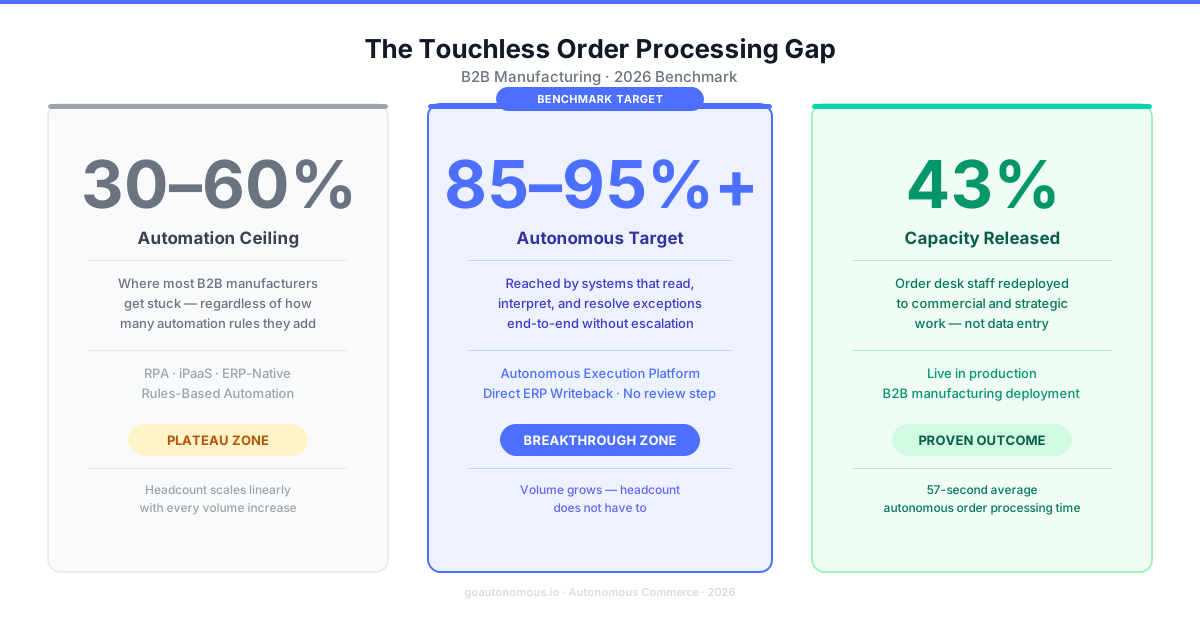
Touchless order processing rate is the single metric that separates order automation from autonomous order execution in B2B manufacturing. Most manufacturers running rules-based automation plateau somewhere between 30 and 60 percent touchless, and they stay there regardless of how many additional rules they write or how many workflow tools they layer on top of their ERP. The ceiling is structural, not incremental. Breaking through it requires a fundamentally different approach: autonomous execution that reads, interprets, and resolves orders end-to-end without a human in the loop. This post explains where the plateau comes from, what 85 percent touchless actually requires operationally, and how to calculate exactly where you stand today.
Table of Content
- What Touchless Order Processing Rate Measures in B2B Manufacturing
- Why Touchless Order Processing Stalls Between 30 and 60 Percent for Most Manufacturers
- What 85 Percent Touchless Order Processing Requires That Automation Cannot Provide
- Touchless Order Processing in Production: Results from B2B Manufacturers and Distributors
- How to Calculate Your Touchless Order Processing Rate and Cost Gap
- See Autonomous Commerce in Action at the 2026 Summit
- Frequently Asked Questions
What Touchless Order Processing Rate Measures in B2B Manufacturing
What Is Touchless Order Processing and How Is It Defined?
Touchless order processing is the percentage of incoming orders that move from receipt to ERP entry without any human intervention. An order is touchless when it is received, validated, priced, and written back to your ERP system, SAP S/4HANA, Oracle Cloud SCM, or Microsoft Dynamics 365, without a person reviewing, correcting, or approving it at any point in that journey. The touchless order processing rate is calculated by dividing the number of fully automated orders by total orders received in the same period, expressed as a percentage.
Why Touchless Rate Is the Only Metric That Reveals Your Actual Automation Ceiling
Most VP Operations and Order Management Directors track order processing time, cost per order, and error rates. Those are useful metrics, but none of them tell you how close you are to eliminating manual order handling. Touchless order processing rate tells you exactly that. It answers the only question that matters for long-term operations: what proportion of your order volume runs without labor?
Consider what happens when you cut average handling time from 12 minutes to 8 minutes. You have reduced cost per order, but you have not changed the fundamental structure of your order desk. Every order still requires someone. Headcount scales linearly with volume. By contrast, when you move from 55 percent touchless to 85 percent touchless, you have removed 30 percent of all orders from the human queue entirely. Volume increases do not generate proportional cost increases. The economics of the operation change permanently.
This is why touchless rate is the metric that Chief Supply Chain Officers and CFOs should use to evaluate any order management investment. It converts the conversation from “how fast is each order?” to “how many orders require no one?” That is the right question for 2026 and beyond.
What Counts as a Touchless Order, and What Disqualifies It
A touchless order meets a specific operational definition: it travels from intake channel through validation, pricing resolution, and ERP writeback without any human action. That means no order desk review, no manual pricing lookup, no exception escalation, and no approval queue before the order is confirmed to the buyer. The order arrives, the system processes it, the buyer receives confirmation. No one touched it.
What disqualifies an order from being counted as touchless? Any of the following: a person forwarded the email to the order entry system, someone corrected a product code that failed to match, a pricing exception required manual approval, or the ERP entry was held for human review before posting. Even a single human action at any stage disqualifies the order. This is the definition that makes the metric meaningful. Relaxing it produces an inflated number that does not reflect operational reality.
It is also worth distinguishing touchless from straight-through processing (STP), a term more common in financial services. In B2B manufacturing, the concepts overlap but touchless order processing typically encompasses a broader intake landscape: EDI 850/855 transactions, EDIFACT messages, email purchase orders, OCI punchout, blanket PO call-offs, and ANSI X12 formats. A fully touchless rate must account for all of those channels, not just structured EDI.
Why Touchless Order Processing Stalls Between 30 and 60 Percent for Most Manufacturers
What Causes the Touchless Order Processing Plateau Below 60 Percent?
The plateau below 60 percent is not a technology problem. It is a structural problem caused by the rules-based architecture that most order automation systems are built on. Rules-based systems process orders that match their rule set perfectly. When an order deviates, a non-standard product description, an unrecognized customer identifier, a pricing exception, a partial availability scenario, the rule fails and the order escalates to a human. The rule failure rate determines the touchless ceiling.
In practice, B2B manufacturers deal with significant order variability. Buyers submit purchase orders in inconsistent formats. Product descriptions are abbreviated differently by different buyers, or reference internal codes that do not map cleanly to the manufacturer’s catalog. Customer-specific pricing agreements create exceptions the standard price list cannot resolve. Partial availability scenarios require judgment calls about splitting shipments or substituting SKUs. Every one of these scenarios is a rule failure. And in most manufacturing environments, enough of them occur to prevent the touchless rate from climbing past 55 to 60 percent no matter how many rules are written.
The structural problem also shows up in how headcount scales. When order volume grows, the order desk grows with it, because the exception rate stays constant even as volume increases. Manual processing burden is not a fixed cost that gets amortized over more orders. It tracks volume almost linearly.
Each time we added one or two million euros in revenue, we had to add another operator. From a cost perspective, that's an unsustainable way of operating a business.

The Four Failure Modes That Prevent B2B Manufacturers from Reaching 85 Percent Touchless
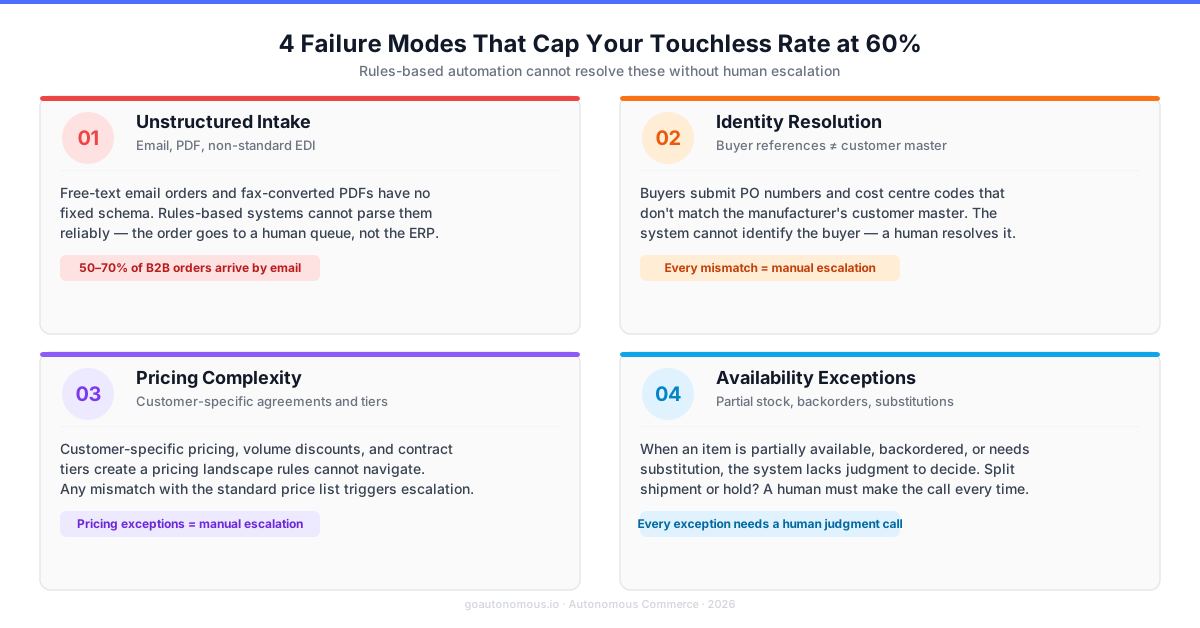
When VP Operations teams investigate why their touchless rate is stuck, they consistently find the same four failure modes regardless of which automation platform they are running.
- Unstructured intake. Email orders, fax-converted PDFs, and portal submissions that do not conform to EDI standards cannot be parsed reliably by rules-based systems. The order goes to the queue instead of the ERP.
- Identity resolution. Buyers submit orders using their own internal references, a PO number, a cost center code, a ship-to location, that do not match the manufacturer’s customer master. The system cannot identify the customer definitively, so a human resolves it.
- Pricing complexity. Customer-specific pricing agreements, volume discounts, contract pricing tiers, and promotional pricing create a landscape that rules cannot navigate reliably. When a line item’s price does not match the default price list, the order escalates.
- Availability and fulfillment exceptions. When a requested item is partially available, backordered, or requires a substitution, the system lacks the judgment to resolve the scenario autonomously. The order escalates for a human to decide.
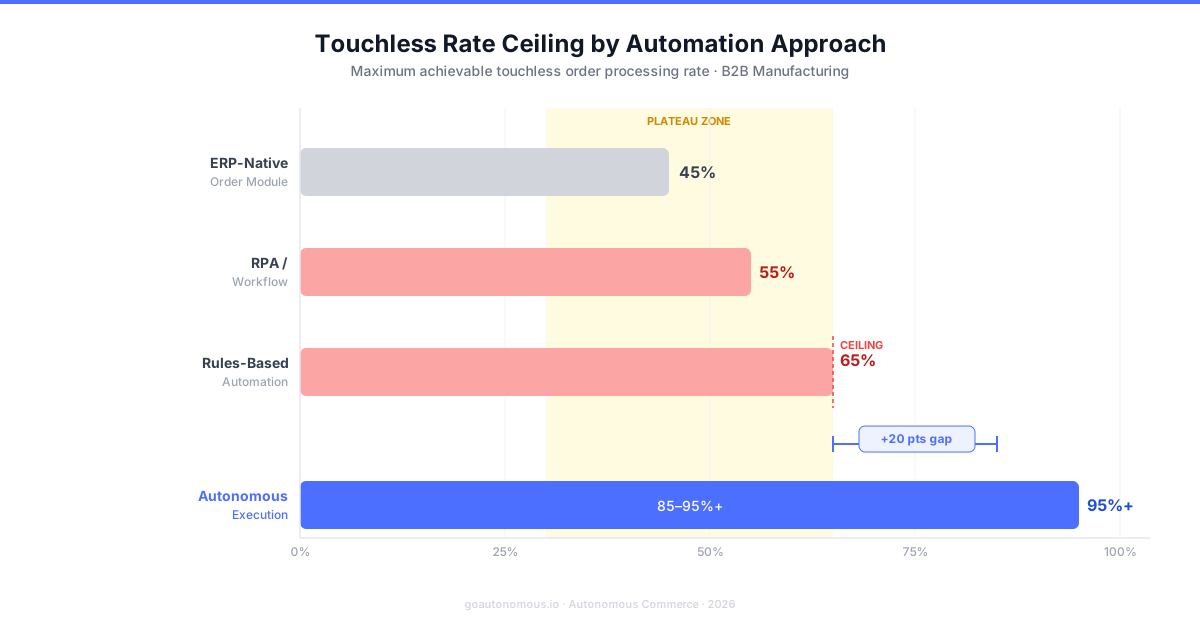
Together, these four failure modes account for the gap between where automation peaks, typically 30 to 65 percent, and where the business needs to be. Each failure mode requires judgment, not rule-matching. Judgment is precisely what rules-based systems cannot provide.
Why Adding More Order Automation Rules Does Not Raise the Touchless Rate
The instinctive response to a stuck touchless rate is to write more rules. If the system is failing on non-standard product descriptions, add rules for common abbreviations. If pricing exceptions are causing escalations, add rules for the most frequent pricing scenarios. This approach works up to a point, and then it stops working entirely.
The reason is combinatorial. Each new rule covers a known exception pattern. But B2B order variability is not a fixed set of known patterns. New buyers join with new conventions. Existing buyers change their internal systems and start submitting orders differently. Seasonal demand shifts create new catalog matching challenges. The exception space keeps expanding. Every rule that gets written is already behind the current exception set.
Furthermore, rules interact. A rule written to handle one exception can conflict with a rule written to handle another. The rules library becomes a liability as it grows. Order management teams spend time debugging rule conflicts rather than processing orders. Meanwhile, the touchless rate stays flat or drifts downward as the exception space outpaces the rules library. This is why organizations running iPaaS platforms, ERP native order modules, or RPA workflows for order processing find themselves on a treadmill: more investment, no movement in the touchless rate.
What 85 Percent Touchless Order Processing Requires That Automation Cannot Provide
How Autonomous Order Execution Achieves 85%+ Touchless Where Automation Stalls
Reaching 85 percent touchless and sustaining it requires a system that handles the four failure modes above without human escalation. That means the system must do things that rules-based automation fundamentally cannot do. Specifically, an autonomous commerce platform built for order execution must be capable of the following:
- Read and interpret free-text email orders with no fixed format
- Identify customers from PO references, not just EDI sender IDs
- Match line items to the product catalog with partial or ambiguous descriptions
- Resolve pricing from customer-specific agreements, not just the standard price list
- Handle partial availability by splitting orders or querying customer preference autonomously
- Write directly to SAP S/4HANA, Oracle Cloud SCM, or Microsoft Dynamics 365 without a human review step
Each of these capabilities requires interpretation and contextual judgment, not pattern matching. Free-text email orders have no schema. Customer identity from a PO reference requires resolving against a customer master using partial information. Product matching with ambiguous descriptions requires understanding what the buyer probably meant, not finding an exact string match. Pricing from customer agreements requires knowing which agreement applies to which buyer in which scenario. None of this is achievable with rules. It requires autonomous execution, a system that reasons about the order, resolves ambiguity, and acts end-to-end without asking for human input.
How Autonomous Execution Compares to RPA, Workflow Automation, and Rules-Based Order Management
Order Management Directors evaluating options for improving their touchless rate typically consider four categories of solution. Understanding how each category handles the four failure modes determines the ceiling they can reach.
RPA automates specific, repetitive UI interactions. It can copy data between systems and trigger workflows, but it cannot read an unstructured email, resolve an ambiguous product description, or make a pricing judgment. RPA raises touchless rates by automating the structured, repetitive portion of order processing. The exception-heavy portion remains manual. This is why RPA implementations commonly plateau in the same 30 to 55 percent range as rules-based systems.
iPaaS and workflow automation platforms connect systems and route data. They are valuable for integration but they are not execution systems. They move orders from one place to another; they do not process the order content itself. Exception handling still requires a human at the end of the workflow.
ERP native order modules, SAP S/4HANA order management, Oracle Cloud SCM order orchestration, Dynamics 365 Commerce, are designed for structured order entry. They handle clean, formatted orders well. They escalate exceptions to order desk staff. They do not autonomously resolve the four failure modes outlined above.
Autonomous order execution is architecturally different. It reads and interprets order content, resolves exceptions using context and customer data, and writes the completed order directly to the ERP without a review step. The comparison below illustrates the difference at each stage of order processing.
Automation vs. Autonomous Execution: A Direct Comparison by Order Processing Stage
| Order processing stage | Rules-based order automation | Autonomous order execution |
|---|---|---|
| Email order intake | Manual or unstructured, requires human parsing | Read, parsed, and validated automatically |
| Non-standard EDI formats | Rule-failed, escalated to order desk | Interpreted from context, no escalation |
| Customer-specific pricing | Manual lookup against contract | Resolved from pricing master automatically |
| Exception handling | Escalated to order desk | Resolved autonomously without human step |
| ERP writeback | Human review required before entry | Direct writeback, no review |
| Order confirmation to buyer | Manual | Autonomous confirmation sent |
| Touchless rate ceiling | 30–65% | 85–95%+ |
Touchless Order Processing in Production: Results from B2B Manufacturers and Distributors
What Near-Full Autonomous Order Processing Looks Like Operationally
When a manufacturer crosses 85 percent touchless, the operational structure of the order desk changes fundamentally. The team that previously processed hundreds of orders per day is now reviewing a fraction of that volume, the genuinely complex cases that require human judgment, customer relationship context, or escalation to the commercial team. Everything else runs without them.
This creates a structural shift in how order management headcount is deployed. Staff that previously spent the majority of their time on data entry, pricing lookups, and exception routing can focus on order quality, customer communication on complex accounts, and the commercial interactions that actually require human judgment. The order desk becomes a strategic function rather than a processing function.
The downstream effects are equally significant. When orders enter the ERP faster and without the queuing delays that come from manual processing, working capital improves. Invoicing cycles shorten. Order-to-cash timelines compress. Error rates from manual data entry fall because there is no manual data entry in the touchless orders. The operational efficiency gains extend well beyond the order desk itself.
How B2B Manufacturers Moved from Fragmented Automation to 85%+ Touchless
The manufacturers running autonomous order execution in production today did not start there. Most began with a combination of EDI, ERP-native order processing, and manual handling for email and exception orders. Their touchless rates reflected that mix: structured EDI orders processed automatically, everything else handled by people.
The shift to 85 percent touchless came from replacing the manual and rules-based layers with autonomous execution, not layering another tool on top. Manufacturers running this in production today report that the autonomous execution layer handles the order types that previously drove exception queues: free-text email orders, partially matching EDI, blanket PO call-offs, and customer-specific pricing scenarios.
One leading Nordic manufacturer processed 28 percent of all orders fully autonomously from day one of go-live, a result that no rules-based system had achieved in the same environment. A global industrial manufacturer that previously relied on a large order desk for manual processing released significant capacity as autonomous execution absorbed the volume. Another manufacturer moved from fragmented automation to processing the vast majority of orders without human intervention, in a deployment that took weeks, not months. See customer success cases →
How to Calculate Your Touchless Order Processing Rate and Cost Gap
The Three-Step Calculation for Your Current Touchless Rate
Calculating your current touchless order processing rate takes three steps. Most manufacturers can complete this exercise using one month of order data from their ERP and their order management system logs.
- Count total orders received last month across all channels: EDI, email, portal, phone, fax, and any other intake point.
- Count orders that moved from receipt to ERP entry without any human touch, no intervention, no review, no correction.
- Divide step 2 by step 1 and multiply by 100. That is your touchless order processing rate.
The calculation is straightforward. The challenge is in the data. Most ERP systems do not natively log whether a human intervened in an order’s processing journey. You may need to cross-reference order management system logs, exception queue records, and manual entry timestamps to identify orders where a person acted. If that data is not available, start with the exception queue, orders that went through the queue are not touchless, and the queue volume gives you a conservative lower bound for your non-touchless count.
Once you have your current rate, you have the baseline. The next step is to understand what closing the gap to 85 percent is worth.
What Every 10 Percentage Point Improvement in Touchless Rate Is Worth Operationally
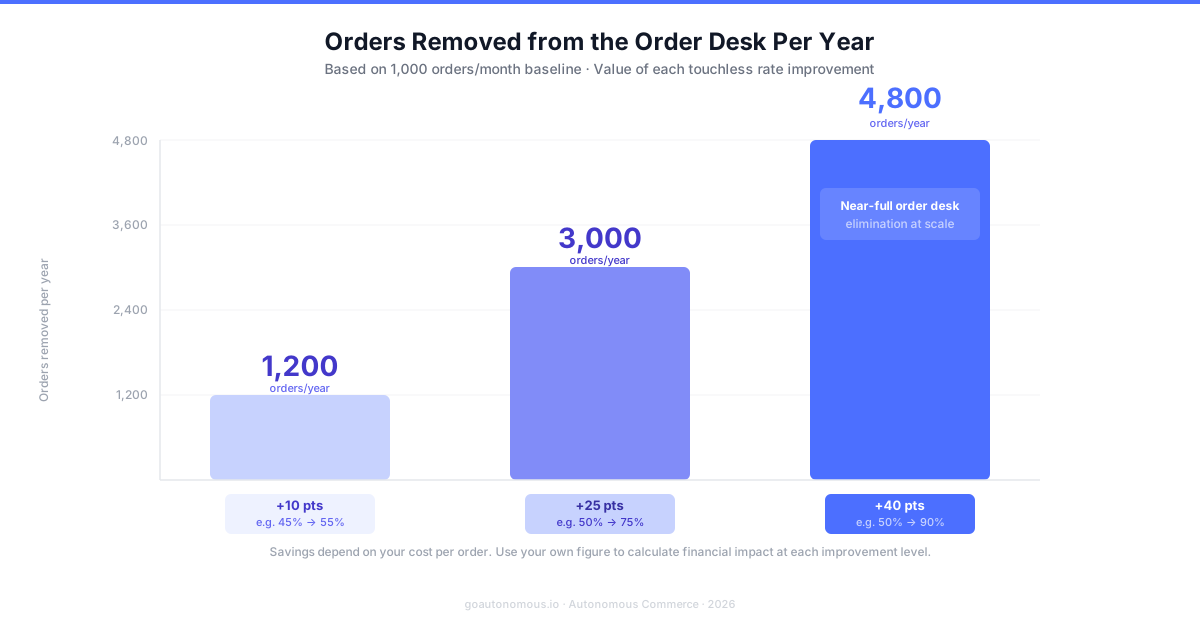
The table below translates touchless rate improvements into operational terms for a manufacturer processing 1,000 orders per month. The exact financial value depends on your cost per order and your operational efficiency baseline.
| Touchless rate improvement | Orders removed from order desk per year (1,000/month baseline) | Operational impact |
|---|---|---|
| +10% (e.g. 45% → 55%) | 1,200 orders | Reduce order desk load by 10% |
| +25% (e.g. 50% → 75%) | 3,000 orders | Potential for 2–3 FTE reduction |
| +40% (e.g. 50% → 90%) | 4,800 orders | Near-full order desk elimination at scale |
Note: savings depend on your cost per order. Use your own figure to calculate the financial impact at each improvement level.
The Hidden Costs Beyond Labor: Working Capital and Downstream Error Rates in B2B Manufacturing
Labor cost is the most visible component of the manual order processing cost. For most manufacturers, the hidden costs are comparable in size or larger. Working capital is the most significant one.
Every hour an order spends in a manual processing queue is an hour that the ERP has not captured the sale. Invoicing cannot start until the order is in the system. For manufacturers on net-30 or net-60 payment terms, a one-day delay in order entry translates directly into a one-day delay in cash receipt. At scale, across thousands of orders per month, that delay creates a persistent working capital drag. Manufacturers running autonomous execution report measurable working capital improvement within weeks of go-live, as order entry delays compress from hours to minutes across the entire order volume.
Error rates are the second hidden cost. Manual data entry generates errors at a rate rules-based systems cannot fully eliminate because some manual entry survives at the exception level. Each error generates a downstream cost: a credit memo, a re-shipment, a customer service interaction, or a dispute that delays payment. When orders are entered autonomously, the manual entry error source disappears entirely for touchless orders. The downstream improvement in order accuracy directly affects customer experience, fewer order errors means fewer service escalations.
For a full view of the financial case including working capital impact and CFO-level ROI framing, see The CFO’s AI Mandate white paper. For the complete picture of what autonomous execution looks like across the full revenue and margin impact, see the full platform overview.
See Autonomous Commerce in Action at the 2026 Summit
The Autonomous Commerce Summit 2026 brings together operations and commercial leaders from B2B manufacturing and distribution who are actively measuring and improving their touchless order processing rate. Hear directly from companies that have made the shift to autonomous execution, and what it means for touchless rate, working capital, and headcount. Attendance is by invitation only.
Request your invitation →
Frequently Asked Questions
A touchless order processing rate above 85 percent is the benchmark for manufacturers running autonomous order execution. Most B2B manufacturers using rules-based automation plateau between 30 and 65 percent. Reaching and sustaining 85 percent or higher requires autonomous execution that can handle unstructured email orders, non-standard EDI, customer-specific pricing, and availability exceptions without human intervention.
Touchless order processing is the percentage of incoming orders that travel from receipt to ERP entry without any human intervention, no review, correction, approval, or manual data entry at any stage. It is measured by dividing the number of orders processed without human touch by total orders received in the same period, then multiplying by 100.
Order automation uses rules and structured workflows to process orders that match predefined patterns. When an order deviates, it escalates to a human. Touchless order processing at 85 percent or higher requires autonomous execution, a system that interprets unstructured orders, resolves exceptions, and writes to the ERP without escalating. Automation plateaus; autonomous execution continues to resolve.
The plateau is caused by four failure modes in rules-based automation: unstructured intake (email and non-EDI orders), identity resolution failures, pricing complexity from customer-specific agreements, and availability exceptions requiring judgment. These require interpretation, not rule-matching, which is why rules-based systems cannot resolve them, and writing more rules does not move the ceiling.
Yes. Autonomous order execution connects to SAP S/4HANA, Oracle Cloud SCM, and Microsoft Dynamics 365 through standard APIs and certified connectors. The system reads from existing customer master, catalog, and pricing data in the ERP and writes completed orders back in standard format. ERP replacement is not required. Implementation typically takes four to eight weeks in standard ERP environments.
Manufacturers deploying autonomous order execution typically see touchless rate improvement from day one of go-live. Significant rate improvement is typically visible within the first 30 to 60 days. The pace depends on order volume, ERP environment, and the proportion of orders coming through unstructured channels.
The hardest order types to make touchless are free-text email orders with no fixed format, orders with ambiguous product descriptions, orders from customers using internal references not mapped to the customer master, orders requiring customer-specific pricing resolution, and orders with partial availability requiring a fulfillment judgment. These are the order types that rules-based automation cannot handle without escalation, and the primary reason most touchless rates plateau below 60 percent.