.svg)





Manufacturing Order Automation in 2026: Why 60% Touchless Is the Ceiling and What Breaks Through It
Most manufacturers have implemented some form of order automation — yet the order desk is still busy. This post explains why standard order automation plateaus below 60% touchless and what it takes to break through to autonomous order execution.
Most manufacturers in 2026 have automated parts of their order process. They handle EDI 850 feeds, route standard portal orders, and run rules-based checks on SAP S/4HANA or Oracle Cloud SCM. Yet the order desk is still busy. Exception queues fill up every morning. Order management directors still review POs before ERP entry. This post explains exactly why standard manufacturing order automation plateaus below 60% touchless and what it takes to break through to 85%+.
Table of Content
- The Manufacturing Order Automation Problem That Still Runs Through Your Order Desk
- Why Automated Order Processing For Manufacturers Plateaus Below 60 Percent
- Automated Order Management Vs Autonomous Order Execution: The Architectural Difference
- How Enterprise Manufacturers Broke Through The Manufacturing Order Automation Ceiling
- Five Questions To Find Your Manufacturing Order Automation Ceiling
- How To Move From Manufacturing Order Automation To Autonomous Order Execution
- See Autonomous Order Execution In Production At The 2026 Summit
- Frequently Asked Questions: Manufacturing Order Automation
The Manufacturing Order Automation Problem That Still Runs Through Your Order Desk
What Is Manufacturing Order Automation In B2B Operations?
Manufacturing order automation is the use of software to receive, validate, and process inbound B2B purchase orders without manual intervention. In practice, it covers EDI ingestion, rules-based validation against price lists and inventory, ERP writeback, and order confirmation. Fully automated orders require no human touch from receipt to confirmation.
That definition sounds complete. In practice, it describes only the orders that already conform to your system’s expectations structured EDI 850 or EDIFACT messages, standard catalog items, and customers on a flat price list. For everything else, the definition quietly breaks down.
VP Operations and Chief Supply Chain Officers at mid-market and enterprise manufacturers often report the same gap. Their automation handles a reliable share of order volume. However, the remaining share emails, PDF attachments, blanket PO call-offs, and orders with custom pricing still flows through the order desk at full manual cost.
Why The Order Desk Is Still Busy After You Automated
The answer is not a lack of investment. Most manufacturers running SAP S/4HANA or Microsoft Dynamics 365 have spent meaningfully on order automation. The problem is architectural. Standard automation tools process orders that match their rules. They escalate everything else. As a result, the order desk does not disappear it becomes an exception-handling unit that processes exactly the orders automation cannot touch.
In most manufacturing environments, those exceptions are not edge cases. They represent 30 to 50 percent of order volume. Customers send orders in the format that works for them not the format your EDI gateway expects. That gap between automation capability and order reality is where cost, error rate, and response time accumulate.
Consequently, headcount on the order desk does not reduce proportionally to automation investment. The team shifts from processing all orders to processing the hard ones. The cost per exception rises because easier orders no longer subsidize the complex work. Order Management Directors feel this in their operational efficiency metrics and in their team’s daily workload.
Why Automated Order Processing For Manufacturers Plateaus Below 60 Percent
What Causes Order Automation To Stall Below 60% Touchless?
Order automation stalls below 60% touchless because rules-based systems can only process orders that match pre-defined patterns. Any order that arrives in an unexpected format, carries non-standard pricing, references a blanket PO, or includes free-text line items falls outside the rule set and escalates to a human. The stall point is not a technology failure it is the structural boundary of rules-based processing.
Operational data from B2B manufacturing deployments shows consistently that format diversity and pricing complexity are the two primary reasons touchless rates plateau. In practice, manufacturers who extend rules-based automation beyond their initial deployment see diminishing returns as rule sets grow more complex and more brittle.
In practice, the 60% ceiling is often lower. Many manufacturers report 40 to 55% touchless on a good week, with that figure dropping when customers send quarter-end rush orders in non-standard formats. The variability itself signals that the system is processing only the predictable portion of order flow.
The Four Failure Modes That Create The Plateau
Four specific failure modes combine to produce the automation ceiling. Understanding each one makes the solution path clear.
- Format diversity: EDI 850 and EDIFACT flows are automated; email orders and PDF attachments are still manual. One unhandled format creates a ceiling that caps touchless rate regardless of how well the rest of the system performs.
- Pricing complexity: Standard price list lookups work for catalog items. Customer-specific pricing agreements, volume tier calculations, and contract rate cards require judgment that rules cannot reliably apply without human review.
- Exception escalation: Any order that does not match a rule routes to the order desk. Exception volume scales directly with order volume. As the business grows, the exception queue grows with it eliminating the productivity gain that automation was supposed to deliver.
- ERP writeback gap: Automation triggers the order and validates fields, but a human still reviews before final ERP entry. That review step is often the single largest time sink in the order process and it sits entirely outside the automated path.
These four modes interact. A pricing exception triggers escalation. The escalation review delays ERP writeback. The delay extends order confirmation time. Each step compounds the cost of the original format or pricing mismatch.
Why Adding More Automation Rules Makes The Problem Worse
The intuitive response to an automation ceiling is to write more rules. If the system cannot handle a specific customer’s order format, add a parser for that format. If a pricing tier creates exceptions, add a rule for that tier. In theory, enough rules should cover enough cases to push the touchless rate higher.
In practice, rule proliferation creates three new problems. First, rules are brittle a customer who changes their PO format invalidates a rule set built specifically for their format. Second, rules are slow to update the IT or operations team that maintains rule sets cannot keep pace with the rate at which customers change ordering behavior. Third, rules conflict as rule sets grow, edge cases produce contradictory outcomes that require human resolution.
The pattern is consistent across manufacturing operations: organizations that pursue rules-based order automation beyond the initial deployment often see total cost of ownership rise faster than touchless rate improvements. The maintenance overhead of a large rule set eventually exceeds the labor cost the automation was meant to eliminate.
Therefore, the ceiling is not a configuration problem. It is a fundamental constraint of the rules-based architecture underlying standard automated order processing tools.
Automated Order Management Vs Autonomous Order Execution: The Architectural Difference
How Does Autonomous Order Execution Differ From Order Automation Tools?
Autonomous order execution replaces the rules layer with AI reasoning that reads order context format, pricing, history, customer contract and resolves orders end-to-end without escalation. Instead of matching an order against a rule set, the system interprets the order the way an experienced order manager would: understanding intent, applying contract terms, resolving ambiguity, and writing directly to the ERP. The result is a touchless rate that can reach 85 to 95% across all order formats and customer types.
The architectural difference matters because it changes which orders the system can handle. Rules-based automation handles the orders that fit the rules. Autonomous order execution handles the full order intake email, EDI 850/855, EDIFACT, cXML, PDF, fax, and free-text without requiring each format to have its own parsing rule. The system reads the order and understands it. That shift in capability is what breaks through the 60% ceiling. Autonomous Commerce is not an automation.
For Order Management Directors and Chief Supply Chain Officers evaluating options, the operational implication is significant. Autonomous execution does not require a parallel manual process for exceptions. It resolves exceptions autonomously. The order desk can redirect to higher-value work rather than managing a permanent exception queue.
How Autonomous Execution Compares To RPA, Workflow Tools, And Rules-based Order Management
RPA, iPaaS connectors, and workflow automation tools all represent meaningful investments for manufacturers trying to reduce order desk labor. However, each operates within the same fundamental constraint as rules-based order management: they execute defined steps on defined inputs. How autonomous execution differs from RPA is not a matter of speed or integration capability it is a matter of what happens when an order does not match the expected pattern.
RPA bots process order fields in structured formats. When a PDF arrives with a non-standard layout or a customer sends a free-text order via email, the bot either fails or flags for human review. Workflow tools route orders through defined approval chains. They do not resolve the underlying ambiguity that caused the routing. iPaaS connectors translate between formats but translation requires a known source format and a known target format. Unmapped formats still go to the order desk.
Autonomous order execution resolves the ambiguity itself. It reads the intent of the order, applies pricing master and contract rules from the ERP, confirms the output, and writes back directly. No human step intervenes. That capability is what separates autonomous execution from the full category of automation tools including RPA, iPaaS, and workflow automation that preceded it.
Automation Vs Autonomous Execution: A Direct Comparison
| Dimension | Order automation tools | Autonomous order execution |
|---|---|---|
| Logic layer | Rules and scripts | AI reasoning across full order context |
| Exception handling | Escalated to order desk | Resolved autonomously |
| Order intake | Structured EDI and portal formats | Email, EDI, portal, PDF, fax, free-text |
| Pricing resolution | Standard price list lookup | Dynamic pricing master and contract rules |
| ERP writeback | Human review before entry | Direct writeback, no review step |
| Exception learning | Requires manual rule updates | Adapts from order history patterns |
| Touchless ceiling | 40–65% | 85–95%+ |
This is the category Go Autonomous built from the ground up: Autonomous Commerce. Not a more advanced automation tool. Not an AI layer added on top of your existing order management software. A purpose-built execution platform that reads, interprets, and resolves B2B orders end-to-end without human intervention, across every order format, pricing structure, and ERP environment your business operates. The distinction from every other AI product in this space is simple: this system does not assist your order team. It executes. Go Autonomous created the Autonomous Commerce category specifically for manufacturers and distributors at this scale, where order complexity, pricing structure, and multi-channel intake make rules-based automation structurally inadequate. Read more in the Welcome to the Era of Autonomous Commerce white paper.
How Enterprise Manufacturers Broke Through The Manufacturing Order Automation Ceiling
What A 85 Percent Touchless Rate Looks Like In Production
An 85% touchless rate does not mean the system handles only the easy orders. It means the system handles the vast majority of real-world order complexity without human intervention. In production, this includes customers who send quarterly blanket PO call-offs via email, orders that reference contract pricing not published in a standard price list, and POs that arrive as scanned PDF attachments with handwritten line items.
At that touchless rate, the order desk still exists but it processes a fundamentally different type of work. The 10 to 15% of orders that require human judgment are genuinely complex: new customer onboarding, contractual disputes, or orders with strategic pricing decisions attached. The team that previously processed hundreds of routine orders per day now focuses on relationship management and commercial decisions. That is a different value proposition from the same headcount.
Moreover, 85%+ touchless means order confirmation velocity changes. Orders that previously waited in an exception queue for hours or days confirm in under a minute. Customers notice. In markets where order responsiveness is a competitive differentiator industrial distribution, spare parts, and high-volume B2B commerce that speed advantage compounds over time.
Results From Manufacturers Running Autonomous Order Execution Today
The results below come from manufacturers operating autonomous order execution in production. All references are anonymized in line with customer confidentiality requirements. Full details are available through Go Autonomous customer success cases.
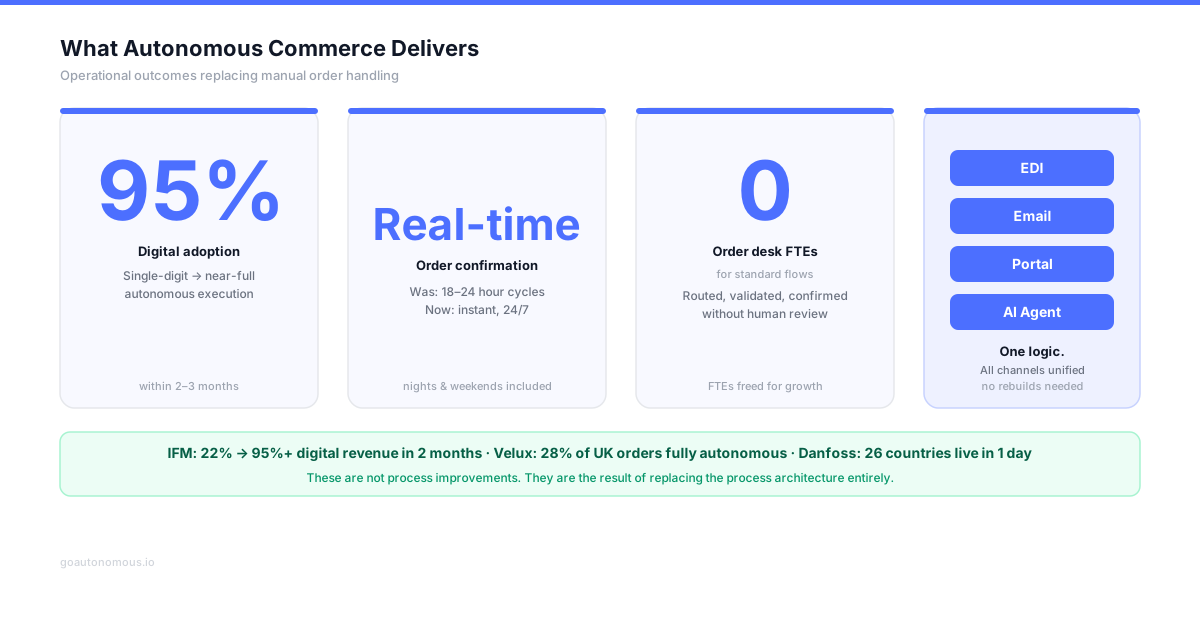
A global industrial manufacturer operating across 26 countries deployed autonomous order execution across its full order intake in a single day. The system processed inbound orders in under one minute from receipt to ERP confirmation. That deployment timeline one day across 26 countries reflects the fact that autonomous execution layers on top of existing ERP infrastructure rather than replacing it.
Each time we added one or two million euros in revenue, we had to add another operator. From a cost perspective, that’s an unsustainable way of operating a business.

A leading Nordic manufacturer that was struggling with working capital locked in manual order processing freed significant working capital and released 40 full-time equivalents from manual order processing. The reduction came not from layoffs but from redeployment the team moved to customer-facing commercial roles where they generated measurable revenue impact.
A third manufacturer moved from 22% digital revenue share to above 95% in under two months. That shift did not require a new sales channel or a customer migration project. Autonomous order execution made the existing digital channel capable of handling the full order complexity those customers brought and customers adopted it because it worked.
What This Means For Operational Efficiency
These results share a structural pattern. In each case, the manufacturer did not replace its ERP. It did not rebuild its order intake process from scratch. It added an autonomous execution layer that reads all order formats, resolves pricing and exceptions, and writes to the existing ERP directly. The result is a dramatic improvement in operational efficiency and cost per order without the risk of a full system replacement.
That pattern matters for VP Operations and Chief Supply Chain Officers evaluating options. The deployment risk of autonomous execution is structurally lower than the deployment risk of replacing an ERP or rebuilding an order management system. The execution layer connects to what already exists. It extends capability rather than replacing infrastructure.
Five Questions To Find Your Manufacturing Order Automation Ceiling
Before evaluating solutions, it helps to quantify exactly where your ceiling sits and what it costs. These five diagnostic questions produce the data points you need to have a grounded internal conversation and to make a compelling business case for moving beyond rules-based automation.
How Do You Calculate Your Current Touchless Order Processing Rate?
Your touchless order processing rate is the percentage of inbound orders that move from receipt to confirmed ERP entry without any human intervention. To calculate it: divide the number of orders processed without human touch in a given period by total inbound orders in the same period, then multiply by 100. Any order that a team member opens, edits, re-routes, or manually validates counts as a non-touchless order, regardless of how brief the intervention was.
Most manufacturers find this number lower than expected when they measure it precisely. An order that requires a team member to open it and click approve even in five seconds is a non-touchless order. That definition tightens the real touchless rate and often reveals that the automation ceiling is lower than the system dashboard suggests.
The Five Diagnostic Questions
- What percentage of your inbound orders require human intervention before ERP entry? If this number is above 30%, you are above the ceiling for rules-based automation.
- How many order formats do you accept and which ones are still processed manually? A single unautomated format can cap your overall touchless rate regardless of how well other formats perform.
- What is your current cost per order, and how does it change with order complexity? If complex orders cost significantly more than simple ones, your exception escalation path is your largest single cost driver.
- When a customer sends a non-standard PO, what happens in the first 60 seconds? If the answer is “someone on the team opens it,” your exception process has no automation at the point of highest impact.
- If your order volume doubled tomorrow, would your order desk need to double too? If the answer is yes, your order processing cost scales linearly with volume which eliminates the unit economics of growth.
What The Answers Tell You About Your Ceiling
These five questions surface the specific constraints that define your current ceiling. Question one quantifies the gap. Question two identifies the format that creates it. Question three prices the gap in commercial terms. Question four locates the exact moment where autonomous resolution would eliminate the cost. Question five translates the ceiling into a growth constraint which is typically the framing that moves the conversation from operations to the executive team.
Agentic Commerce changes where customers ask for things. Autonomous Commerce changes how companies deliver them. One is a new way to place orders. The other is a new way to move revenue.
For Order Management Directors, this diagnostic provides the internal business case. For VP Operations, it quantifies the cost of staying at the current ceiling versus investing in autonomous execution. For Chief Supply Chain Officers, it reframes order automation from a process efficiency initiative to a growth scalability question. Specifically, it asks: can you grow order volume without growing order desk headcount?
How To Move From Manufacturing Order Automation To Autonomous Order Execution
Moving from rules-based automated order processing to autonomous order execution does not require replacing your ERP or rebuilding your order management system. The transition follows three phases that layer capability on top of existing infrastructure. Each phase delivers measurable improvement before the next begins.
Phase 1: Consolidate Order Intake Across All Channels
The first step is mapping every channel and format through which inbound orders arrive. For most manufacturers, this produces a longer list than expected. EDI 850 and EDIFACT from large accounts. Email orders from mid-market customers. Portal submissions from customers using your B2B e-commerce front end. PDF attachments from field sales and distributors. Fax orders from legacy accounts. Free-text messages from customers who treat email like a conversation rather than a structured transaction.
Each of these channels carries order intent. Standard automation handles the ones that match its parsers. Autonomous execution reads all of them through the same intake layer. Phase 1 connects every format and channel to that unified intake point. The goal at this phase is full order visibility every order in the system, regardless of format, without exception.
In practice, this phase often reveals order volume that was previously invisible to the automation system. Email orders that team members handled entirely outside the order management platform. Fax-to-PDF conversions that bypassed the EDI gateway. Those hidden orders, once connected, immediately improve the measurable touchless rate because they move from entirely manual to at least partially automated.
Phase 2: Remove The Exception Escalation Path
The exception escalation path is the mechanism that sends unresolved orders to the order desk. In rules-based systems, it is the default response to any order that does not match a rule. Removing it does not mean ignoring exceptions it means resolving them autonomously rather than escalating them to humans.
This phase requires connecting the autonomous execution system to the data sources it needs for resolution: the pricing master, customer contract repository, order history, and ERP product catalog. With that context available, the system can resolve pricing exceptions by applying the correct contract rate. It can resolve format exceptions by interpreting the order intent. It can resolve product code mismatches by referencing historical orders from the same customer. In each case, resolution replaces escalation.
For manufacturers on SAP S/4HANA, Oracle Cloud SCM, or Microsoft Dynamics 365, this connection happens through standard API integration. The autonomous commerce platform does not require a new ERP instance or a data migration project. It connects to the pricing and contract data that already exists in the ERP and uses it to resolve the exceptions that previously required human judgment.
Phase 3: Close The Loop On ERP Writeback And Autonomous Confirmation
The final phase eliminates the human review step before ERP entry. In most rules-based automation deployments, this review step persists even after automation handles the initial processing. A team member opens the order, confirms the validation output, and approves the ERP write. That step is often framed as a quality control measure. In practice, it is the last manual step in an otherwise automated process and it is the step that determines whether an order is truly touchless.
Closing this loop requires confidence in the resolution quality from phases 1 and 2. When the system has read the order correctly, applied the right pricing, resolved the relevant exceptions, and matched the order to the correct ERP fields, the writeback is safe to execute without review. Autonomous execution delivers that confidence through resolution logic that includes audit trails for every decision so the order desk can review decisions after the fact rather than before ERP entry.
At the completion of phase 3, the full order process intake, validation, pricing resolution, exception handling, ERP writeback, and customer confirmation runs end-to-end without human intervention for the majority of order volume. That is autonomous order execution. That is what breaks through the manufacturing order automation ceiling. To see how this applies to your environment, speak with our team.
See Autonomous Order Execution In Production At The 2026 Summit
The Autonomous Commerce Summit 2026 brings together operations leaders from B2B manufacturing and distribution who have moved beyond rules-based order automation to autonomous execution. If you are evaluating how to break through the 60 percent touchless ceiling and want to see what 85 percent looks like in production, not in a vendor demo but in live manufacturing environments, this is where that conversation happens. Attendance is by invitation only.
Attendees include VP Operations, Chief Supply Chain Officers, and Order Management Directors from manufacturers across the Nordics, DACH, UKI, Benelux, and France who are actively working through the transition from automation to autonomous execution. Sessions cover ERP integration, exception resolution architecture, and the business case for moving beyond the 60% ceiling.
Frequently Asked Questions: Manufacturing Order Automation
Manufacturing order automation is the use of software to receive, validate, and process inbound B2B purchase orders without manual intervention. It typically covers EDI ingestion, rules-based validation against price lists and inventory, ERP writeback, and order confirmation. Standard automation tools handle structured order formats; autonomous order execution extends this capability to all formats including email, PDF, and free-text orders.
Standard rules-based order automation typically plateaus at 40 to 65% touchless, depending on order format diversity and pricing complexity. Autonomous order execution, which replaces the rules layer with AI reasoning, reaches 85 to 95%+ touchless across all order formats and customer types.
Order automation uses rules and scripts to process orders that match pre-defined patterns and escalates everything else to human review. Autonomous order execution uses AI reasoning to read order context, resolve exceptions, apply pricing rules, and write directly to the ERP without human intervention — across all order formats, not just the ones that match a rule set.
Rules-based order automation stalls below 60% because it can only process orders that match its rule set. Format diversity, pricing complexity, exception escalation, and the ERP writeback review step each cap the touchless rate. Any order that does not match a defined rule goes to the order desk, and that exception volume represents 30 to 50% of inbound orders for most manufacturers.
Yes. Autonomous order execution layers on top of existing ERP infrastructure through standard API integration. It connects to the pricing master, contract repository, and order data already in SAP S/4HANA, Oracle Cloud SCM, or Microsoft Dynamics 365 without requiring a new ERP instance or data migration.
Deployment timelines vary by manufacturer complexity and ERP environment. However, manufacturers operating the Go Autonomous platform have gone live across multi-country operations in a single day, with order processing running in under one minute from receipt to ERP confirmation. The execution layer connects to existing infrastructure rather than replacing it, which reduces deployment risk and timeline.
Yes. Autonomous order execution reads all inbound order formats — email, EDI 850/855, EDIFACT, cXML, PDF, fax, and free-text — through the same intake layer. It resolves format-related exceptions autonomously by interpreting order intent and applying the relevant pricing and contract rules, without routing non-standard orders to the order desk.