
.svg)





EDI Integration: End-to-End Autonomous Execution
Extend your EDI investment to cover every quote and order channel: not just EDI-connected customers. The Autonomous Execution Fabric handles what EDI cannot reach.

EDI Handles the Standard Transactions. Not the Exceptions.
EDI is the backbone of B2B commerce: for customers who have it. For the other 40-60%, every order still arrives by email, phone, or portal and requires manual processing.
EDI exceptions add a third problem: when a transaction fails validation, it lands in a queue for human review. Each exception takes 15-60 minutes to resolve. Multiply by thousands of orders per month.
The Autonomous Execution Fabric covers the full 100%.
EDI transactions, EDI exceptions, and every non-EDI channel: all processed with the same speed and accuracy. See all integrations.
What EDI Handles: Standard Transactions From Your Partners
What EDI Handles: Standard Transactions From Your Partners
EDI is fast and reliable: for the customers who use it.
850 purchase orders, 840 RFQs, 855 acknowledgements, 856 ship notices. If a customer sends structured EDI transactions, they get fast, error-free processing. If they do not, or if a transaction fails validation, the process breaks down immediately.
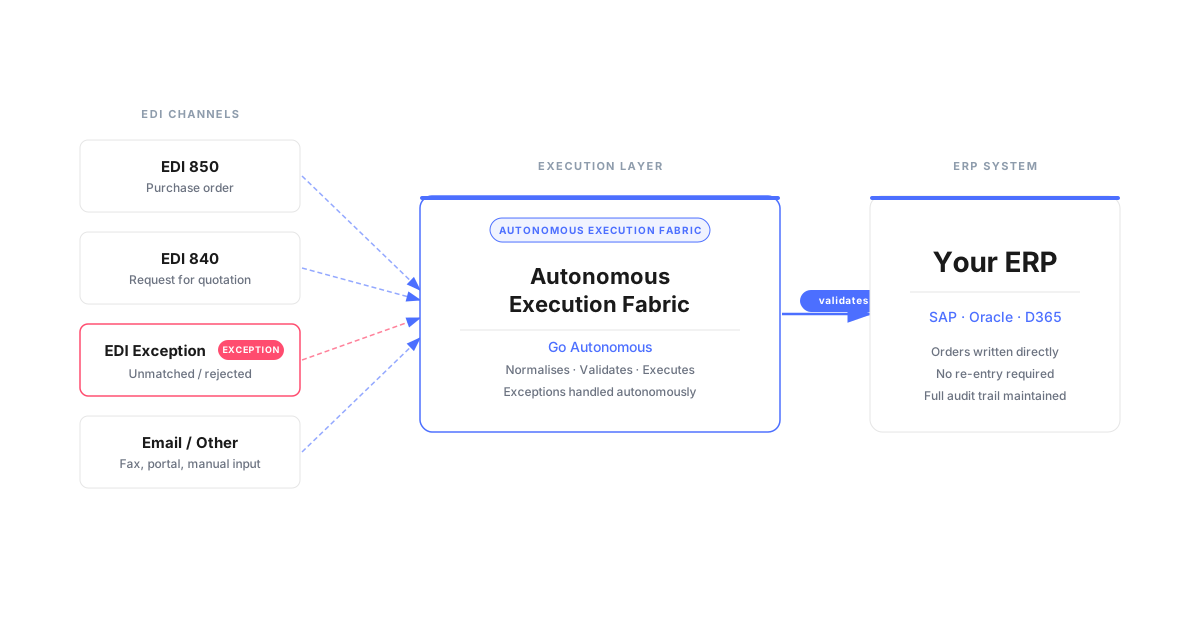
What EDI and Autonomous Execution Cover: The Full 100%
What EDI and Autonomous Execution Cover: The Full 100%
EDI covers your EDI-connected customers. Autonomous execution covers everyone else.
Email orders, portal orders, phone orders, and EDI exceptions all processed in seconds by the Execution Fabric. Every customer gets the same execution speed regardless of the channel they use. See how this connects to SAP.
Non-EDI Customers: Same Execution Speed as Your EDI Partners
Non-EDI Customers: Same Execution Speed as Your EDI Partners
Your biggest customers are on EDI. Your fastest-growing ones may not be.
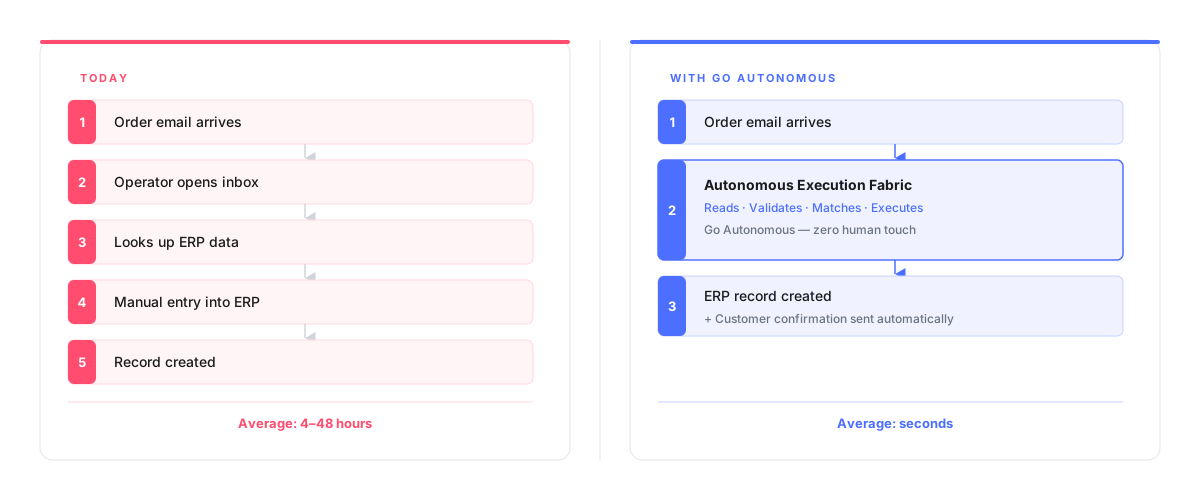
The Execution Fabric processes non-EDI orders in the same seconds it takes to process an EDI 850. No channel receives slower service. No customer is penalized for their ordering method.
Six Ways Autonomous Execution Extends Your EDI Stack
Process every EDI exception automatically: no manual review queue
Every failed EDI transaction is read, corrected, and written to ERP without human intervention.
Extend EDI speed to email, portal, phone, and API order channels
Non-EDI customers get the same seconds-fast processing as your EDI-connected partners.
Handle every RFQ and quote request with the same execution layer as orders
EDI 840 and email RFQs both processed in seconds. Quote responses sent automatically.
Eliminate the operational cost of EDI exception management at scale
No exception queue. No manual review. No delay. EDI exceptions resolved in the same flow.
Scale order volume without adding EDI seats, VAN costs, or headcount
Handle 10x more orders across all channels on the same infrastructure.
Maintain full EDI audit trail while adding new channel coverage
All executions logged in your ERP. EDI compliance unchanged. Coverage extended to 100%.
Want to See What End-to-End Execution Looks Like?
Want to See What End-to-End Execution Looks Like?
Download the white paper on autonomous quote and order execution.
The full playbook for B2B manufacturers and distributors running EDI. Covers standard transactions, exception handling, non-EDI channel coverage, and ERP record creation in one flow.


From EDI Document to ERP Record: End-to-End Execution
From EDI Document to ERP Record: End-to-End Execution
A live walkthrough: EDI 850, EDI exception, and email order processed side by side.
See all three processed by the Execution Fabric in seconds. Each writes a validated record to ERP. The same speed, the same quality, regardless of source format.
No content available.
Autonomous EDI Execution: What Full Coverage Delivers
Autonomous EDI Execution: What Full Coverage Delivers
Fewer order errors (Nilfisk)
Digital revenue in 2 months (IFM)
Orders fully autonomous (Velux)
Countries live in 1 day (Danfoss)
Frequently Asked Questions About EDI Integration
What is autonomous EDI execution and how is it different from standard EDI?
Standard EDI handles structured transactions between trading partners. Autonomous EDI execution extends this: it processes EDI transactions, handles every exception without human review, and covers all non-EDI channels with the same speed. Go Autonomous is not an EDI provider: it is the execution layer that makes your EDI investment cover 100% of your order volume.
Does Go Autonomous replace our existing EDI provider?
No. Go Autonomous connects alongside your existing EDI provider. EDI-connected customers continue through EDI. Non-EDI customers and EDI exceptions are handled by the Execution Fabric with identical speed. Your EDI investment is extended, not replaced.
What happens to EDI exceptions today and how does Go Autonomous handle them?
Today, EDI exceptions are routed to a queue where an operator manually corrects or re-enters the data. The Execution Fabric reads every EDI exception, interprets it, validates against your ERP, and creates a clean record automatically.
Which EDI transaction sets does Go Autonomous support?
Go Autonomous handles all standard ANSI X12 and EDIFACT transaction sets: 850/ORDERS, 840, 855/ORDRSP, 856/DESADV, and 810/INVOIC. Exception types across all sets are handled autonomously.
What happens to orders from customers who do not use EDI?
They get the same execution speed as your EDI customers. Email orders, portal orders, phone orders, and API orders are all processed by the Execution Fabric at the same speed as EDI: in seconds.
How does the Autonomous Execution Fabric connect to our ERP via EDI?
The Execution Fabric sits between your order channels and your ERP. EDI transactions from your EDI provider pass through the Execution Fabric for validation before writing to SAP, Oracle, or Dynamics 365. Non-EDI channels are handled directly.
What is the ROI of autonomous EDI execution versus standard EDI alone?
Standard EDI covers 40-60% of your order volume. Exceptions and non-EDI customers require manual effort. Autonomous execution covers 100% of volume with zero additional headcount. Nilfisk reduced order errors by 43%. IFM grew digital revenue from 22% to 95%+ in two months.
What B2B Leaders Say About Autonomous EDI Execution





See the Autonomous Execution Fabric in Action
Connect every quote and order channel to your ERP. No reconfiguration. Live in days.
See the Autonomous Execution Fabric in Action
Connect every quote and order channel to your ERP. No reconfiguration. Live in days.